Service businesses get paid differently from shops. There is no cart and no product — there is a scope of work, a milestone or a retainer, and an invoice that goes out when the work is approved. The moment of payment is the moment the client says "looks good," and if your invoice cannot be paid right then, that yes cools into a 30-day wait. A checkout on the service invoice — with the rails your clients actually use — is what keeps "approved" and "paid" close together. Here is how to run it with Stripe and Paystack.
Why the checkout matters more for services
A product sale is often paid at the point of purchase. A service is billed after the work, which introduces a gap: you finish, you invoice, and then you wait for the client to act. Every step between "I should pay this" and "done" widens that gap. If the invoice makes them leave the document, open a banking app, and make a transfer, some clients simply defer it. A checkout on the invoice collapses the gap — the client approves and pays in the same breath, from the same screen.
Both rails, because service clients are everywhere
Service businesses are rarely single-market. An agency in Lagos serves brands in London; a consultant in Nairobi advises clients in New York and locally. So the checkout has to carry both worlds, on your own keys:
- Stripe — card payments from clients anywhere in the world.
- PayPal — for international clients who prefer it.
- Paystack — for African clients paying by card, bank transfer, USSD, mobile money, or M-Pesa (in Kenya).
Each client opens the invoice and pays the natural way — a London client by card, a Nairobi client by M-Pesa, an Accra client by mobile money, a New York client by PayPal — each in their own currency, each reconciled to the invoice automatically. It is the Stripe-and-Paystack-on-one-invoice idea, pointed at how service firms bill.
Retainers and milestones, handled
Two service-billing patterns benefit most from an on-invoice checkout:
- Retainers. Set a recurring invoice and the client is billed automatically each cycle, with the checkout on every one — so monthly revenue you have already earned does not wait on you to send a reminder.
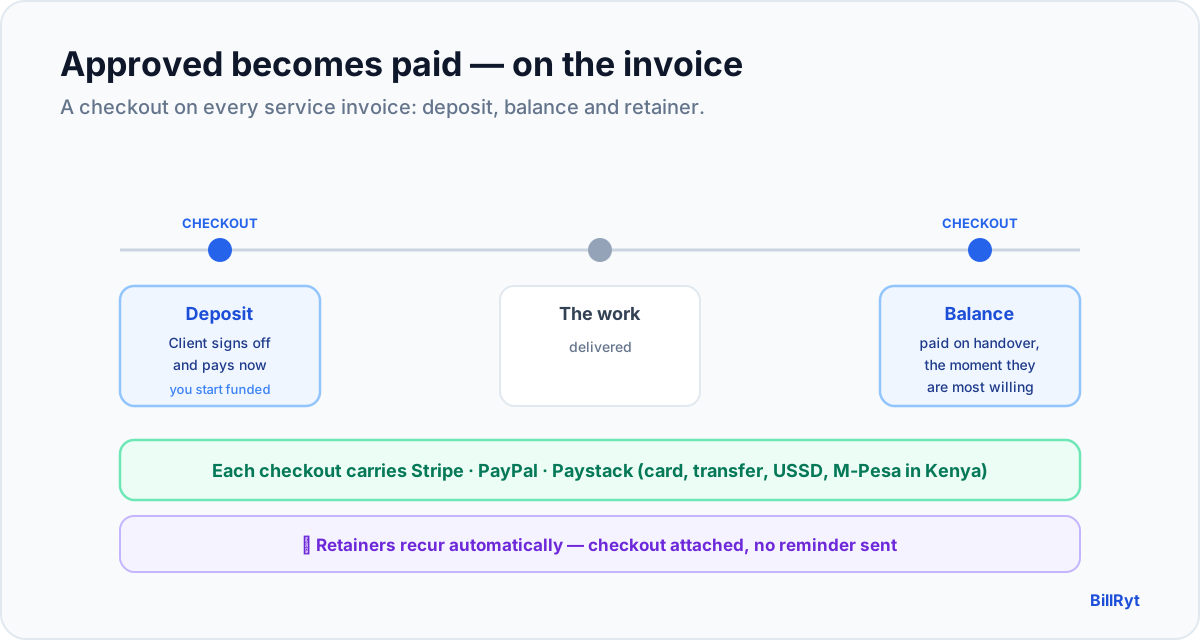
- Milestones. Bill a deposit up front and the balance on delivery; each invoice carries the checkout, so the deposit is paid before you start and the balance the moment you hand over. The client pays at the exact point they are most willing to — approval — instead of a month later.
A worked example
Your agency finishes a project for a UK brand and a separate retainer month for a Nairobi client. You send the UK brand a 3,500 GBP invoice and the Nairobi client their 180,000 KES retainer invoice (set to recur). The UK brand opens theirs, approves the work, and pays by card through your Stripe on the spot. The Nairobi client's recurring invoice goes out on schedule and they pay by M-Pesa through your Paystack. Both flip to Paid automatically, both reconcile to their invoices, and next month the retainer bills itself again. You spent zero time chasing either.
Your own keys, your own margin
Because you connect your own Stripe, PayPal and Paystack accounts, each client pays through the rail that is cheapest and most natural for them, and the money settles directly to you at each gateway's standard rate — BillRyt never takes a slice. For a service business where margin is your time, offering more ways to pay costs you nothing and gets you paid faster.
Where it fits in your plan
Online checkout — connecting Stripe, PayPal and Paystack so clients pay on the invoice — starts on the Professional plan ($19/month), which also includes recurring billing for retainers. This post recommends Agency ($29/month) because service firms with a team usually also want team seats and included accounting (BillRyt Books), so approved-and-paid invoices become real books without a separate tool. On the free plan you can still build and send the invoices and record payments manually.
Deposits protect your cash flow
The milestone pattern is worth dwelling on, because it is where an on-invoice checkout most changes a service firm's cash position. Billing a deposit up front — say 40% on signing, 60% on delivery — only works in practice if the client can pay the deposit immediately; a deposit invoice that requires a bank transfer often stalls, and you end up starting work unpaid. With a checkout on the deposit invoice, the client signs off and pays in the same moment, so you begin funded. The balance invoice then carries its own checkout for the handover. Across a pipeline of projects, that shift — from "invoice and wait" to "approve and pay" at both the deposit and the balance — is the difference between chasing cash and having it. And because retainers recur with the checkout attached, your predictable monthly revenue arrives without a single reminder sent.
What the client experiences
From the client's side there is nothing to learn: they open the invoice on any device, no account, see the amount and a Pay button, choose the rail they already use, and land on a paid invoice. That familiarity is exactly why an on-invoice checkout converts an approval into a payment instead of a follow-up email.
In short
For a service business, the invoice is where "approved" should become "paid" — which only happens if the invoice has a checkout. BillRyt puts Stripe, PayPal and Paystack on every service invoice, so clients anywhere pay the moment they approve, by the rail they already use, in their own currency, with each payment reconciled automatically. Retainers recur with the checkout attached; milestones collect a deposit and a balance at exactly the right moments. Checkout starts on Professional ($19); Agency ($29) adds team seats and included books. Close the gap between the work being approved and the money arriving, and cash flow stops being the hardest part of running a service firm.
You can start free to build service invoices, then connect Stripe and Paystack on a paid plan to add the checkout.