"Lightweight" is one of those words software throws around until it means nothing. For a client billing system it should mean something precise: you can run every ongoing billing relationship you have — retainers, repeat invoices, statements, a way for clients to pay — in a tool you understand on day one, without the drag of an enterprise resource planner built for a factory. BillRyt is that kind of system. Here is what lightweight buys you, and, honestly, where it stops being the right choice.
Heavy systems solve a problem you may not have
Enterprise billing suites and full ERPs exist to model genuinely complex operations: multi-entity consolidation, procurement, manufacturing, deep GL structures. They are heavy because the problems they solve are heavy. The trouble is that a solo consultant or a small agency billing 20 clients a month inherits all that weight to solve a problem that is, at its core, simple: bill the same clients regularly, track who has paid, chase who has not.
A lightweight system throws out the machinery you do not need and keeps the loop you run every day. You are not configuring modules; you are sending invoices and getting paid.
What "lightweight" includes here — the ongoing-client parts
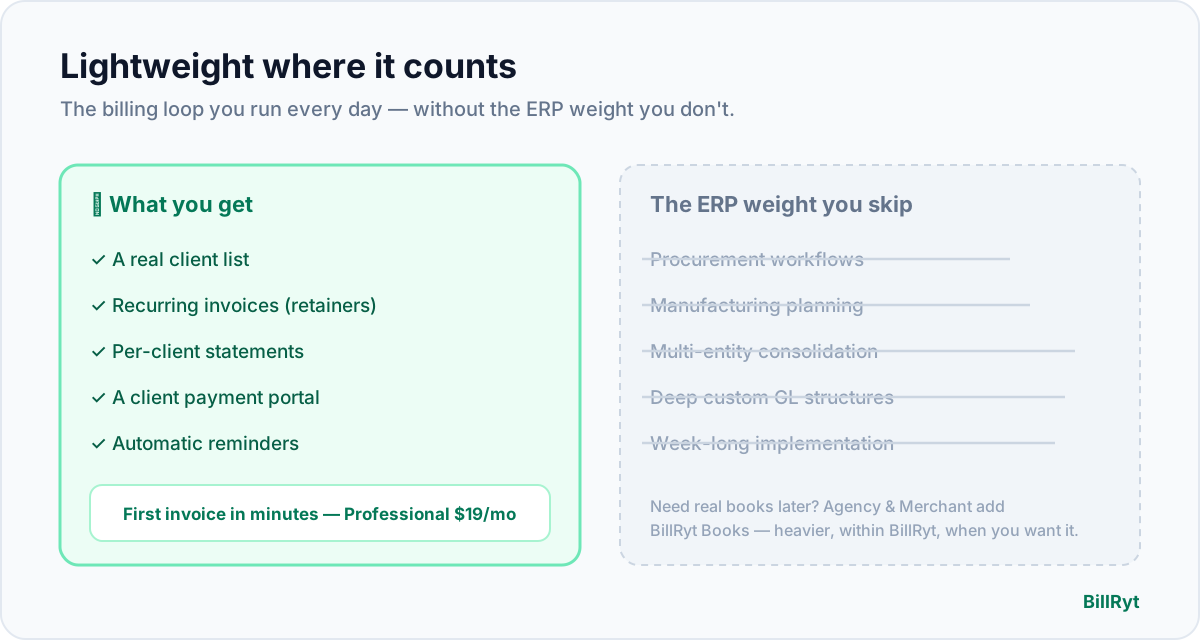
Lightweight does not mean thin. For managing clients over time, BillRyt gives you the pieces that actually recur:
- A real client list. Every client saved once — contact details, tax settings, currency — and reused on every future document. Your roster is the backbone, not an afterthought.
- Recurring invoices. Put retainers and repeat billing on autopilot, so the invoice a client expects every month sends itself instead of waiting on you to remember.
- Per-client statements. Give any client a clean statement of everything billed and paid over a period — the document that answers "what do I owe you overall?" without you assembling it by hand.
- A client payment portal. Clients get a single place to see and pay what they owe, rather than digging through email for the latest invoice.
- Automatic reminders. Overdue invoices chase themselves on a schedule you set, so following up is not a task you have to own.
That is a complete client-billing system — the relationship managed over time — with none of the ERP scaffolding. On the Professional plan ($19/month) it is the full solo toolkit: every document type, recurring billing, the portal and reminders, unlimited documents.
Lightweight where it counts: time-to-value
The truest test of "lightweight" is how fast a new user is productive. With BillRyt you add a client and send a first invoice in minutes — no chart of accounts, no implementation project, no onboarding call required. Compare that to standing up a heavy system, where you can spend a week configuring before you bill a single client. For a small business, that week is the whole point: you want to bill clients, not run software.
A worked example
You are a freelancer with six retainer clients and a few project clients. Each month the six retainers should just bill automatically; the project clients get invoices as work ships. On a heavy system you would model all this through modules and hope the automation holds. On BillRyt you set the six retainers as recurring invoices once — they send themselves every month — and raise project invoices as needed. Clients pay through the portal, reminders handle the stragglers, and if a client asks "what have I paid you this quarter?" you send a statement in two clicks. The system is doing the repetitive work; you are doing the client work.
Being honest about where lightweight stops
A good lightweight tool tells you its edges. BillRyt is a billing and accounts-receivable system, plus optional accounting on the higher plans — it is not an ERP. If your business genuinely needs procurement workflows, manufacturing resource planning, multi-entity consolidation or deep custom GL structures, you need a heavier system, and you should choose one. Lightweight is the right call when your billing is "recurring and project invoices to a book of clients, get paid, keep clean records" — which is most small and mid-sized service businesses. When you outgrow even that on the record-keeping side, BillRyt's own Agency ($29) and Merchant ($39) plans add full accounting (BillRyt Books) and team seats, so you can get heavier within BillRyt before you ever need an ERP.
A quick test for "lightweight enough"
If you are weighing tools, here is a fast way to tell whether one is lightweight in the way that helps you. Time three things on a trial: how long to add your first client, how long to send your first invoice, and how long to set up a recurring bill. In a genuinely lightweight system all three are minutes and none needs a manual, a setup call, or a concept you have to learn first. If any of them requires configuring accounts, mapping ledgers, or booking an onboarding session before you can bill, the tool is heavier than your job — and that weight does not go away; it shows up every time you onboard a teammate or a new client. BillRyt is built to pass that test: add a client, send an invoice, set a retainer to recur, all inside your first session. The point of lightweight is not fewer features — it is that the features you need are reachable without a project to unlock them.
In short
A lightweight client billing system should let you run every ongoing billing relationship — retainers, recurring invoices, per-client statements, a payment portal, automatic chasing — in a tool you grasp on day one, without ERP weight you will never use. BillRyt does that on the Professional plan for $19/month, and grows with you through Agency and Merchant when you want books and a team. It is honest about its edge, too: if you need manufacturing or multi-entity ERP machinery, this is not that. But if what you actually do is bill a book of clients and get paid, lightweight is not a compromise — it is the correct amount of tool.
You can start free and have your first client billed in minutes, then move to Professional for recurring billing and the portal.