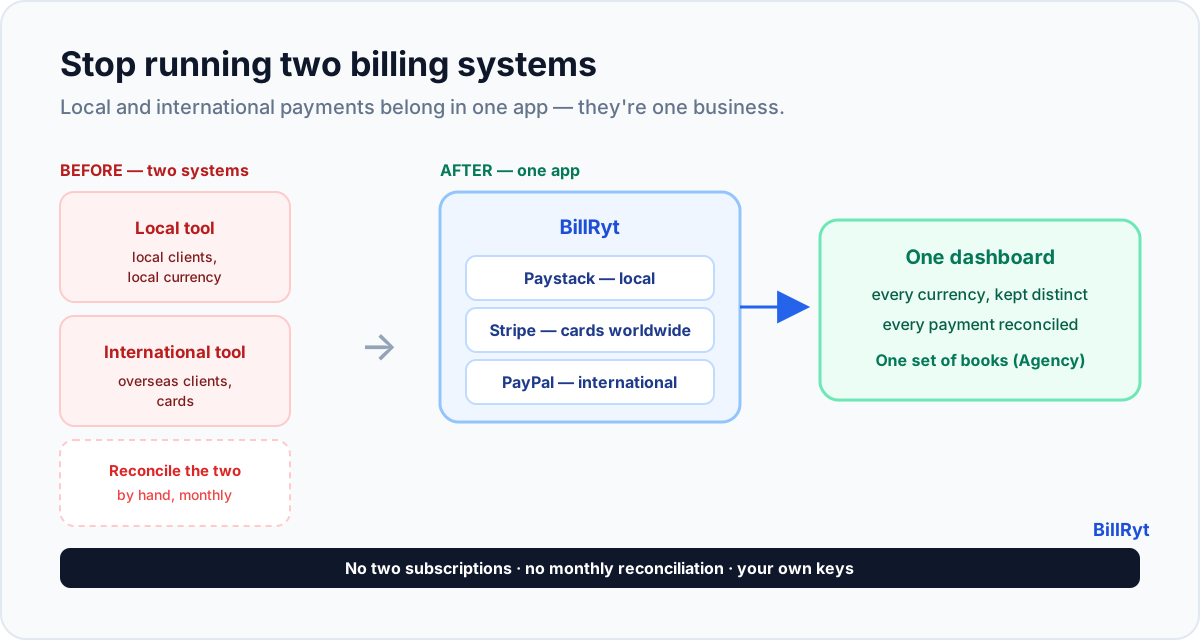
Most businesses that sell beyond their own doorstep end up with a split: one tool or method for local clients, another for international ones. It feels unavoidable — local clients pay one way, overseas clients pay another — but the split quietly costs you money and hours. Two payment setups to maintain, two views of who owes you, and a monthly reconciliation to make them agree. A single invoicing app that collects both local and international payments removes all of that. Here is how it works.
The hidden cost of two systems
When your local revenue lives in one place and your international revenue in another, three costs follow. First, money: two subscriptions or setups, each with its own fees. Second, time: every month you stitch two separate pictures of receivables into one by hand, and your books never quite agree until you do. Third, errors: a payment recorded in one system and not the other, a client chased from the wrong place, a currency total added up incorrectly across the two. None of that work earns you a cent — it is pure overhead created by the split.
One app removes all three at once.
Every rail on the same invoices
BillRyt carries local and international payment methods on the same invoices, using your own keys for each:
- Stripe — card payments from clients anywhere in the world.
- PayPal — for international clients who prefer it.
- Paystack — for local African payments: card, bank transfer, USSD, mobile money, and M-Pesa (in Kenya).
Whatever "local" means for you and wherever "international" reaches, each client opens the invoice and pays the natural way — a nearby client by their local rail, an overseas client by card or PayPal — each in their own currency. Every payment, from any rail, reconciles to its invoice automatically and lands in the same dashboard.
Multi-currency, kept honest
Local and international by definition means more than one currency. BillRyt denominates each invoice in the client's own currency — totalled and taxed correctly — and keeps your reporting honest by never blending currencies into a single meaningless figure. Your local-currency income and your USD, GBP or EUR income show distinctly, so the numbers you make decisions on are trustworthy. Multi-currency invoicing is on every plan, including free; only online collection and higher volume are paid.
A worked example
In one month you invoice a local client 300,000 in your home currency, a UK client 2,200 GBP, and a US client 3,000 USD. On a split setup, the local client pays through your local method and the two overseas clients through a separate international one — and at month-end you reconcile two systems and hope they agree. On BillRyt, all three are ordinary invoices: the local client pays their local way through Paystack, the UK and US clients pay by card or PayPal through Stripe/PayPal, and every payment reconciles to its invoice in the same dashboard. One view of receivables, one set of books, no stitching.
One ledger, one set of books
The real payoff is downstream. Because every payment — local and international — lands in one place, you get a single, current answer to "what are we owed?" and, on the Agency plan ($29/month), one set of books that includes all of it. BillRyt Books turns your local and foreign-currency income into proper double-entry accounts automatically, and up to 15 team seats let your people work in one workspace. No exporting between tools, no reconciling two systems into a spreadsheet.
Start free, switch on collection when ready
You do not have to commit up front. Start on the free plan to build and send multi-currency invoices and record payments manually. When you want clients to pay online — local and international — Professional ($19/month) switches on Stripe, PayPal and Paystack and removes the free document limit; Agency ($29) adds the books and team a growing business wants. You use your own gateway keys throughout, so each payment settles directly to you with no BillRyt surcharge.
One question to test any "does both" claim
Plenty of tools claim to handle local and international payments. One question sorts the real ones from the rest: does every client, wherever they are, pay on the same invoice and reconcile into the same ledger — or does "international" mean a bolt-on that lands somewhere else? A genuine both-worlds app puts the local rail and the international rail on one document, records each payment against the invoice it came from, and shows you a single view of receivables across every currency. A pretender routes overseas payments through a separate flow you then reconcile by hand — which is the two-system problem wearing one login. Ask where the money lands and how it gets attached to the invoice; if the answer is "the same place, automatically," you have found the app that actually collapses the split. BillRyt is built so both rails resolve to one invoice, one dashboard and, on Agency, one set of books.
In short
Running one system for local clients and another for international ones is a tax you do not have to pay — in money, time and errors. BillRyt is a single invoicing app that collects both: Stripe and PayPal for clients worldwide, Paystack for local African payments including M-Pesa in Kenya, every invoice in the client's own currency, every payment reconciled into one dashboard and one set of books. Start free, switch on online collection on Professional, and add books and a team on Agency. Your local and international revenue belong in one place — because they are one business.
You can start free to build invoices in any currency, then connect the rails to collect from every client in one app. The moment your local payments and your international payments share one dashboard and one set of books, the monthly reconciliation that used to eat an afternoon simply stops existing — and the time goes back into the business rather than into making two systems agree.