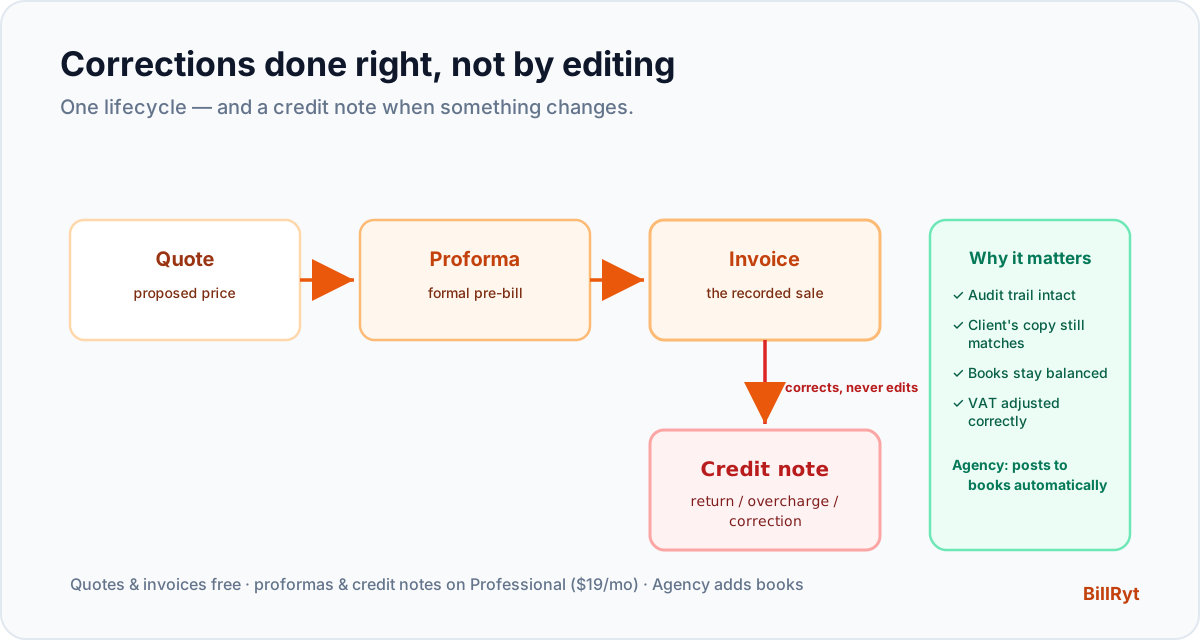
Most billing tools handle the happy path — send a quote, turn it into an invoice, get paid. The real world is messier: a client returns something, an invoice had an error, a project scope shrank after billing. How a tool handles those corrections is what separates tidy books from a mess. The answer is a complete document lifecycle — quote → proforma → invoice → credit note — where every stage is a proper document, not an edit to a sent one. Here is that workflow and why the credit-note end of it matters so much.
The four documents, one lifecycle
- Quote / estimate — your proposed price, to win the work.
- Proforma invoice — a formal pre-bill to request a deposit, clear customs, or get approval.
- Invoice (tax invoice) — the definitive bill that records the sale.
- Credit note — the correct way to reduce or reverse an invoice after it has been issued: a return, an overcharge, a cancelled item, a goodwill discount.
In BillRyt these are stages of one flow. A quote converts to a proforma or straight to an invoice; an invoice, when something changes, is corrected with a credit note. Nothing is retyped between stages, and nothing that has been sent is quietly edited.
Why you never fix a sent invoice by editing it
Here is the discipline that keeps your records defensible: once an invoice is issued, you do not change its numbers. If a client returns an item or you overcharged, you issue a credit note against that invoice for the difference. The original invoice stands as the record of what was billed; the credit note stands as the record of the correction. Editing or deleting the sent invoice instead breaks the audit trail, confuses the client (who has the original), and — if you keep books — throws your accounting out of balance. A proper credit-note workflow is not bureaucracy; it is what lets you correct a mistake without creating a bigger one.
A worked example
You invoice a client 500,000 for ten units. They return two. Instead of editing the paid invoice, you raise a credit note for the two returned units against that invoice. The client now holds the original invoice and a credit note that clearly reduces the balance; your records show both the original sale and the correction; and if the client had already paid in full, the credit note documents what you owe back or can apply to their next invoice. Everyone can see exactly what happened, because each step is its own document with its own reference.
Consistency across the whole flow
Because the documents flow from one another, the numbers stay consistent end to end: the quote's line items become the invoice's, and the credit note references the invoice it corrects. You are never reconciling a quote in one place, an invoice in another, and a refund noted in an email. One client, one thread of documents, from proposal to correction — which is exactly what an auditor, an accountant, or a client's finance team wants to see.
Where it fits in your plan
Quotes and invoices are on every plan, including free. Proformas and credit notes are Professional-plan features ($19/month) — Professional is BillRyt's full solo document toolkit, so the complete quote → proforma → invoice → credit note lifecycle runs from Professional up. Agency ($29/month) adds team seats and full accounting (BillRyt Books) on top, so every document in the flow — including credit notes — posts to real double-entry books automatically. If you keep books, that is where the credit-note discipline pays off most: corrections are reflected in your accounts without a manual journal.
It works across currencies and clients
The lifecycle is currency-aware: a quote in EUR becomes an invoice in EUR and, if needed, a credit note in EUR, each denominated correctly. And every document is shareable as a clean PDF or a public link the client opens without an account. So whether you are billing locally or across borders, the same tidy flow applies.
Credit notes and your tax records
There is a tax reason the credit-note discipline matters, not just a tidiness one. Once you have issued a tax invoice — and especially if VAT or another sales tax was on it — that invoice has usually already been recorded for tax purposes. If you later just edit or delete it, your tax records and the client's no longer agree, which is exactly the kind of discrepancy that causes problems in a review. A credit note is the recognised instrument for this: it reverses part or all of an invoice with its own dated, numbered document, so both the original charge and the reversal (including any tax adjustment) are on the record. When a return or overcharge involves VAT, the credit note adjusts the tax correctly rather than leaving your filed figures overstated. On the Agency plan, where BillRyt Books is included, that adjustment flows into your accounts automatically — the credit note is not just a nicer client experience, it keeps your books and your tax position correct without a manual journal entry.
In short
A billing tool should handle corrections as gracefully as sales. BillRyt runs the whole lifecycle — quote → proforma → invoice → credit note — as one connected flow, so you never fix a sent invoice by editing it: you issue a credit note, and both the original and the correction stand as clean, referenced documents. Quotes and invoices are free; proformas and credit notes are a Professional feature at $19/month, and Agency adds books so corrections post to your accounts automatically. Tidy books are not about never making a mistake — they are about correcting one properly, and that is what this workflow is for.
You can start free to build quotes and invoices, then move to Professional for proformas and credit notes — the full document flow. The first time a client returns something or an invoice needs correcting, you will be glad the fix is a clean credit note against the original rather than a quietly edited invoice that no longer matches what the client holds or what your books say.