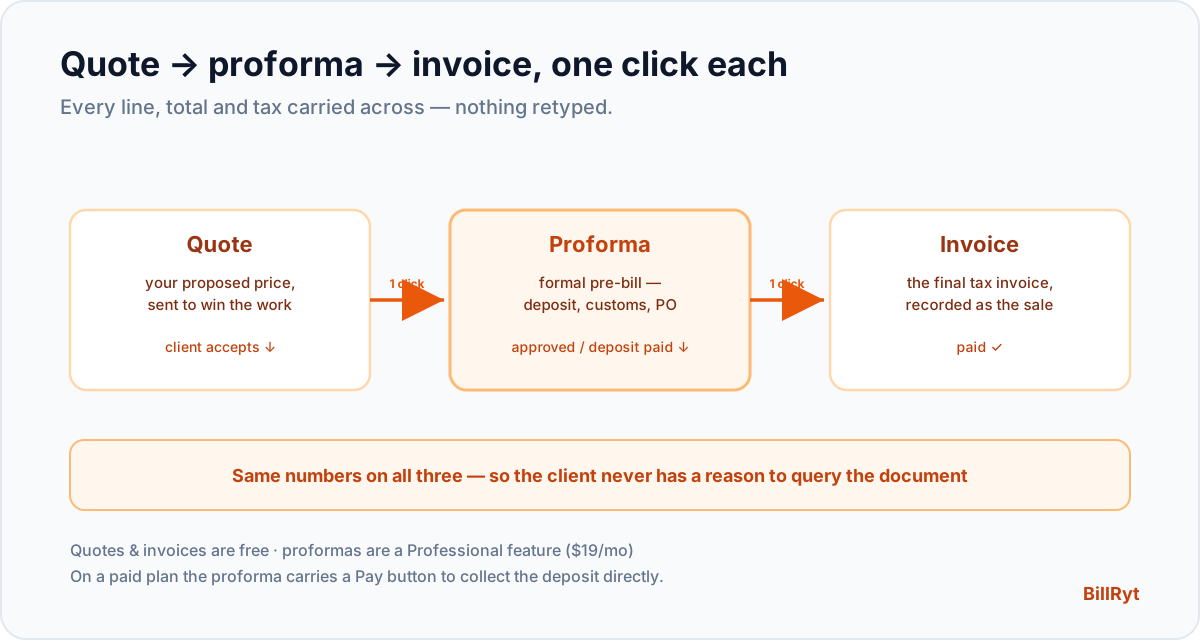
The path from "here's my price" to "here's what to pay" has a step many businesses handle badly: the proforma invoice. A quote wins the work; a proforma turns that agreement into a formal request the client can act on — pay a deposit, clear customs, get an approval through their finance team — before you issue the final tax invoice. Done by hand, it means retyping the quote into a new document and hoping the numbers match. Done properly, it is one click. Here is the clean quote-to-proforma workflow.
Quote, proforma, invoice — what each one is for
These three documents look similar and do different jobs:
- Quote (or estimate): your proposed price, sent to win the work. Not a demand for payment.
- Proforma invoice: a formal "this is what you will be billed" issued once the quote is accepted — used to request a deposit, support an import/customs process, or get purchase approval. It looks like an invoice but is not yet a tax invoice or a record of a sale.
- Invoice (tax invoice): the final, definitive bill and the document that records the sale for your books.
Moving cleanly between them — without retyping — is the workflow that keeps your numbers consistent and your client moving toward payment.
The one-click conversion
In BillRyt you build a quote once, with your line items, quantities, prices, tax and currency. When the client accepts, you convert that quote into a proforma invoice in a click — every line, total and tax carried across exactly, nothing retyped, nothing to mistype. When the proforma is approved or the deposit is paid, you convert it again into the final invoice. The document flows forward through its lifecycle instead of being rebuilt at each stage, so the amount on the quote, the proforma and the invoice can never silently drift apart.
Why this matters beyond convenience
Retyping is not just slow; it is where errors and disputes are born. A transposed figure between the quote and the proforma, a line dropped, a tax rate not carried over — each is a reason a client queries the document and payment stalls. A single source that flows quote → proforma → invoice removes that class of error entirely. It also gives you and the client a clear, consistent paper trail: the same numbers, the same reference, from proposal to payment.
A worked example
You quote a client 850,000 for a project, in their currency, with two line items and VAT. They accept. You convert the quote to a proforma invoice in one click and send it so their finance team can raise a purchase order and pay a 40% deposit. Once the deposit lands, you convert the proforma to a final tax invoice for the full amount, which posts to your records. At no point did you retype a figure, and the client saw the same numbers on all three documents — so nothing was queried and nothing stalled.
Where it fits in your plan
Quotes and final invoices are available on every plan, including free. Proforma invoices are a Professional-plan feature ($19/month) — Professional is BillRyt's full solo document toolkit, adding proformas, credit notes, statements and recurring billing on top of the free quote-and-invoice basics. So the full quote → proforma → invoice conversion runs from Professional up. If you also want a team and accounting on top, Agency ($29) adds those, but the document workflow itself is Professional.
Add a payment step to the proforma
Because a proforma often exists to collect a deposit, it helps to let the client pay it directly. On a paid plan you can connect your own Stripe, PayPal and Paystack keys, so the proforma carries a Pay button — the client settles the deposit by card, PayPal, or a local rail (bank transfer, USSD, or M-Pesa in Kenya) and it reconciles to the document automatically. The deposit is collected the moment the client is ready, not a week later after a manual transfer.
When you actually need a proforma
Not every sale needs a proforma, so it helps to know the moments that do. The common ones: collecting a deposit before you start work or ship goods (the proforma is the formal request the client's finance team can pay against); customs and import/export, where a proforma invoice is often required to declare goods and their value before a commercial invoice exists; purchase-order approval, where a client's procurement process needs a formal pre-bill to raise a PO against; and letters of credit or advance-payment terms, where the buyer's bank needs the document up front. In each case the proforma is not the final tax invoice — it is the bridge between "we agreed a price" and "you have been billed." Recognising these moments means you send a proforma when it genuinely unblocks the client, rather than defaulting to a plain invoice and then scrambling when their finance team asks for something they can process. BillRyt makes producing that document a one-click step off the quote, so the bridge is never the bottleneck.
In short
Converting a quote to a proforma invoice should be one click that carries every line, total and tax across untouched — and then another click from proforma to final invoice when it is paid. BillRyt runs that quote → proforma → invoice flow as a single document moving through its lifecycle, so your numbers never drift and your client never has a reason to query them. Quotes and invoices are free; proformas are a Professional feature at $19/month, and you can let the client pay a deposit on the proforma directly. It is the difference between a billing process that flows and one you rebuild by hand at every stage.
You can start free to build quotes and invoices, then move to Professional for proformas and the full conversion workflow. The next time a client's finance team asks for a proforma before they can pay you, it will be a single click off the quote you already sent — not a document you rebuild from scratch under time pressure.