Plenty of businesses do not fit neatly into "local" or "international." A Lagos agency bills brands in London and shops in Lagos. A Nairobi studio serves US startups and Kenyan SMEs. A diaspora founder invoices clients back home and clients in their new city. For these businesses, most tools force a bad choice: pick a platform built for card-paying Western clients that ignores African rails, or a local tool that cannot smoothly take an overseas card. BillRyt is built to refuse that choice — one billing platform that serves international and African clients equally well, each paying their own way.
The false either/or
The reason this is hard is that the payment worlds evolved separately. International clients pay by card or PayPal and think in USD, GBP or EUR. African clients pay by bank transfer, USSD or mobile money — M-Pesa in Kenya, for instance — and think in KES, NGN or GHS. A tool optimised for one world tends to treat the other as an afterthought: the "global" invoicing app has no clean way to take a Lagos bank transfer, and the local app makes an overseas client jump through hoops to pay a simple card.
You should not have to run two billing systems to serve two kinds of clients. That is the whole premise of BillRyt.
One platform, three rails, every currency
BillRyt puts all the rails on the same invoices, using your own keys for each:
- Stripe — card payments from clients anywhere in the world.
- PayPal — for international clients who prefer it.
- Paystack — for African clients paying by card, bank transfer, USSD, or M-Pesa (in Kenya).
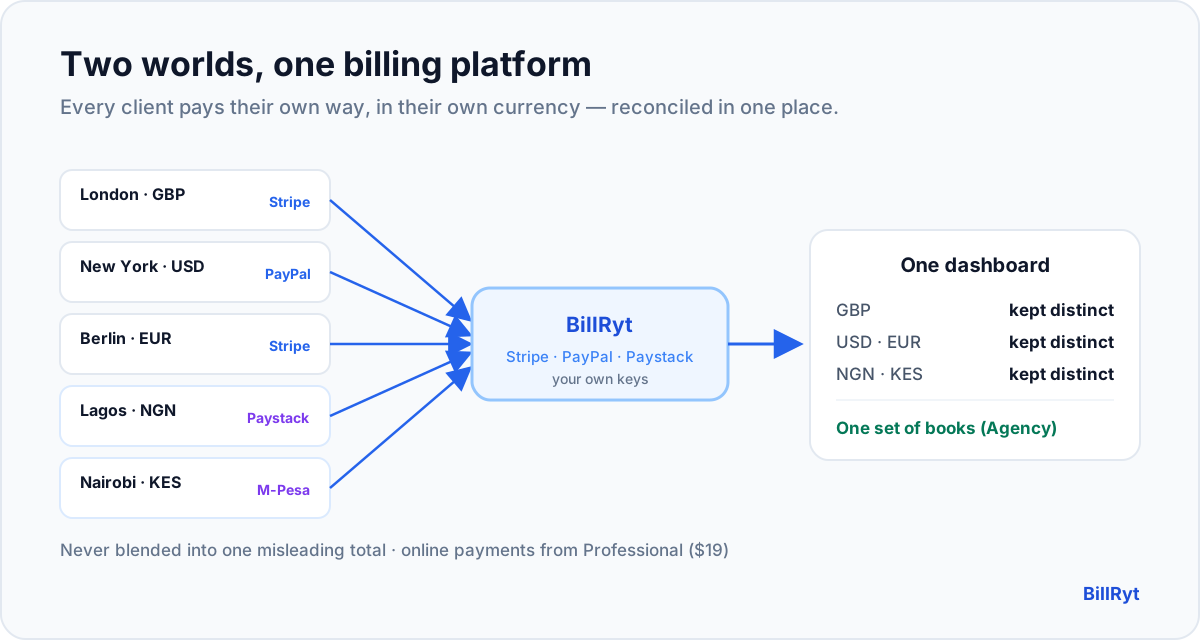
And every invoice can be denominated in the client's own currency — USD, GBP, EUR, NGN, KES, GHS and more — totalled and taxed correctly, so nobody has to convert anything. A client in Manchester sees a clean GBP invoice and pays by card; a client in Accra sees a GHS invoice and pays by mobile money; a client in Lagos pays a NGN invoice by bank transfer. Same platform, same dashboard, same set of books.
A worked example
Your agency closes five invoices this month:
| Client | Currency | Pays via |
|---|---|---|
| London brand | GBP | Stripe (card) |
| New York startup | USD | PayPal |
| Lagos retailer | NGN | Paystack (bank transfer) |
| Nairobi SME | KES | Paystack (M-Pesa) |
| Berlin company | EUR | Stripe (card) |
On a single-world tool, two or three of those would be a manual mess — an overseas card the local tool cannot take, or an African transfer the global tool ignores. On BillRyt, all five are ordinary invoices. Each client pays the native way, every payment reconciles to its invoice automatically, and your dashboard shows five currencies kept distinct rather than blended into one misleading total. You served two continents from one screen.
Why "your own keys" matters across borders
Because you connect your own Stripe, PayPal and Paystack accounts, each client pays through the rail that is cheapest and most natural for them, and the money settles directly to you. An overseas card runs through your Stripe; a Lagos transfer runs through your Paystack; BillRyt never sits in the middle taking a cut. Letting each client pay their own way is not just convenience — it protects your margin on every invoice, in every currency.
Books that span both worlds
For a business straddling markets, the accounting can be the messy part — foreign-currency income here, local income there. The Agency plan ($29/month) includes full accounting (BillRyt Books) and up to 15 team seats, so income from every rail and currency feeds one set of books, and your team works in one workspace. You get a Stripe-and-Paystack workflow on one invoice and the books to match, without exporting between tools.
The real cost of running two billing systems
Businesses that serve both worlds often end up with two tools — a "global" invoicing app for the overseas clients and a local tool for the African ones — and quietly pay for it three times over. First in money: two subscriptions, two payment setups, two things to maintain. Second in time: every month you reconcile two separate views of who owes you and stitch them into one picture by hand, and your books never quite agree until you do. Third in errors: a payment recorded in one system and not the other, a client chased from the wrong tool, a currency total added up incorrectly across the two. None of that work makes you a cent — it is pure overhead created by the split.
One platform removes all three costs at once. With BillRyt, the London card payment and the Lagos bank transfer land in the same dashboard, reconcile against the same kind of invoice, and feed the same set of books. There is one view of receivables, one place to chase from, and one currency-aware report — so the time you used to spend making two systems agree goes back into the business. Serving two markets is an advantage; paying twice to bill them is not, and you do not have to.
In short
A business that serves both international and African clients should not need two billing systems. BillRyt is one platform with three rails — Stripe and PayPal for clients worldwide, Paystack for African clients including M-Pesa in Kenya — and full multi-currency invoicing, so every client pays their own way in their own currency and every payment lands in one dashboard and one set of books. On the Agency plan you get team seats and included accounting on top. Whether your next invoice goes to London or Lagos, New York or Nairobi, it is just an invoice — and it gets paid, in the currency the client thinks in, through the rail they already trust.
You can start free to build multi-currency invoices, then connect Stripe, PayPal and Paystack to serve every client on one platform. One account, every currency, every rail — so the question stops being which system can take this client's money and becomes simply when the invoice goes out.