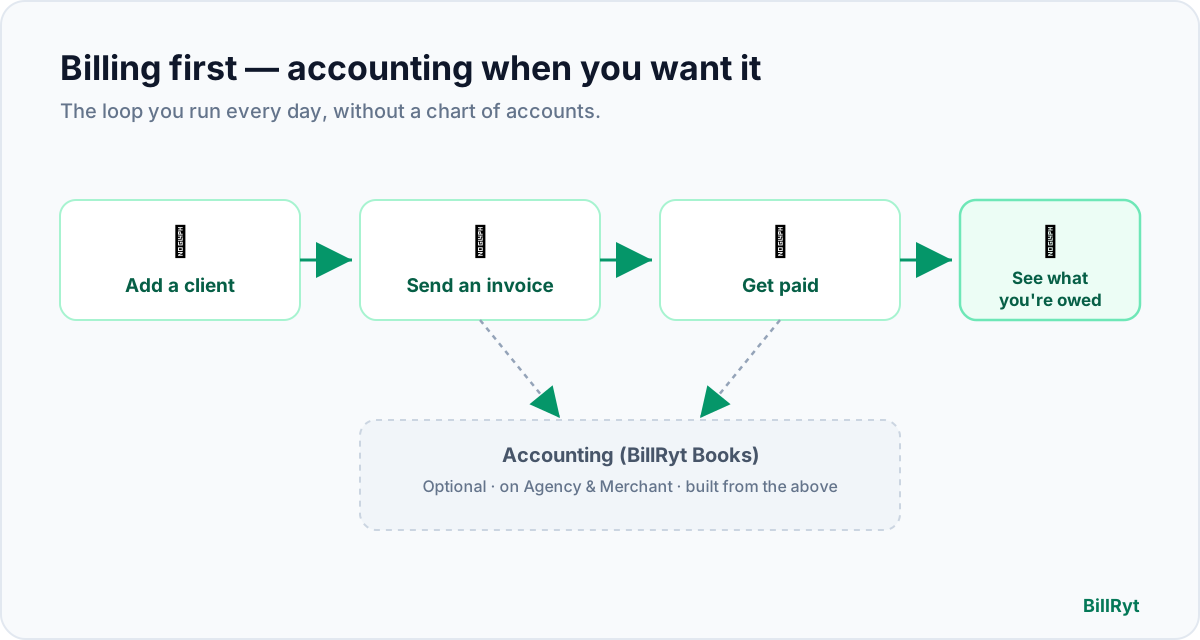
Somewhere along the way, "send my clients an invoice and get paid" turned into "set up a chart of accounts." You went looking for a way to bill people and ended up staring at journal entries, opening balances and a bank-reconciliation screen you never asked for. If that is you, you do not need accounting software. You need a billing platform — and there is a difference.
Billing software vs accounting software
They sound similar and they are not the same job:
- Billing software exists to get money in. Create a quote, turn it into an invoice, send it, collect the payment, chase the late ones, and see who owes you what. That is the whole loop.
- Accounting software exists to keep the books. Double-entry ledgers, a chart of accounts, journals, trial balances, and financial statements for your accountant and the tax authority.
Every business eventually touches both. But most small businesses need the billing loop every single day and the accounting layer occasionally — usually at month-end or tax time. When a tool forces the accounting model on you before you have sent your first invoice, it has the priorities backwards.
What "billing-first" feels like
BillRyt is built the other way round. Day one, you do the thing that pays you:
- Add a client — name, email, currency. That is it.
- Send an invoice (or a quote first, then convert it in one click).
- Get paid — the client taps a payment link; you connect Stripe and Paystack so they pay by card, bank transfer, USSD or M-Pesa depending on where they are.
- See what you're owed — one screen shows outstanding, overdue and paid, and automatic reminders chase the stragglers for you.
No chart of accounts. No opening balances. No "which account does this post to?" You are billing in minutes, not configuring a ledger for an afternoon.
Accounting is there when you want it — not before
Here is the part that matters: choosing a simple billing platform does not mean you are stuck without books forever. BillRyt keeps accounting optional and downstream. When your business grows into needing proper double-entry books — a profit and loss, a balance sheet, ledgers for your accountant — BillRyt Books is included on the Agency and Merchant plans and builds itself from the invoices and payments you already recorded. You are never forced into it, and you never have to migrate to a second tool to get it.
So the honest positioning is: start with billing, add accounting if and when you need it. Not the reverse.
Who this is for
- Freelancers and consultants who bill a handful of clients and just want to get paid on time.
- Agencies and studios who live in quotes and invoices, not journals.
- Any owner who was told to "use accounting software" and found themselves 90% in features they will never touch.
The Professional plan ($19/month) is the sweet spot here: every document type, all the reports, recurring billing, the client portal and online payments — and no accounting layer to wade through. If you later want the books, Agency ($29) adds them without a migration.
Signs you need billing, not accounting (yet)
A quick gut check. You probably need a billing platform — not accounting software — if most of these are true:
- Your day is "send invoices, chase the late ones," not "categorise transactions."
- You do not have (or want) a bookkeeper logging in daily.
- You have closed an accounting app because it asked you to set something up before you could invoice.
- Your questions are "who owes me and how do I get them to pay," not "what is my trial balance."
- You want your accountant to sort the formal books at year-end, not to live in your invoicing tool.
If that is you, forcing a general-ledger tool into the role is friction with no payoff. A billing platform meets you where the work actually is.
A worked example
You quote a client 1,200 for a project. They accept, so you convert the quote to an invoice in one click — same line items, same amounts. You send it; the client opens a link and pays by card or bank transfer; BillRyt marks it paid and drops it out of your "overdue" list. At no point did you choose an account to post to, record a debit and a credit, or reconcile anything. That is the entire loop, and it is the loop you repeat every week. The accounting — if and when you want it — is generated from these same actions later, not demanded up front.
The upgrade path is there, quietly
Because BillRyt keeps the two jobs in one product, growing into books is not a project. Turn on Agency and your existing invoices and payments become a profit and loss and a balance sheet — the formal view your accountant asks for — without you re-entering anything. You get the reassurance that "real books" are one step away, while your day-to-day stays as simple as sending an invoice.
The one-question test
If you are unsure whether a tool is billing-first or accounting-first, ask it one question: how many steps until I can send my first real invoice? A billing-first platform gets you there in a couple of minutes — add a client, add line items, send. An accounting-first tool makes you pass through setup first: pick or import a chart of accounts, set opening balances, connect a bank feed, confirm tax mappings. Neither is wrong in the abstract, but they are optimised for different people. If your job is to get money in the door, you want the tool that lets you do that immediately and treats the formal books as something it can generate for you afterwards. That is the test, and it is the line BillRyt is built on.
You should be able to send an invoice today and think about ledgers later. That is what a billing-first platform is for.