Sooner or later a client asks the question a single invoice cannot answer: "What is my overall position with you?" They want one document showing everything billed, everything paid, and what is still outstanding over a period — a statement of account. Assembled by hand from your records it is a tedious, error-prone job. Generated properly it is one click per client. Here is how a statement-of-account generator works and why it quietly gets you paid faster.
What a statement of account is (and is not)
A statement of account is not another invoice. It is a summary of a client's whole relationship with you over a chosen period: each invoice issued, each payment received, and the running balance that results. Where an invoice says "pay this for this job," a statement says "here is everything between us, and here is the total you still owe." Clients — especially their finance teams — use it to reconcile their own records, approve a batch payment, or simply understand what they owe before month-end.
Generated in a click, not assembled by hand
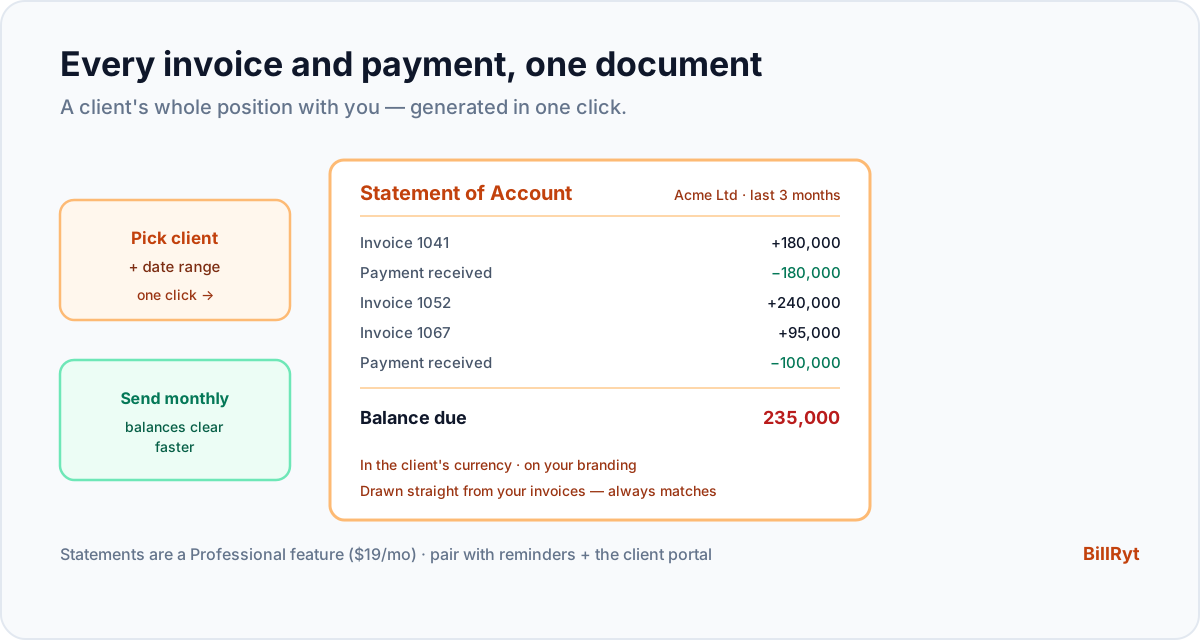
In BillRyt you do not build a statement; you generate it. Pick a client and a date range, and the tool pulls every invoice and payment for that client and produces a clean, branded statement — each line dated, the payments applied, and the closing balance calculated for you. It is denominated in the client's currency, shareable as a PDF or a public link, and correct by construction because it is drawn from the same records that hold the invoices and payments. There is no spreadsheet to maintain and no risk of a figure that disagrees with the underlying invoices.
Why statements get you paid faster
A statement is a gentle, professional nudge that works differently from an invoice. A client may let a single invoice sit, but a statement showing three unpaid invoices and a clear total is harder to ignore — it reframes "a bill" as "an outstanding relationship." Sending statements on a regular cadence (say, month-end) surfaces everything outstanding at once, prompts finance teams to clear balances in a batch, and catches the invoice a client genuinely forgot. It is one of the highest-leverage accounts-receivable habits a small business can adopt, and a generator makes it a two-minute routine instead of an afternoon.
A worked example
At month-end a client asks for a statement before they run their payment batch. In BillRyt you select the client, set the range to the last three months, and generate. The statement lists their five invoices, the two payments they have made, and the closing balance of what remains — in their currency, on your branding — as a PDF and a link. You send it; their finance team reconciles it against their own records in minutes and pays the outstanding balance. You assembled nothing by hand, and the numbers match your invoices exactly because they came from them.
Statements plus reminders plus a portal
A statement is even stronger alongside the rest of BillRyt's accounts-receivable tooling. Automatic reminders chase individual overdue invoices on a schedule; the client portal gives a client a live place to see and pay what they owe; and statements give the periodic, whole-relationship summary. Together they mean chasing payment is mostly automatic — the statement is the monthly summary, the reminders are the nudges, and the portal is where the client acts. That is the difference between accounts receivable as a chore and as a system.
Where it fits in your plan
Statements of account are a Professional-plan feature ($19/month) — Professional is BillRyt's full solo toolkit, adding statements, proformas, credit notes, aging reports, recurring billing and the client portal on top of the free quote-and-invoice basics. Agency ($29/month) adds team seats and full accounting (BillRyt Books) if you want the whole picture in double-entry books, but generating client statements is Professional.
When to send statements
A statement is most powerful on a rhythm rather than only on request. Three moments are worth building in. Month-end, to every client with an open balance — this surfaces everything outstanding at once and lines up with when finance teams run payments. When a balance ages — a client who has drifted into 60-plus days overdue gets a statement showing the full picture, which lands harder than another copy of one invoice. On request — when a client's finance team asks before a payment run, you generate it in seconds instead of assembling it while they wait. You do not need to send every client a statement every month; send them where a balance is open or slipping. Done this way, statements become the periodic, whole-relationship layer of your accounts receivable — the monthly summary that sits above the individual invoices and their reminders — and clients come to expect and act on them, which is exactly the habit that shortens how long your money sits unpaid.
In short
A client statement-of-account generator answers the question no single invoice can: what is this client's overall position with me? BillRyt generates it in a click — every invoice, every payment, and the closing balance for a chosen period, in the client's currency, on your branding, drawn straight from your records so it can never disagree with them. Sent on a regular cadence alongside reminders and the client portal, statements are one of the simplest ways to get paid faster. Statements are a Professional feature at $19/month; Agency adds team seats and books. Stop assembling them by hand and make the monthly statement a two-minute routine.
You can start free to send invoices, then move to Professional to generate client statements of account. Make the month-end statement a two-minute routine per client, and you will find balances clearing faster simply because clients can finally see their whole position with you in one clear document instead of a scatter of separate invoices. Paired with automatic reminders and a client portal to pay through, the statement turns accounts receivable from a monthly worry into a system that mostly runs itself.