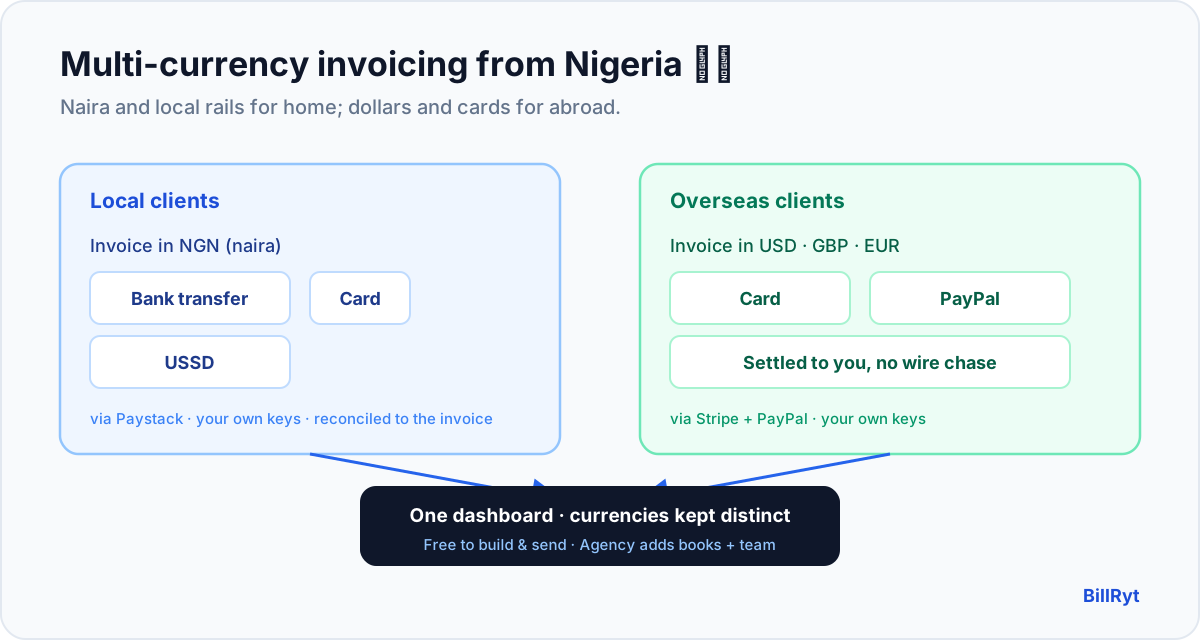
A Nigeria business today rarely bills in one currency. You invoice local clients in naira, and — more and more — you invoice clients in the US, the UK or across Africa in their currencies too. The tool that serves you well has to speak both: NGN with local payment methods for home, and USD, GBP or EUR with cards for abroad. Most invoicing tools do one and fumble the other. Here is multi-currency invoicing that fits a Nigerian business on both sides.
Two client lists, two sets of expectations
What gets an invoice paid quickly is the currency it is in and whether the client can pay by a method they already use.
- Your Nigerian clients expect an invoice in NGN, payable by bank transfer, card or USSD — the ways money moves locally.
- Your overseas clients expect an invoice in their currency (USD, GBP, EUR), payable by card or PayPal — the ways they pay every supplier.
Price a local client in dollars and they query the rate; hand an overseas client a Nigerian account number and a transfer form and they stall. BillRyt handles both on the same invoices.
Real multi-currency, not a currency label
Multi-currency should mean each invoice is genuinely denominated in its own currency — totalled, rounded and taxed correctly in NGN, USD, GBP or EUR — not a relabelled version of one number. BillRyt does that per invoice, and its dashboards keep the currencies distinct rather than adding naira to dollars into a figure that means nothing. Multi-currency invoicing is available on every plan, including free, so looking professional to an overseas client never costs extra — only online collection and higher volume are paid.
Local collection: naira via Paystack
Connect your own Paystack account and your Nigerian clients pay a BillRyt invoice by bank transfer, card or USSD — settled to you at Paystack's standard rate, with the payment reconciled to the invoice automatically. There is no account number to publish and match by hand; the payment starts from the invoice, so BillRyt knows exactly which invoice it belongs to and marks it paid.
International collection: cards and PayPal via Stripe
For clients outside Nigeria, connect Stripe for card payments worldwide and PayPal for those who prefer it. Your London or New York client opens an invoice in their own currency and pays by card in two taps — no international bank transfer, no SWIFT fees. The money settles to your connected account and the invoice marks itself paid, exactly like the local ones. You bring your own gateway keys, so the money is between you and the gateway with no BillRyt cut.
A worked example
In one month you bill three clients: a Lagos distributor 1,900,000 NGN, a London brand 2,400 GBP, and a New York startup 3,000 USD. In BillRyt you create three invoices in three currencies. The Lagos distributor pays by bank transfer through your Paystack; the London brand pays by card through your Stripe; the New York startup pays by PayPal. All three flip to Paid automatically, and your dashboard shows NGN, GBP and USD side by side — never blended. One tool handled your home market and two overseas ones, with no second system and no manual reconciliation.
Books and team for a growing Nigeria business
As you grow you want your naira income and your foreign-currency income in one set of books. The Agency plan ($29/month) includes full accounting (BillRyt Books) and up to 15 team seats, so every payment — transfer, card or PayPal — feeds proper double-entry records and your team works in one workspace. Online collection itself starts on Professional ($19/month); the free plan already covers building and sending multi-currency invoices and recording payments manually.
Why one tool beats a naira tool plus a "dollar workaround"
Many Nigerian businesses run a local invoicing habit for naira clients and an improvised workaround for dollar clients — a separate payment link here, a bank form there — then reconcile the two by hand. That split costs money, time and errors every month. A single multi-currency tool collapses it: naira and dollars land in the same dashboard, reconcile against the same kind of invoice, and feed the same books. You stop maintaining two systems just because your clients live in more than one country.
What to look for in a Nigeria multi-currency tool
If you are comparing options, five questions separate a real multi-currency tool from a naira tool with a currency dropdown. Does each invoice get genuinely denominated, totalled and taxed in its own currency, or is it one number relabelled? Can Nigerian clients pay by the local methods they actually use — bank transfer, card, USSD — through your own Paystack, reconciled to the invoice? Can overseas clients pay by card or PayPal through your own Stripe, without a bank-transfer chore? Does the money settle to your own gateway accounts at the standard rate, with no cut skimmed in the middle? And does the dashboard keep NGN, USD and GBP distinct rather than blending them into a figure that means nothing? A tool that answers yes to all five is one you can run a cross-border Nigeria business on; one that does not will have you improvising a "dollar workaround" beside it. BillRyt is built to answer yes to every one.
In short
Multi-currency invoicing software for a Nigeria business has to serve both sides of your client list: NGN with bank transfer, card and USSD for local clients through Paystack, and USD, GBP or EUR with cards and PayPal for overseas clients through Stripe — all on the same invoices, each denominated correctly, reconciled into one dashboard and one set of books. Multi-currency invoicing is free to build and send; online collection is Professional and up, with Agency adding books and a team. Whether your next invoice goes to Lagos or London, it speaks the client's currency and offers a payment method they already trust.
You can start free to build NGN and foreign-currency invoices today, then connect Paystack, Stripe and PayPal to collect from every client.