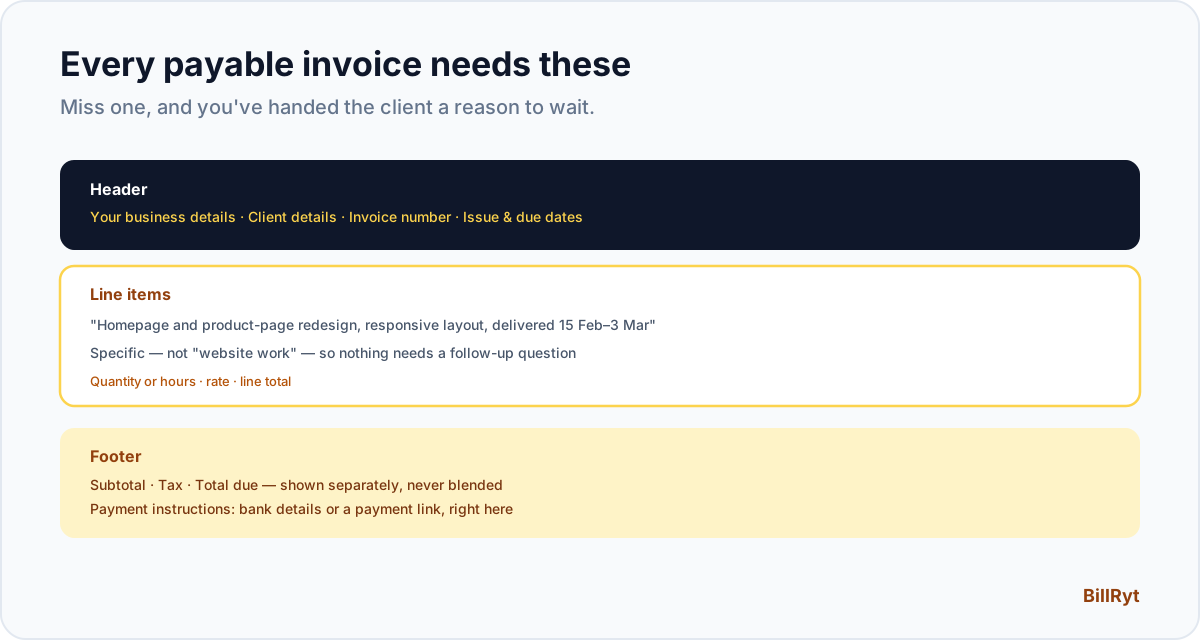
The mechanics of sending an invoice are simple — a document, an amount, a client. What trips up almost every freelancer on their first one isn't the concept, it's the details: which pieces are actually required, which are optional polish, and which small omissions quietly give a client an excuse to sit on payment for another week. Here's the full list, in the order it should appear.
The non-negotiable elements
Every invoice, regardless of industry, needs these pieces to be complete and payable:
- The word "Invoice" — clearly labelled, so it's never confused with a quote or a receipt.
- A unique invoice number — sequential, never reused, even if a invoice is later cancelled.
- Your details — name or business name, address, email, and phone number.
- Client details — name, business name if applicable, and billing address.
- Issue date — the date you're sending it.
- Due date — the exact date payment is expected, not a vague "within 30 days."
- Line items — what was delivered, quantity or hours, rate, and line total.
- Subtotal, tax, and total — shown separately, never blended into one number.
- Payment instructions — bank details, a payment link, or both.
Miss any one of these and you've handed the client a legitimate reason to pause — "I need your bank details first" is a real delay, not an excuse, if you forgot to include them.
Your business information
Beyond the bare legal requirement, a proper header signals that you run this as a real business, not a favour between friends. Your name or business name, a logo if you have one, and contact details a client can actually use if something's unclear. This is also where a client-facing invoice quietly builds trust — an invoice that looks considered gets treated as a serious obligation, not an afterthought.
Client information — get it exact
Small mismatches here cause real delays: a client's finance team matching your invoice against a purchase order will bounce it back if the legal entity name doesn't match exactly, or if there's no reference number for a PO-based client. If you were given a purchase order or project code when the work was agreed, include it — it's often the single field an accounts-payable process is scanning for first.
Line items: the part that actually gets read
A subtotal without detail invites questions; a detailed, specific line item answers them before they're asked. "Consulting services" tells a client nothing they can verify. "Website redesign — homepage, services page, and contact form, delivered 3–14 March" tells them exactly what they're paying for and when it happened. This single change — specificity over vagueness — is one of the most common reasons invoices get flagged for review by a client's accounts team, which is exactly the delay you're trying to avoid. If you want a shortcut to well-phrased line items without writing them from scratch, BillRyt's free invoice description generator turns a rough note like "website work" into a specific, professional description in seconds.
Dates and payment terms
State your issue date and an explicit due date — not "Net 30" alone without the actual calendar date it resolves to. A client is far more likely to pay on time when the invoice tells them the exact day, not a term they have to calculate themselves. If you're not sure which payment term to use or want the due date worked out automatically, BillRyt's free payment terms calculator converts Net 7/30/60 and other common terms into the precise due date for any issue date.
Payment instructions — don't make them ask
Bank account details, a payment link, or both, sitting directly on the invoice. This sounds obvious until you've actually forgotten it once and had a client reply "how do I pay this?" — a reply that adds a full day or more to your payment cycle purely because a required field was missing.
The invoice number mistake almost everyone makes
Starting your numbering at "0001" or "1" isn't wrong exactly, but it does silently tell a new client this is your very first invoice ever — not the confidence signal you want to send. Many established freelancers start at 1001 or similar instead, and always zero-pad the number (0001, not 1) so invoices sort correctly in a folder or spreadsheet. If you want this handled for you, BillRyt's free invoice number generator creates a compliant, correctly-padded sequence with your own prefix and starting number.
A worked example, put together
Invoice #1004, issued 4 March, due 3 April (Net 30). From: Amara Okafor, Okafor Design Studio, hello@okaforsdesign.com. To: Lagos Retail Group Ltd, PO #LRG-2216. Line item: "Homepage and product-page redesign, responsive layout, delivered 15 Feb–3 Mar — $1,800." Subtotal $1,800, VAT (7.5%) $135, Total $1,935. Payment: bank transfer details below, or pay online via the link. Every field a client's accounts team needs is there, in one read, with nothing to chase.
Invoice, quote, or proforma — not the same document
First-time invoicing confusion often starts one step earlier: sending an invoice when what was actually needed was a quote or a proforma. A quote is a non-binding estimate sent before work begins, used to agree scope and price. A proforma invoice looks like an invoice but isn't a demand for payment yet — it's commonly used to confirm order details before a deposit or full payment, especially for new or international clients. An invoice is the real, final demand for payment for work already delivered or in progress. Sending an invoice at the quoting stage confuses a client about whether they actually owe money yet, which is its own quiet source of delayed or disputed payment.
International clients: a couple of extra fields
If you're invoicing a client in another country, a few additional details prevent back-and-forth: state the currency explicitly next to every amount (don't assume it's obvious from context), include your IBAN/SWIFT or equivalent international banking details if you're being paid by bank transfer, and note which party absorbs any international transfer fees — an unstated assumption here is a common, avoidable source of a short payment landing in your account.
Why this matters more than it seems
None of this is about looking impressive — it's about removing every reason payment could stall. A missing due date, a vague description, or absent bank details each cost you real days waiting for a reply, and those days compound across every invoice you send in a year. Getting the format right once, from your very first invoice, means you're never the reason your own payment is late.
Where BillRyt fits
BillRyt's free plan generates invoices with automatic sequential numbering, your saved client details, line-item descriptions, and your default payment terms already applied — so every invoice after your first one takes seconds, not a checklist. Start free and send a properly formatted invoice today.