Almost every freelancer delays sending a payment reminder longer than they should, for the same reason: it feels awkward to ask, even though you're only asking for money you're already owed. The good news is that a well-written reminder doesn't read as awkward or aggressive at all — it reads as professional, expected, and easy to act on. Here's exactly how to write one at each stage.
Why sending a reminder is not the rude part
Most late payments happen because an invoice got buried in an inbox, not because a client is deliberately withholding payment. A clear, well-timed reminder is doing your client a favour — it's the nudge that gets an overlooked invoice back in front of the person who can actually pay it. The rude version of a reminder isn't the one you send on time; it's the one you send three weeks late, tinged with frustration you've been sitting on the whole time.
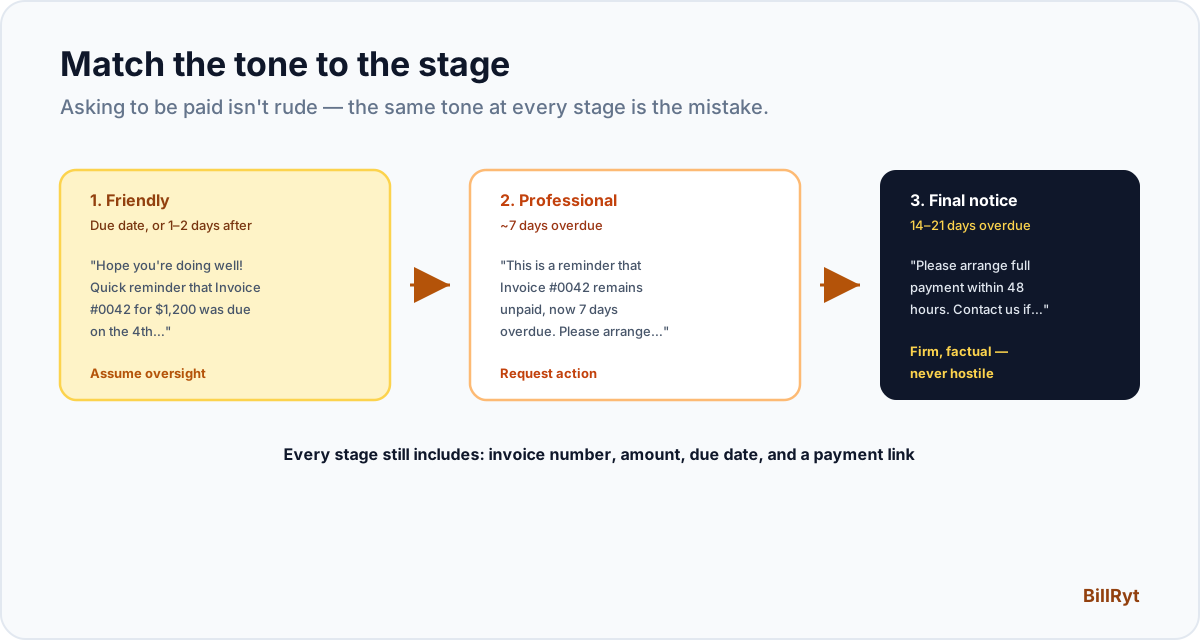
Match the tone to the stage
Sending the same tone at day 2 and day 30 overdue is the actual mistake, not sending a reminder at all. A three-stage approach works for almost any relationship:
Stage 1 — Friendly (due date or a few days after). Assume oversight, not avoidance. Warm, brief, easy to act on.
Hi [Client], hope you're doing well! This is a quick reminder that Invoice [number] for [amount] was due on [date]. Could you let me know when to expect payment? Happy to help if you have any questions. Thank you!
Stage 2 — Professional (around a week overdue). Still courteous, but clearly moves from a nudge to a request for action.
Dear [Client], this is a reminder that Invoice [number] for [amount] remains unpaid, now [X] days overdue. Please arrange payment at your earliest convenience. If this has already been settled, please disregard this message and send your confirmation.
Stage 3 — Final notice (two to three weeks overdue). Firm, specific about consequences, still professional — never hostile.
Dear [Client], this is a final notice regarding Invoice [number] for [amount], now [X] days overdue. Please arrange full payment within 48 hours. If you're experiencing difficulty, please contact us immediately to discuss a payment arrangement before further action is taken.
What every reminder should include, regardless of tone
- The invoice number and amount, stated plainly — don't make the client dig through old emails.
- The original due date and how many days overdue it now is.
- A payment link or your bank details, right there in the message.
- A clear next step: "Can you confirm a payment date?" gets a reply. "Please pay" often doesn't.
WhatsApp vs email — use both, at the right moment
For clients in Africa and parts of Asia in particular, a WhatsApp message frequently gets read faster than an email buried in an inbox. A sensible pattern: send the friendly first reminder by whichever channel you normally communicate with the client through, then follow up by both channels once you're past the professional stage — redundancy is reasonable once an invoice is genuinely overdue.
The mistake that undoes a good reminder
Adding visible frustration — even mild sarcasm, even a passive-aggressive "as previously mentioned" — undoes all the professionalism of an otherwise well-written message, and gives a client a reason to feel defensive rather than cooperative. Keep every stage, including the final notice, factual rather than emotional. State what's owed, by when, and what happens next — nothing more.
If the client disputes the invoice when reminded
Occasionally a reminder surfaces a genuine dispute rather than simple oversight — a client who replies saying the amount is wrong, or the work wasn't completed as described. Treat this as a separate conversation from the reminder itself: acknowledge the dispute specifically, ask what they believe is incorrect, and pause escalation (don't send a firmer reminder on top of an unresolved dispute) until it's addressed. Escalating tone on a genuinely disputed invoice usually makes the disagreement harder to resolve, not easier.
Keep a record of what you sent, and when
Beyond getting paid, a dated record of each reminder sent — even just your own sent-mail folder — matters if a payment becomes seriously overdue and you need to demonstrate you followed a reasonable, professional collection process before taking further action. This is rarely needed, but it costs nothing to have and can matter a great deal on the rare occasion it does.
How BillRyt handles this automatically
Manually tracking which client needs which tone at which day is exactly the kind of task that's easy to let slip. BillRyt's own default reminder schedule sends a friendly reminder 3 days before the due date, another on the due date itself, then escalating notices at 3, 7, and 14 days overdue — with an optional late fee (2% at 7 days, 5% at 14 days) that can apply automatically. Every workspace can edit the timing, wording, and fees, or turn any step off entirely — it's a starting point, not a fixed rule.
Try the free generator
If you're chasing a specific invoice right now and want a properly worded message without starting from a blank page, BillRyt's free payment reminder generator writes friendly, professional, or final-notice messages for WhatsApp and email — fill in the invoice details, pick a tone, and copy the result straight into your next message.
In short
A payment reminder is a normal, expected part of running a business — the discomfort around sending one almost always outweighs how it actually lands. Get the tone right for the stage you're at, keep every message factual rather than frustrated, and make it as easy as possible for the client to act — that combination gets invoices paid faster than either silence or an angry email ever will.