A vague line item doesn't just look unpolished — it's a genuine, common reason invoices get held up. A client's finance team reviewing "consulting services — $2,000" has nothing to verify it against, and an invoice they can't verify is an invoice they can query, and a queried invoice is a delayed one. Here's what actually changes when you get specific, with real examples.
The pattern behind every good description
A strong line item answers three questions on sight: what was delivered, roughly when, and — implicitly — why the amount charged is reasonable for it. It doesn't need to be long. It needs to be exact.
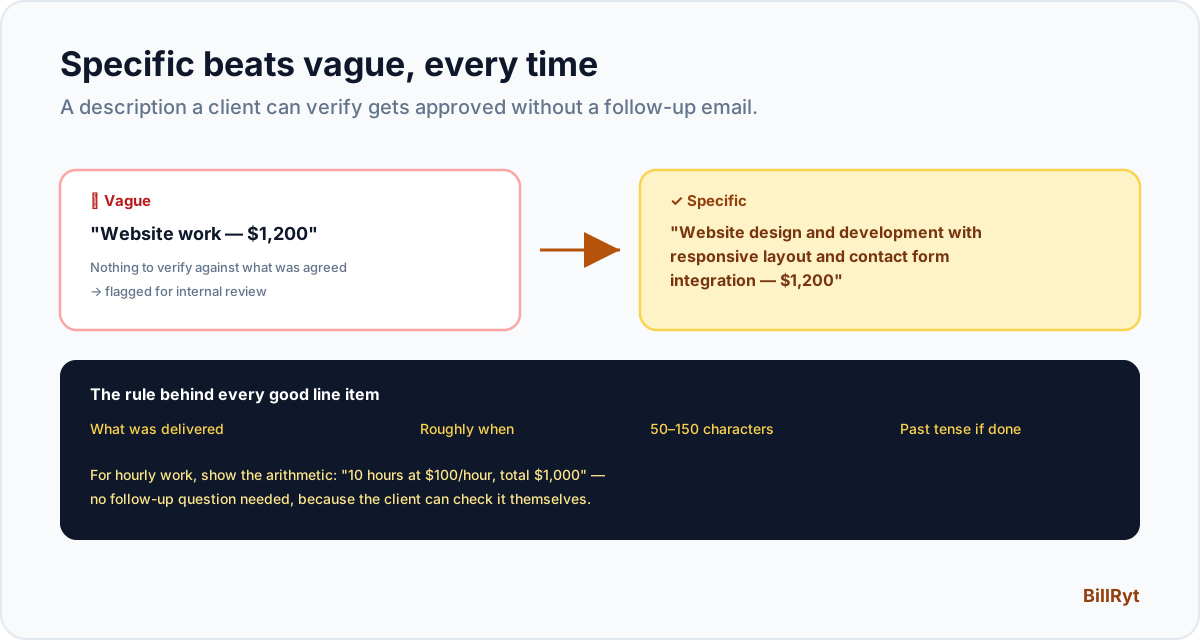
- Vague: "Website work — $1,200"
- Specific: "Website design and development with responsive layout and contact form integration — $1,200"
Same price, same work, but only one of these survives a finance team's first read without a follow-up email.
Examples by category
Web development
- Vague: "Development"
- Specific: "Custom SaaS platform development: database design, REST API, front-end build, and deployment"
Design
- Vague: "Logo"
- Specific: "Logo design and brand mark creation with primary, secondary, and icon variants"
Marketing
- Vague: "SEO"
- Specific: "SEO audit, keyword strategy, and on-page optimisation for priority pages"
Consulting
- Vague: "Consulting"
- Specific: "Business advisory services — monthly retainer covering operational and strategic priorities"
Bookkeeping / finance
- Vague: "Bookkeeping"
- Specific: "Monthly bookkeeping: transaction categorisation, bank reconciliation, and accounts summary"
Video and media
- Vague: "Video"
- Specific: "Video editing and post-production: rough cut, client review, colour correction, and master export"
Trades and construction
- Vague: "Repairs"
- Specific: "Plumbing labour — 2 hours at $90/hour: replaced kitchen sink fittings and tested for leaks"
Legal and contracts
- Vague: "Legal work"
- Specific: "Contract drafting and review: terms of engagement, liability clauses, and payment terms"
Notice the shape each one follows: a clear service name, then the concrete components that make up the deliverable — not a paragraph, just enough that nobody has to ask "what exactly is this."
Why this actually speeds up payment
Finance teams at any company above a certain size don't approve invoices from memory — someone checks each line against what was agreed, often without ever having been in the room when it was agreed. A vague description forces that person to either guess, chase the internal requester for clarification, or flag it for review — all three of which push your payment further down the queue. A specific description lets that same person approve it on the first pass, because there's nothing left to verify.
Adding a time period when it matters
For ongoing or recurring work, naming the period covered removes a second common ambiguity: "Consulting — March 2026" or "Social media management, 1–31 May" tells the client exactly which month's retainer this is, which matters enormously once you're three months into a recurring engagement and the client is trying to reconcile a run of similar-looking invoices.
Length: specific doesn't mean long
The sweet spot is roughly 50–150 characters — one clear sentence, not a paragraph. Long enough to be unambiguous, short enough that it's actually read rather than skimmed past. Every example above sits comfortably in that range.
Matching the client's own language
If a client refers to a project internally by a specific name or code ("Project Phoenix," a PO number, a ticket ID), using that same term on your invoice does more for fast approval than any amount of polish — it's the exact phrase their internal system is searching for when someone reconciles invoices against approved work.
Past tense for completed work, present for ongoing
"Designed and delivered brand identity system" reads as finished, billable work. "Monthly SEO management and reporting" reads as an ongoing retainer. Using the wrong tense is a small thing, but it's exactly the kind of small thing that makes an invoice feel slightly off to whoever's reviewing it — and "slightly off" is often enough to trigger a second look you didn't need to invite.
Avoiding jargon the client doesn't share
A description can be specific and still fail if it's written in language only you understand. "Refactored the auth middleware" means nothing to a non-technical client signing off an invoice, even though it's perfectly specific to another developer. "Rebuilt the login system for improved security and speed" describes the same work in terms a client's finance team can actually evaluate against what they remember agreeing to. Specificity and plain language aren't in tension — the best line items have both.
Try it without writing from scratch
Coming up with a specific, well-phrased description for every line item, every time, is real friction — which is exactly why BillRyt's free invoice description generator exists. Type a rough note like "logo design" or "bookkeeping," pick your industry and tone, and it returns three professional, ready-to-use variations pulled from real, industry-specific phrasing — not a generic template stretched to fit.
For hourly work, show the arithmetic
When billing by the hour, a description that states the rate and hours separately, not just a final total, gives a client's finance team the arithmetic to verify the line themselves: "Marketing consulting, 10 hours at $100/hour, total $1,000" needs no follow-up question, while "Marketing consulting — $1,000" invites one, because there's no way to check it against an agreed hourly rate without asking. This is a small addition — rate × hours = total — but it's often the single detail separating an invoice that's approved on sight from one that gets queried.
In short
The gap between "consulting services" and a properly specific description costs nothing to close, and it's one of the few invoice details that measurably affects how fast a finance team moves your payment through their queue. Get specific once, on every line, and you remove one more excuse for delay before it ever has the chance to cost you a week.