Invoice numbers get almost no thought until a tax audit, a mismatched sequence, or a client's finance team asks why invoice #47 was followed by #52. The rules are simple, but getting them wrong — even innocently — creates real problems later. Here's the full set.
The two rules that actually matter
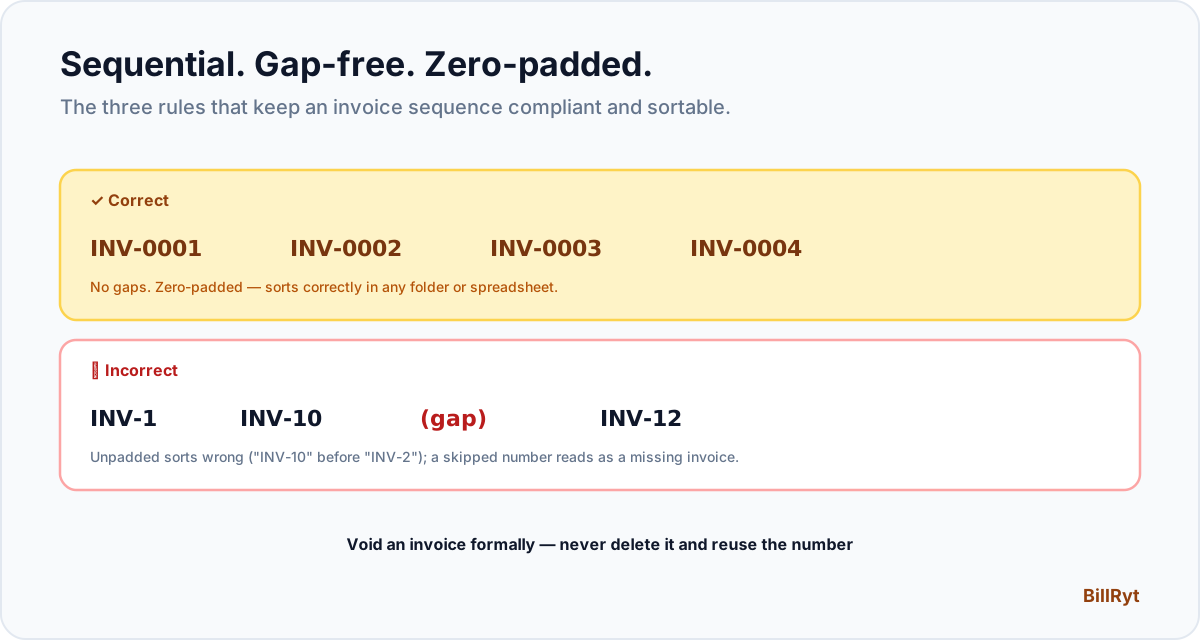
Sequential and gap-free. In most jurisdictions, invoice numbers must run in an unbroken sequence — no skipped numbers, even for a cancelled or voided invoice. A gap in the sequence reads to an auditor as a missing or hidden invoice, whether or not that's actually what happened. If you void an invoice, keep its number retired rather than reusing it, and note the void — don't simply delete it and let the next invoice take its number.
Never reused. Once a number has been assigned, it belongs to that invoice permanently, even if the invoice is later cancelled, refunded, or replaced with a credit note. Reusing a number creates exactly the kind of ambiguity a numbering system exists to prevent.
Zero-padding: small detail, real impact
"INV-1" and "INV-10" and "INV-2" don't sort correctly next to each other in a folder or spreadsheet — "INV-10" sorts before "INV-2" alphabetically. Zero-padding to a fixed width (INV-0001, INV-0002 … INV-0010) fixes this permanently. Four digits (up to 9,999) covers most small businesses for years; larger operations sometimes use five or six.
Common formats, and when each makes sense
Simple sequential — INV-0001, INV-0002. The clearest option for most freelancers and small businesses: one continuous count, no resets.
Year-prefixed — 2026-0001, 2026-0002. Resets each January, which keeps individual years' numbers shorter and makes it obvious at a glance which year an invoice belongs to. Common once you're issuing enough invoices that a single unbroken sequence starts running into the thousands.
Date-based — 20260304-001. Encodes the exact issue date into the number itself; useful if you need to trace an invoice's date without opening it, though it makes the number longer.
Client-coded — ACME-001, ACME-002. Useful if you invoice a small number of large, recurring clients and want each client's own sequence visible at a glance — though note that most tax authorities still expect an overall sequential record across all clients combined, so this works best as a secondary reference alongside a master sequence, not a replacement for one.
Whichever format you choose, the golden rule stays the same: unique, sequential within that format, and never reused.
What number should you start at?
There's no legal requirement to start at 1. Many established businesses deliberately start at 1001, 5000, or a similar round number, purely so a new client doesn't see "Invoice #1" and correctly infer they're your very first customer. This is a business-perception choice, not a compliance one — starting at 1 is entirely valid too.
The prefix is doing more work than it looks like
A short, consistent prefix (INV-, or your initials, or a client code) does two jobs at once: it makes the number instantly recognisable as yours in a client's inbox full of other invoices, and it gives you a natural way to run parallel sequences if you ever need one (for example, a separate prefix for a different business line).
Credit notes and refunds need their own sequence
A credit note (issued to reverse or partially reverse an invoice) should have its own separate sequential numbering, not borrow from the invoice sequence — mixing the two makes it much harder for anyone reconciling your records later to tell at a glance which documents are invoices and which are adjustments. A common, clean convention is a distinct prefix: INV-0001 for invoices, CN-0001 for credit notes, each with its own gap-free sequence.
Multiple entities or currencies
If you invoice through more than one legal entity, or in more than one currency, resist the temptation to interleave a single shared sequence across all of them — it becomes very difficult to audit later which numbers belong to which entity. A separate prefix per entity or currency (US-0001 vs KE-0001, for example), each independently sequential, keeps the records cleanly separable while still satisfying the sequential, gap-free rule within each stream.
A mistake worth naming directly: embedding sensitive data
Avoid encoding anything sensitive into the number itself — a running total of your annual revenue, for instance, is occasionally seen in home-grown numbering schemes and is a genuinely bad idea, since the number is visible to every client who receives an invoice.
Try the free generator
Setting up a numbering system correctly the first time avoids ever having to renumber later — a genuinely painful cleanup once dozens of invoices already exist. BillRyt's free invoice number generator produces a properly formatted, zero-padded sequence with your own prefix and starting number, so you can see exactly what your first invoice — and your thousandth — will look like before you commit to a format.
Switching numbering systems mid-year
If you've been numbering inconsistently and want to fix it, the clean approach is to pick a point going forward — don't retroactively renumber invoices that have already been sent, since that breaks the audit trail those documents already form. A common, defensible transition is to adopt the new format starting from your next invoice, keeping a note of exactly when and why the format changed, in case anyone reviewing your records later asks about the shift.
In short
Invoice numbering is one of the few invoicing details with a genuinely correct answer: sequential, gap-free, zero-padded, and never reused. Pick a format that suits how many invoices you expect to send and how you want to reference them later, set it once, and let it run — it's the kind of detail that only ever causes a problem when it's ignored from the start.