Stripe is excellent at one thing African businesses genuinely need: taking card payments from clients abroad. If your customer is in London or New York, a Stripe card charge is smooth and familiar. The problem is not Stripe — it is that Stripe Invoicing alone is card-and-USD-first, and half your clients may be down the road in Nairobi, Lagos or Accra, where the way people actually pay is a bank transfer, USSD, mobile money or M-Pesa. This is not a case for ditching Stripe. It is a case for putting Stripe and the local rails on the same invoice — which is exactly what BillRyt does.
The real gap: Stripe covers "them", not "here"
Think about who pays you. Your overseas clients want to tap a card — Stripe territory. Your local African clients want to pay the way they pay everything else: a transfer, a USSD code, or M-Pesa if they are in Kenya. Stripe Invoicing is not built around those local methods, and it defaults to USD rather than KES, NGN or GHS. So a Stripe-only setup quietly serves your foreign clients well and leaves your local ones to "figure it out" — which means slow payments and manual follow-up on the half of your book that is closest to home.
The fix is not to replace Stripe with a local-only tool and lose your overseas card payments. It is to run both, cleanly, from one place.
How BillRyt completes the picture
BillRyt is the invoicing layer that carries both rails on a single workflow, using your own keys for each:
- Stripe for overseas cards. Connect your Stripe account and your international clients pay by card exactly as they do today — settling to you, no BillRyt markup.
- Paystack for local Africa. Connect Paystack and your local clients pay by card, bank transfer, USSD, or M-Pesa (in Kenya) — the methods they actually use — from the same invoice.
- Local currencies, first-class. Invoice in KES, NGN, GHS, USD, GBP or EUR per client, each document denominated and taxed correctly, so nobody has to "work out the conversion."
- One ledger for both. However a client pays, the invoice is marked paid and reconciled in the same place, so your view of who owes you is complete rather than split across tools.
This is the practical meaning of a "Stripe invoicing alternative for Africa": you keep Stripe for what it is good at and add the local rails Stripe alone does not cover — the same idea as putting Stripe and Paystack on one invoice, applied to a whole business.
A side-by-side, scoped honestly
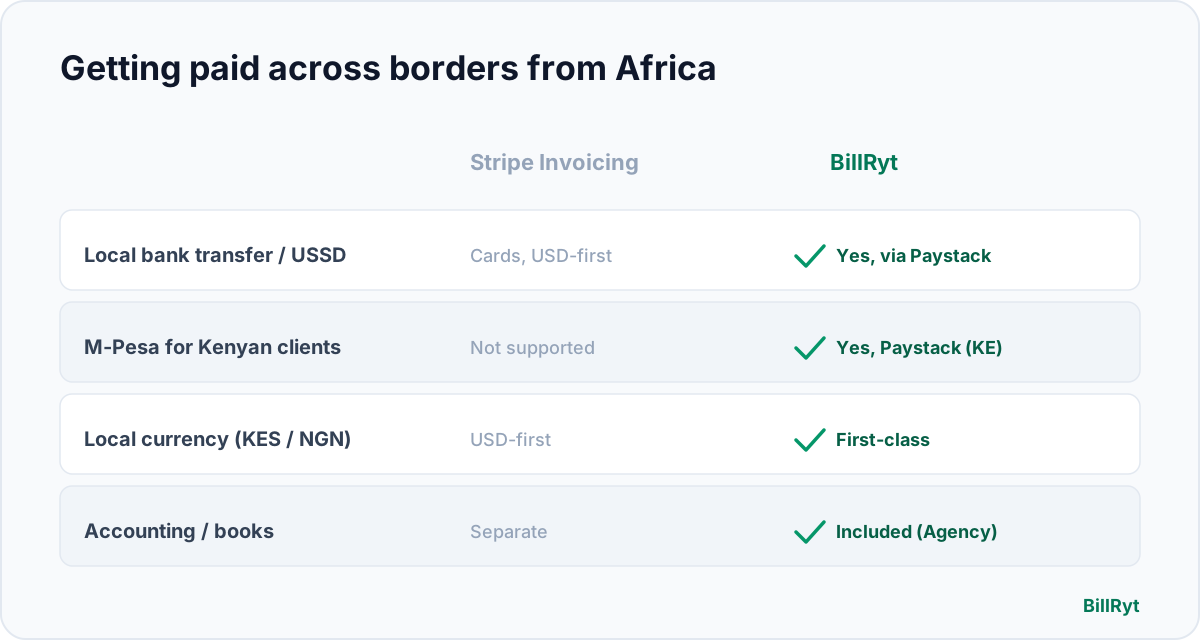
| Getting paid across borders from Africa | Stripe Invoicing alone | BillRyt (Agency) |
|---|---|---|
| Overseas card payments | Yes | Yes — via your Stripe |
| Local bank transfer / USSD | Cards, USD-first | Yes — via Paystack |
| M-Pesa for Kenyan clients | Not supported | Yes — Paystack (KE) |
| Local currencies (KES / NGN / GHS) | USD-first | First-class |
| Accounting / books | Separate | Included |
Read that scope carefully: this is about getting paid across borders from Africa. For a business whose clients are only in the US or EU and only pay by card, Stripe on its own is perfectly good and you may not need anything else. The moment a meaningful share of your clients are local African payers, the Stripe-only setup leaves money moving slowly — and pairing Stripe with Paystack closes that gap.
A worked example
You run a studio in Nairobi. This month you bill a London agency 4,000 GBP and three Kenyan clients a total of 320,000 KES. On a Stripe-only invoice tool, the London agency pays by card beautifully — and your three Kenyan clients get a USD-leaning invoice and no in-invoice way to pay by M-Pesa, so you end up sending an M-Pesa number separately and matching payments by hand. On BillRyt, the London agency still pays by card through your Stripe, and each Kenyan client opens their KES invoice and pays by M-Pesa or bank transfer through your Paystack — every payment recorded against its invoice automatically. Same tool, both worlds, one clean ledger.
Why "your own keys" matters here
Because you connect your own Stripe and Paystack accounts, BillRyt never sits between you and your money. Each client pays the native, cheapest-for-them way — an overseas card via Stripe, a local transfer or M-Pesa via Paystack — and the funds settle directly to your Stripe or Paystack balance. BillRyt earns from a flat subscription, not a slice of your payments, so letting each client pay their own way is pure upside for your margin.
What you keep from Stripe
Adopting BillRyt does not cost you anything you value about Stripe. You keep your Stripe account, your Stripe rates, and your existing card-payment experience for overseas clients — BillRyt simply drives it through the invoice rather than a separate dashboard. Nothing about your international collection gets worse; you are only adding a second rail beside it. That is worth stressing because "alternative" can sound like "rip it out and start again", and here it is the opposite. Your London and New York clients notice no change — they still tap a card. Your Nairobi and Lagos clients get something they did not have before: a way to pay the invoice by the local method they already use. You are strictly adding coverage, not trading one gap for another, and the single ledger means both rails report to the same place.
In short
A Stripe invoicing alternative for Africa is not about abandoning Stripe — it is about completing it. Keep Stripe for overseas card payments, add Paystack for the local bank transfers, USSD and M-Pesa your African clients actually use, invoice everyone in their own currency, and reconcile it all in one ledger. On BillRyt's Agency plan you get that dual-rail workflow plus included accounting for $29/month, using your own keys so the money lands with you. If your client list spans "here" and "abroad", that is the difference between getting paid promptly on both halves and chasing the local half by hand.
You can start free to build multi-currency invoices today, then connect Stripe and Paystack when you are ready to collect on both.