For an agency, a quote is not just a price — it's the first real deliverable a prospective client sees. A client who is comparing three agencies is, whether they realise it or not, judging the quote as a preview of the work: clean and considered, or thrown together in whatever tool was open. A quote builder built for agencies has to treat that document with the same care as a client-facing deliverable, not an afterthought bolted onto invoicing. Here is what that looks like, plus a fact worth knowing before you assume it costs extra.
What a quote needs to do for an agency
An agency's quote works harder than a freelancer's. It often needs to:
- Break work into clear line items — deliverables, phases, or a day-rate breakdown a client's finance team can follow.
- Carry your brand consistently — logo, colours, and a document layout that looks like the same agency who will do the work.
- Convert cleanly — into a proforma for deposit collection, or straight into an invoice, without retyping a single figure.
- Look right in any currency — for agencies pitching international clients alongside local ones.
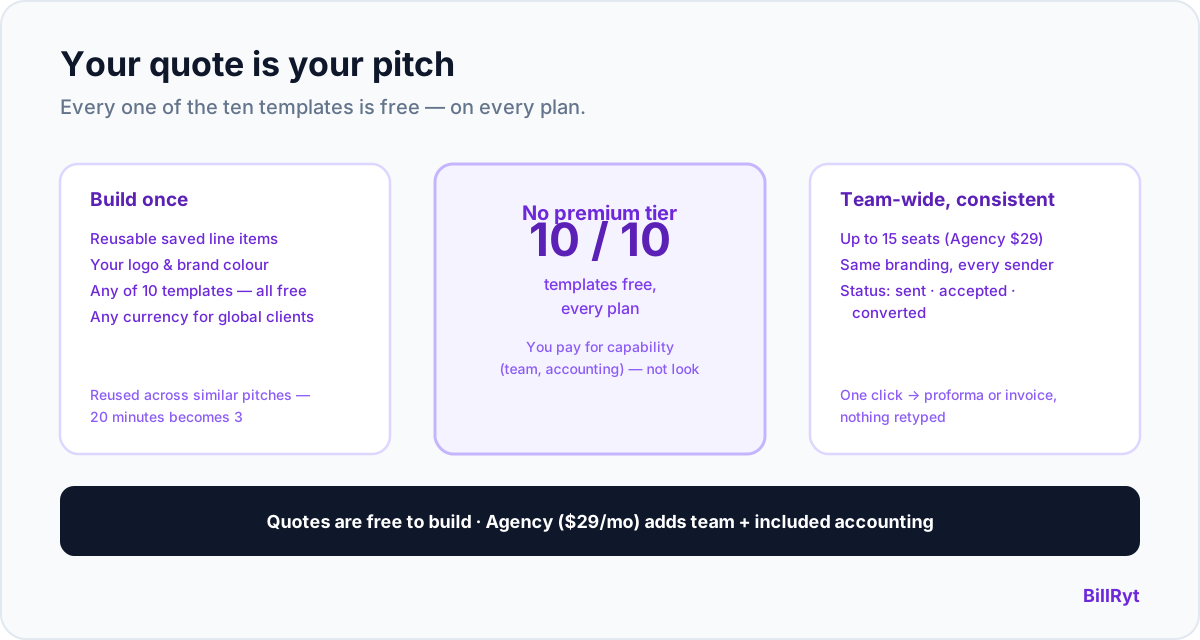
BillRyt's quote builder covers all four: reusable saved line items so a standard package doesn't get rebuilt from scratch each time, your branding applied automatically, and one-click conversion onward to a proforma or invoice.
The fact worth knowing: every template is free
Here is something that changed recently and is worth stating plainly: every document template — all ten of them — is available on every BillRyt plan, including free. There used to be a distinction between "standard" and "premium" templates gated by plan; that gate has been removed. So the polished, professional-looking template you pick for a client-facing quote is not an upsell — it is simply the template you choose, free, whether you are on the free plan or Agency. What you are paying for on the paid plans is capability (proformas, team seats, accounting), not a nicer-looking document.
A worked example
You are pitching a mid-size retail client alongside two competing agencies. You build the quote with a clean line-item breakdown of the phases, pick a template that matches how you present your other work, and it carries your logo and brand colour automatically. The client opens a document that looks considered — not a generic spreadsheet export — and it takes you minutes to build because the line items are pulled from a saved package you use for similar projects. When they say yes, you convert the same quote into a proforma to collect a deposit, with every figure carried across untouched.
Team quoting without stepping on each other
Agencies rarely have one person writing every quote. On the Agency plan ($29/month), up to 15 team members share the workspace — so your account managers can each build and send quotes under the agency's branding, from the same client list and saved line items, without duplicating work or drifting into inconsistent formatting. Everyone's quotes look like they came from the same agency, because they did.
From quote to won business, tracked
A quote builder is only half the job; knowing what happened to each quote is the other half. BillRyt's quote list shows status at a glance — sent, accepted, converted — so you are not chasing "did they get back to us?" across email threads. When a quote is accepted, convert it directly to an invoice or route it through a proforma if the client needs one, and the pipeline from pitch to paid stays in one place.
Where it fits in your plan
Building and sending quotes — with any of the ten templates — is available on every plan, including free. What Agency ($29/month) adds is the team layer (up to 15 seats), plus included accounting so accepted quotes and the invoices they become feed real books automatically. There is no separate "premium quoting" tier to unlock; the document quality is the same from day one.
What a scattered quoting process actually costs
Before a shared quote builder, agencies often end up with quotes built in whatever tool was open when the request came in — a document editor for one account manager, a spreadsheet for another, a generic invoicing tool's default template for a third. The client rarely notices any single instance of this, but they do notice the pattern across a pitch process: three documents that do not look like they came from the same place erode the "considered, professional agency" impression before a single word of the proposal is read. Beyond the client-facing cost, a scattered process means every quote starts from a blank page — nobody is reusing a package that has already been refined, so estimation drifts and pricing gets inconsistent between account managers pitching similar work.
Reusable line items are the real time saver
The saved-line-items feature matters more than it sounds for an agency specifically, because agencies quote the same categories of work repeatedly — a website build, a monthly retainer, a campaign package — with variations on scope rather than starting fresh each time. Building a package once (the line items, typical quantities, standard pricing) and reusing it across similar pitches turns a 20-minute quote into a 3-minute one: pull the package, adjust the specifics for this client, send. Multiply that across a busy month of proposals and the saved time compounds into hours, on top of the consistency it enforces across who is doing the quoting.
In short
An agency's quote is a pitch, and it deserves to look like one — which is why every BillRyt template, all ten, is free on every plan rather than gated behind an upgrade. Build quotes from reusable line items, in your brand, convert them in one click when a client says yes, and let your whole team quote consistently on Agency's shared workspace. The document quality was never the thing you had to pay for; the team and the books are.
You can start free to build your first branded quote, then move to Agency when your team needs to quote together.