Wholesale orders bring two complications regular retail invoicing doesn't: the price genuinely changes based on quantity, and the buyer is often in another country paying in their own currency. Handling either one manually is a nuisance; handling both at once, order after order, is where a generic invoicing tool starts costing real time.
Why wholesale billing breaks generic tools first
A retail-only invoicing tool assumes one price per product and one currency per business, both reasonable defaults for a single storefront selling to individual customers. Wholesale breaks both assumptions at once — the same product genuinely costs different amounts depending on order size, and buyers are frequently not in the seller's own country at all. Neither gap shows up in a demo with one sample invoice; both show up immediately on the first real bulk, international order.
Volume pricing that applies itself
Set quantity-based price tiers per product — a lower unit price once an order crosses a threshold, and another lower still at a higher threshold — and BillRyt applies the correct tier automatically as the quantity on an invoice line changes. You're not manually recalculating a discount every time a wholesale buyer orders more than your standard price applies to, and you're not maintaining a separate price list outside the product itself that can drift out of sync with what you actually charge.
Invoicing in the buyer's currency, not yours
A wholesale buyer overseas expects a total in their own currency, not one they have to convert themselves before they know if the order makes sense for their margins. Multi-currency invoicing is available on every BillRyt plan, including Free — you set the currency per invoice, so a domestic wholesale order and an international one from the same product catalogue each invoice correctly without any manual conversion step.
A worked example
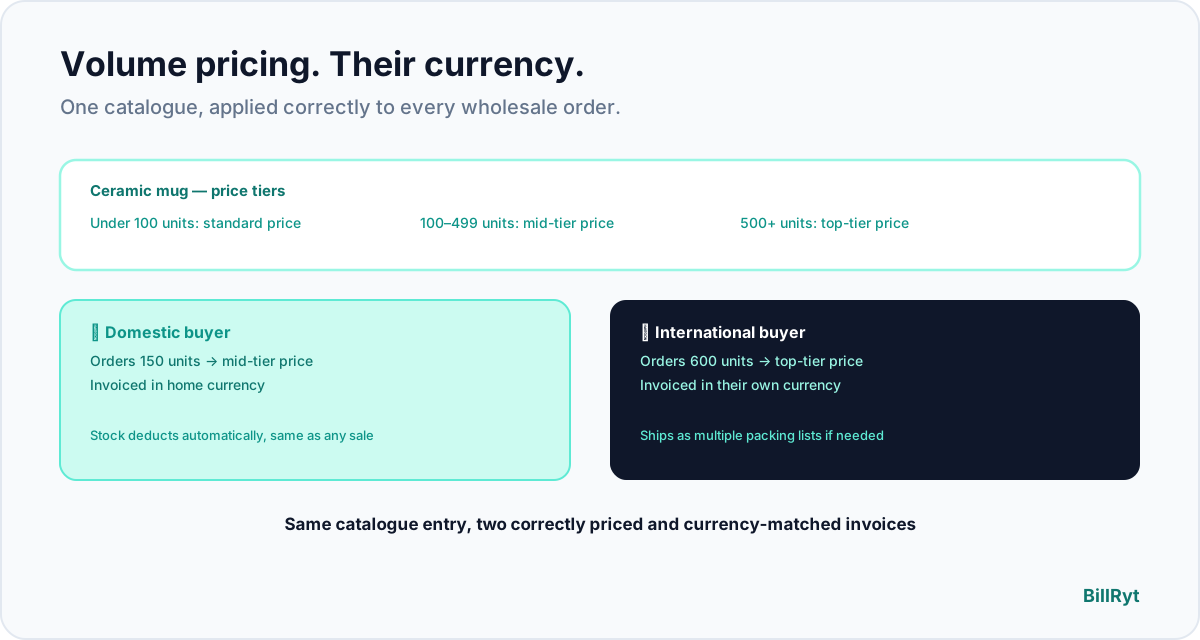
A homeware wholesaler sells the same ceramic mug at three volume tiers: standard price under 100 units, a lower per-unit price from 100–499, and a further discount at 500+. A domestic buyer orders 150 units and is invoiced in the wholesaler's home currency at the middle tier automatically. The same week, an international buyer orders 600 units and is invoiced in their own currency at the top tier — same product, same catalogue entry, two completely different invoices, neither requiring a manual price lookup or currency conversion.
Getting paid across the same range of buyers
Once the invoice is right, collection needs to match where the buyer actually is. Stripe and PayPal connect for buyers anywhere in the world; Paystack — including M-Pesa for Kenyan buyers — covers Africa specifically. Online payment collection through any of these requires Professional ($19/month) or above; inventory and volume pricing are part of the Merchant plan ($39/month).
Stock stays accurate at wholesale volumes too
A 500-unit wholesale order deducts stock the same way a single retail sale does — automatically, once, at the moment the invoice is sent or the shipment is marked shipped — and writes to the same permanent stock movement ledger. Selling in bulk doesn't mean stepping outside the inventory system into a manual adjustment; it's the identical mechanism, just at a larger quantity per line.
Why this beats a static wholesale price list
A separate wholesale price sheet — a PDF, a spreadsheet — drifts from what you actually charge the moment you update pricing in one place and forget the other. Tiered pricing that lives on the product record itself, applied automatically based on the quantity actually ordered, removes that entire category of error: there's one source of truth for what a given quantity costs, and every invoice reads from it directly.
Large orders, shipped in pieces, tracked properly
Wholesale orders don't always move as one shipment — stock arrives in batches, or a buyer wants an early partial delivery on part of a large order. BillRyt tracks packed quantities per line item across multiple packing lists against the same invoice, so a 500-unit wholesale order shipping in three batches over a month is handled correctly, with each shipment's stock deduction and movement-ledger entry recorded separately rather than forcing an all-or-nothing "shipped" status.
A portal for buyers who reorder regularly
A wholesale buyer who orders monthly doesn't want to email you for a copy of their last invoice or ask what they currently owe across several orders. BillRyt's client portal gives them self-service access — a passwordless magic-link login, not a password to manage — showing their invoice history, current balance, and full statement of account, styled with your business's own branding.
Quoting before the order is confirmed
Wholesale relationships often start with a negotiation — a buyer asks what a given quantity would cost before committing. BillRyt's quote builder pulls from the same tiered-pricing catalogue, so a quote for 300 units reflects the correct volume price automatically, in the buyer's currency, before any invoice exists. Once the buyer confirms, that quote converts in one click into a proforma or final invoice with the same figures — no re-quoting by hand once the order is real.
Reporting that separates domestic from international revenue
A wholesaler selling both locally and internationally needs to see those two revenue streams clearly, not blended into one misleading total. Because BillRyt's dashboard breaks revenue down by currency and auto-converts it into an overall figure, a wholesaler can see exactly how much of this month's revenue came from international buyers versus domestic ones, without manually separating invoices by currency after the fact.
In short
Wholesale invoicing has two specific requirements retail billing doesn't — pricing that changes with volume, and currency that changes with the buyer's location — and both need to apply automatically, order after order, rather than being recalculated by hand each time. That combination, on top of the same automatic stock deduction every other sale uses and the same partial-shipment tracking a large order actually needs, is what makes wholesale billing genuinely different from just "invoicing, but bigger numbers" — the mechanics scale with the order, not just the total on the page.
Start free to explore the document pipeline, then move to Merchant ($39/month) for volume pricing and inventory.