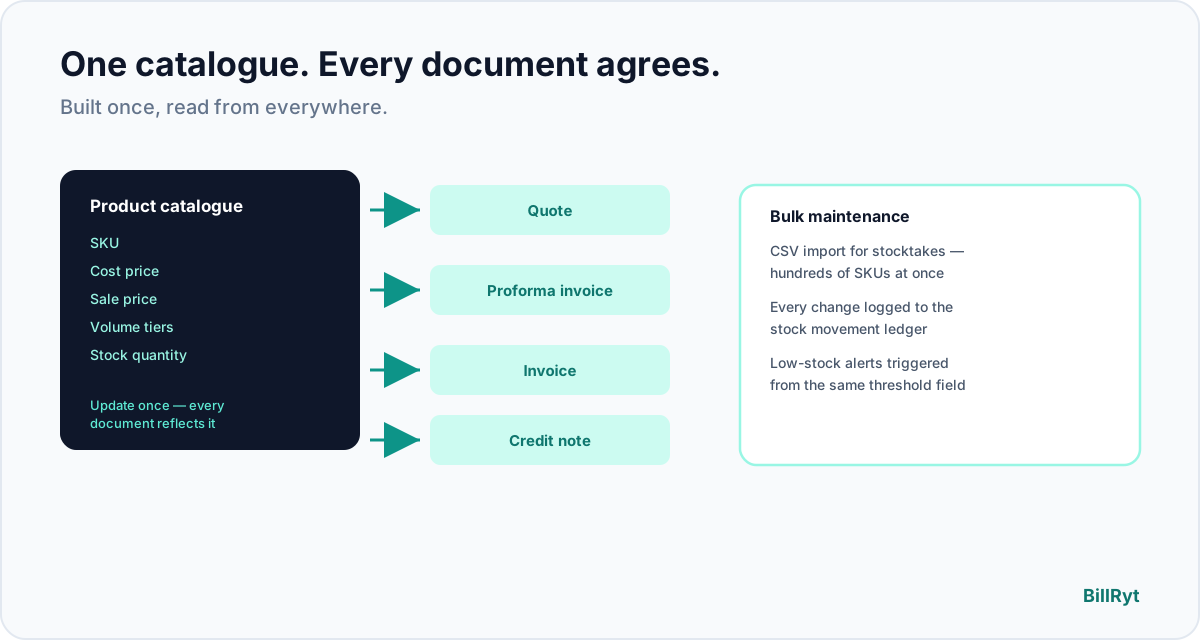
Every business selling physical products or repeatable services ends up with a catalogue whether they build one deliberately or not — it's really just a question of whether that catalogue lives in one trusted place or is silently, imperfectly re-created every single time someone types a product name into a brand-new invoice. The second version is where prices drift, SKUs get typo'd, and two invoices for the same item end up with two different numbers on them.
Build the catalogue once
Add each product to BillRyt with its SKU, cost price, sale price, and — if you track stock — a starting quantity. From that point, every quote, proforma, invoice, and credit note pulls from that same record instead of anyone re-typing product details by hand. Update a price once on the product, and every future document reflects it automatically; you're never hunting down which invoice still has last quarter's price.
Volume pricing lives on the product, not in someone's head
For products sold at different price points depending on quantity, price tiers attach directly to the product record — a threshold quantity and the unit price that applies from there. A line item's price resolves automatically based on the quantity entered, so the discount structure isn't something a team member needs to remember or apply manually order by order.
Itemized documents that stay accurate at scale
An itemized invoice is only as trustworthy as its source data. Because every line item on every document type draws from the same catalogue, an invoice, the proforma that preceded it, and a credit note issued against it all agree on what a product actually costs — there's no scenario where the deposit was calculated at one price and the final invoice quietly used another because someone typed a fresh number in.
Stock-aware where it matters, flexible where it doesn't
Not every catalogue item needs quantity tracking — a service add-on or a one-off custom item might not represent physical stock at all. Stock tracking is a per-product toggle, so a catalogue can mix tracked physical goods with untracked service lines, and each document type handles both correctly: tracked items affect quantity on hand and feed the stock movement ledger, while untracked lines behave like an ordinary invoice item.
Why a shared catalogue matters more as a team grows
A single owner typing every invoice by hand might keep prices consistent through sheer familiarity with their own product line. The moment a second or third person starts creating documents, that informal consistency breaks down — one team member remembers last month's price, another quotes this month's. A shared catalogue removes the need for anyone to remember pricing at all; it's simply what the system already knows.
A worked example
A stationery supplier catalogues 40 SKUs, each with cost and sale price, 15 of them with volume tiers for bulk school and office orders. A sales rep quoting a new client picks products directly from the catalogue — no manual price lookup, no risk of quoting last month's number. The quote converts to an invoice at the same prices, and when the client later reorders at a higher quantity, the catalogue's tier pricing applies automatically without anyone recalculating a discount by hand.
What this saves at reconciliation time
When a catalogue is the single source every document reads from, reconciling revenue against cost becomes straightforward: every sold line item traces back to a real cost price on the product record, so gross margin per product and per order is a real number rather than an estimate reconstructed after the fact. On the Merchant plan, BillRyt Books turns that same catalogue-linked sales data into proper double-entry postings, so cost of goods sold is already accounted for rather than a separate spreadsheet exercise at month end.
Updating the catalogue in bulk, not one product at a time
A catalogue of any real size needs to be maintainable in bulk, not edited product by product. You can bulk-import corrected stock counts for hundreds of SKUs at once from a CSV — useful after a physical stocktake or a large delivery — and every change lands in the stock movement ledger with a timestamp, so a bulk update is just as traceable as a single sale.
The catalogue is also where low-stock alerts start
Because every product's stock threshold lives on its catalogue record, that's also where BillRyt watches for low stock — once a tracked product crosses its reorder threshold, a single digest email goes to the workspace owner covering every affected item, rather than a separate alert system disconnected from the catalogue itself. The same record that prices your documents is the one that tells you when to reorder.
Quotes built from the catalogue convert cleanly
A sales conversation often starts with a quote before any commitment exists. Because the quote builder reads from the same catalogue as every other document, a quote for a mix of products reflects real prices — including any volume tiers that apply — from the first draft, and converts in one click into a proforma or invoice with those same figures intact. There's no separate "quoting price list" that can drift from what the catalogue actually says by the time an order is confirmed.
One catalogue, every plan-appropriate document type
The same catalogue record feeds whichever document type a sale actually needs — a straightforward invoice for a walk-in sale, a proforma for a deposit on a larger order, a credit note if something needs adjusting after the fact. A business doesn't maintain separate product data per document type; there's one record per product, and every document reads the same current price, SKU, and — where relevant — stock level from it.
In short
A product catalogue that lives in one place, feeds every document type, and applies volume pricing automatically closes the specific gap where pricing mistakes come from — the moment someone re-types a product's details instead of pulling them from a single, trusted source. That's the real value of catalogue-driven billing, distinct from inventory tracking itself: not just knowing what's in stock, but guaranteeing every document — quote, deposit, final invoice, and any correction after the fact — agrees on exactly what it costs, with one place to fix it when a price genuinely needs to change.
Start free to explore the document pipeline, then move to Merchant ($39/month) to build your product catalogue.