The UK–Nigeria corridor is one of the busiest in global business: Nigerian companies serving UK clients, UK companies with Nigerian operations, and founders who move between London and Lagos and bill in both. If that is your business, you know the specific headache — a London client wants a GBP invoice they can pay by card, a Lagos client wants a NGN invoice they can pay by bank transfer, and most tools make you choose which one to serve well. BillRyt handles both ends from one account. Here is exactly how.
Two clients, two completely different expectations
Picture the two invoices you send in the same week:
- The London client expects a clean invoice in GBP, and expects to pay by card in a couple of clicks — the way they pay every other supplier. Ask them to make an international bank transfer to a Nigerian account and you have introduced fees, forms and a week of delay.
- The Lagos client expects an invoice in NGN, and expects to pay by bank transfer, USSD or card through Paystack — the way business is done locally. Send them a card-only checkout priced in pounds and you have made a simple payment awkward.
Serving both well means matching each client's currency and their native payment rail. A tool that only does one leaves half your revenue moving slowly.
How BillRyt covers both ends
From a single account, on your own gateway keys:
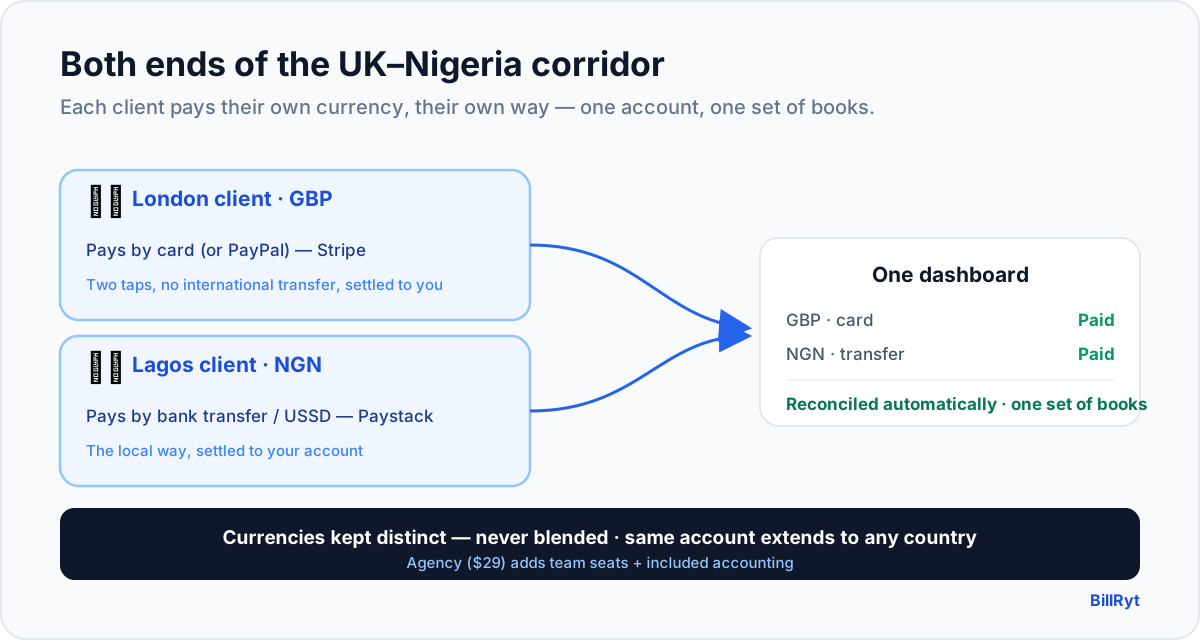
- For the UK client: invoice in GBP and connect Stripe (and PayPal if they prefer) so they pay by card or PayPal instantly, settled to you.
- For the Nigerian client: invoice in NGN and connect Paystack so they pay by bank transfer, USSD or card — the local way — settled to your Nigerian account.
Each invoice is denominated and taxed in its own currency, each client pays their native way, and both payments reconcile automatically into the same dashboard. You are not running a "UK system" and a "Nigeria system" — you are running one billing platform that speaks both.
A worked example
This month you invoice a London agency 3,500 GBP and a Lagos distributor 1,900,000 NGN. In BillRyt you create two invoices in two currencies. The London agency opens theirs and pays by card through your Stripe; the Lagos distributor opens theirs and pays by bank transfer through your Paystack. Both invoices flip to Paid automatically, your outstanding figure updates, and your dashboard shows GBP and NGN side by side — never added together into a number that would mean nothing. The pound came in by card, the naira by transfer, and you touched neither payment manually.
The margin point
Because you use your own Stripe, PayPal and Paystack keys, each side of the corridor settles directly to you at the gateway's own rate — no BillRyt surcharge in the middle. The London client's card runs through your Stripe; the Lagos client's transfer runs through your Paystack. You are not converting one into the other or paying to route money across the border inside the tool; each payment simply lands where it should, in the currency it was made in. For a cross-border business, that is real money kept on every invoice.
Books and team across the corridor
A UK–Nigeria business usually wants its accounts to make sense across both currencies, and often has people on both ends. The Agency plan ($29/month) includes full accounting (BillRyt Books) and up to 15 team seats, so GBP income and NGN income feed one set of books and your London and Lagos colleagues work in one workspace. It is the same Stripe-and-Paystack-on-one-invoice idea scaled to a whole business with two home markets.
Not just UK and Nigeria
Although this corridor is the example, nothing about BillRyt is limited to it. The same account bills clients in the US, Europe, Kenya, Ghana or anywhere else — Stripe and PayPal for the international side, Paystack for African clients — each in their own currency. UK and Nigeria is simply one common pairing of a platform built for international and African clients together.
The reconciliation win on both ends
The part that saves the most time is invisible until you have lived without it: reconciliation. When a UK client pays by card and a Nigerian client pays by bank transfer through two disconnected tools, you spend the end of every month matching payments to invoices by hand — squinting at a GBP card settlement and a NGN transfer reference and hoping you attach each to the right document. Because BillRyt initiates both payments from the invoice itself, it already knows which invoice each belongs to. The London card marks its invoice Paid; the Lagos transfer marks its invoice Paid; your outstanding figure updates on both ends without you touching a spreadsheet. Across a busy corridor with dozens of invoices a month in two currencies, that automatic matching is the difference between a clean close and a lost afternoon — and it works the same whether the money arrived as a pound by card or a naira by transfer.
In short
A business working the UK–Nigeria corridor needs to serve two clients with opposite expectations: a London client who wants GBP and a card, and a Lagos client who wants NGN and a bank transfer. BillRyt does both from one account — Stripe and PayPal for the UK end, Paystack for the Nigerian end, each invoice in its own currency, both reconciled into one dashboard and one set of books on the Agency plan. And the same setup extends to clients anywhere else in the world. One account, both home markets, every client paid the way they expect.
You can start free to build GBP and NGN invoices, then connect Stripe, PayPal and Paystack to collect on both ends. The corridor runs both ways, and so does BillRyt: the pound comes in by card, the naira by transfer, and both close cleanly in the same set of books.