Virtual assistant work runs on trust and recurring small amounts — a retainer here, an hourly block there, usually for several clients at once. The billing tool that fits that reality looks nothing like the accounting software built for a company with a finance department. Here's what actually matters when you're the one sending every invoice, following up on every late payment, and doing it all between client tasks.
Before: the manual chase
If you've been invoicing manually — a Word template, a screenshot of a bank transfer, a WhatsApp message asking "did you get a chance to pay that?" — you already know the actual cost isn't the invoice itself. It's the follow-up. Remembering who owes what, when it was due, and whether you already asked once this week is its own unpaid job on top of the client work.

What changes with a real system
BillRyt replaces that manual chase with automatic email payment reminders sent before and after a due date — you set it up once per invoice and it runs without you remembering to nudge anyone. Every invoice's status (sent, paid, overdue) is visible in one dashboard instead of scattered across bank alerts and message threads. When you do need to check exactly what a client owes across every invoice you've sent them, a statement of account is one click away, not a manually rebuilt spreadsheet.
Getting paid, wherever your clients are
Virtual assistants working with African clients or diaspora clients need payment methods that actually match where the money's coming from. In Kenya, that includes M-Pesa through Paystack, alongside card and bank transfer. In Nigeria, it's card, bank transfer, and USSD through Paystack — M-Pesa is a Kenyan (and Tanzanian/Mozambican) rail specifically, not a Nigerian one, so it's never listed as an option there. For clients outside Africa, Stripe and PayPal cover card payments worldwide. All of this connects on the Professional plan ($19/month) — online payment collection isn't available on Free.
A worked example
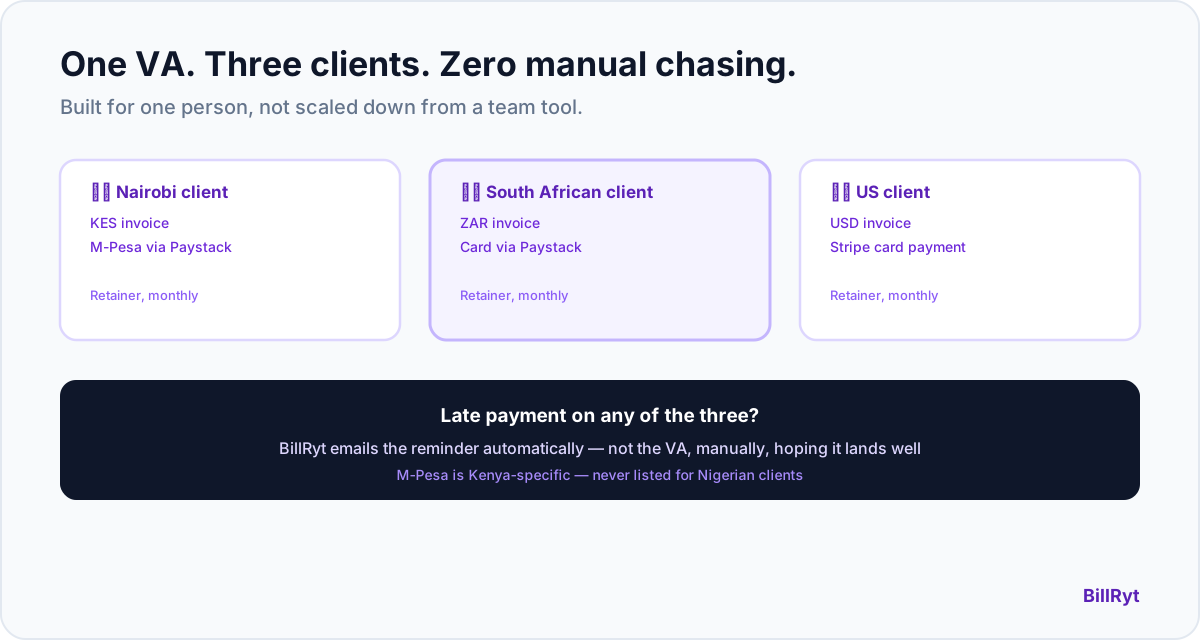
A VA in Nairobi supports three retainer clients: one local business paying in KES via M-Pesa, one South African client paying by card, and one US-based client paying in USD via Stripe. Each client gets an invoice in their own currency (multi-currency invoicing is free on every plan, including Free), with the payment method that actually works for them attached automatically. When a payment is late, BillRyt sends the reminder — not the VA, manually, hoping it doesn't read as pushy.
Simple pricing that matches solo work
The Free plan covers up to 12 documents a month with no client cap — enough to trial the whole workflow before committing to anything. Once you need online payment collection, recurring billing for retainers, or the client portal, Professional ($19/month) unlocks all of it: unlimited documents, all payment gateways, proformas, credit notes, statements, aging reports, and automated reminders. There's no separate "starter" tier that leaves out the features that actually save time — it's one plan with everything a solo operator needs.
A portal that doesn't ask clients to do more work
Retainer clients checking their balance shouldn't need a password they'll forget between billing cycles. BillRyt's client portal uses a magic-link login — the client enters their email, gets a secure link valid for 72 hours, and sees exactly what they owe, styled with your business name and colours, not a generic template. For a VA managing several ongoing relationships, that's one less "can you resend that invoice?" message per client per month.
Trying it before committing to anything
A VA weighing a new tool doesn't want to commit to a paid plan before seeing whether it actually fits how they bill. The Free plan removes that risk: up to 12 documents a month, no cap on how many clients you add, and multi-currency invoicing included from day one. That's enough to build real invoices for a real client relationship, see exactly how the workflow feels, and decide whether Professional's automation is worth $19/month before paying for it.
Recurring retainers, generated automatically
Most VA income is retainer-based — the same client, the same amount, every month. Re-creating that invoice by hand each cycle is exactly the kind of repetitive task a VA would automate for a client, so it's worth automating for yourself too. BillRyt's recurring billing generates and sends the invoice on schedule once you've set the amount and frequency, so a monthly retainer with three clients means three invoices that happen without you opening the app that day.
Looking professional without paying extra for it
Some invoicing tools reserve their better-looking templates for a higher tier, which is an odd thing to gate for a solo operator whose invoice often is the client's first impression of how seriously to take the relationship. All 10 of BillRyt's document templates are free on every plan, including Free — a VA doesn't need to upgrade just to send a document that looks like it came from an established business rather than a hastily filled-in form.
Everything in one place, even solo
The value of running all of this from one workspace compounds the busier a VA gets. Client records, invoice history, payment status, and reminders all live together, so switching between three retainer clients doesn't mean switching between three different tracking systems, each half up to date. That's arguably more valuable for a solo operator than for a large team — there's no one else to catch what a scattered system drops.
In short
Virtual assistant billing doesn't need a scaled-down enterprise accounting tool — it needs a system built around the actual shape of the work: several concurrent clients, recurring small amounts, payments arriving through different local rails, and follow-up that happens automatically instead of manually. That's the specific gap BillRyt's Professional plan fills for one person running client work solo.
Start free with up to 12 documents a month, then move to Professional ($19/month) when you're ready to turn on payments and reminders.