When you are a solo founder, every tool you adopt is a tax on the same scarce resource: your attention. You are building the product, talking to customers, doing support and, somewhere in the gaps, making sure money actually comes in. Invoicing should be the least of your worries and too often it is a recurring one — a fiddly template, a manual reminder you forgot to send, a client in another country asking which currency to pay in. This is what user-friendly invoicing looks like for a company of one, wherever in the world that one person happens to be.
Friendly means fast, not feature-stuffed
For a solo founder, "user-friendly" has a specific meaning: you can do the whole job in minutes without a manual. BillRyt is built to that standard. Add a client, add a few line items, send — as an email or a public link the client opens without an account. There is no chart of accounts to configure, no onboarding project, no finance vocabulary to learn first. The first invoice goes out in the time it would take to format a heading in a word processor.
That speed is not a lack of depth; it is depth pointed at the right job. Everything you need as a founder — quotes, recurring invoices, credit notes, automatic reminders, a client portal — is there when you want it, and out of the way when you do not.
Getting paid from anywhere, in any currency
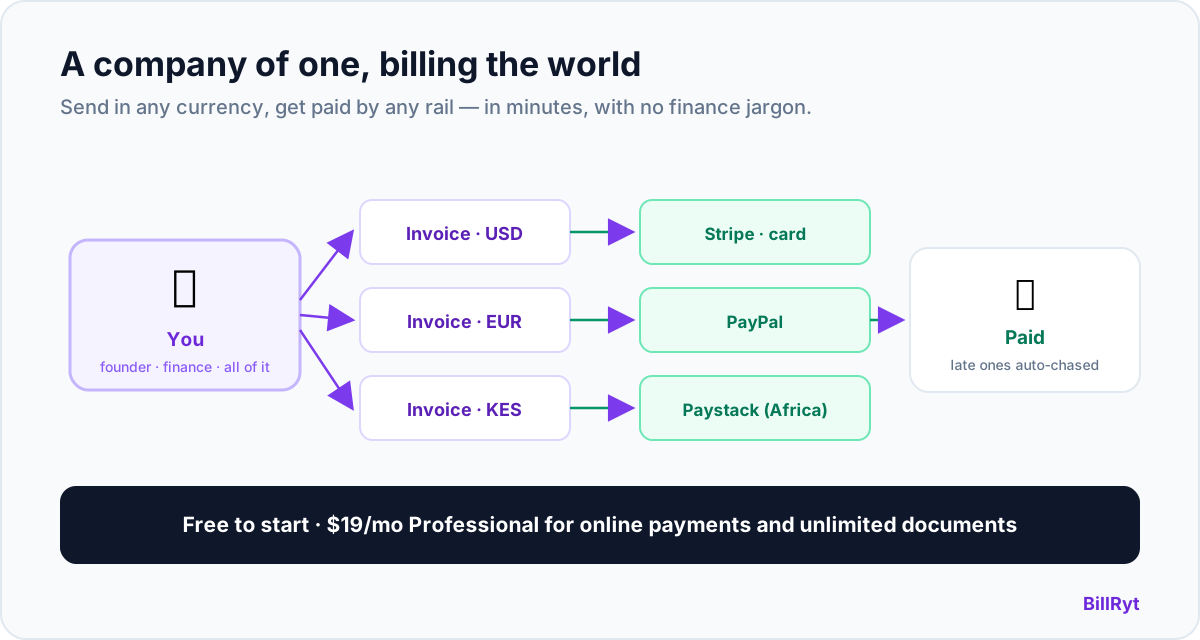
Solo founders are global now. You might be in Austin billing a client in Berlin, in Nairobi billing a client in London, or in Manila billing a client in Sydney. Currency and payment method are where amateur-looking invoicing quietly costs you money. BillRyt handles both:
- Multi-currency, per client. Invoice in USD, GBP, EUR, KES, NGN or more — each invoice denominated and taxed correctly, so a client never has to "work out the conversion."
- The payment rails your clients actually use. Connect your own Stripe for card payments worldwide, PayPal for clients who prefer it, and Paystack for African clients paying by bank transfer, USSD or M-Pesa (in Kenya). Each client pays the native way and the invoice marks itself paid.
You look like an established company to a client on the other side of the planet, because the invoice speaks their currency and offers a payment method they recognise.
The founder's real enemy: chasing payment
The single most draining part of solo billing is following up. You did the work, sent the invoice, and now you are the awkward person emailing "just checking in" — except you are also busy, so you forget, and the payment slips a month. BillRyt takes this off your plate with automatic reminders: overdue invoices chase themselves on a schedule you set, in a professional tone, without you having to be the nag. Recurring invoices go further — retainer and subscription clients are billed automatically every cycle, so revenue you already earned does not wait on you to remember to ask for it.
A worked example
You are a solo founder in Lisbon. This month you bill a US customer 2,500 USD, an EU customer 1,800 EUR, and a Kenyan customer 90,000 KES. You create three invoices in three currencies in a few minutes. The US and EU customers pay by card through your Stripe (or PayPal, if they prefer); the Kenyan customer pays by M-Pesa through your Paystack. All three mark themselves paid, your outstanding number updates itself, and the one client who is slow gets a polite automatic nudge three days after the due date — sent while you were shipping a feature, not thinking about accounts. That is a finance function you did not have to staff.
What it costs a company of one
You can start on the free plan — send professional invoices and quotes, share a public link, record payments manually — with no card. When you want clients to pay online and you want unlimited documents, Professional at $19/month is the founder's plan: every document type, recurring billing, the client portal, automatic reminders, and all three payment rails, with no team or accounting overhead you do not need yet. It is the full solo toolkit without the accounting complexity — priced for one person, built for one person.
Growing past solo
If you hire and become a team, the same account grows with you: Agency ($29) adds team seats and included accounting; Merchant ($39) adds inventory. You do not migrate tools when you stop being solo — you just turn on what you need. But until then, nothing about BillRyt makes you pay for, or learn, features a company of one does not use.
The five-minute test for founder-friendly invoicing
Here is a quick way to judge any invoicing tool as a solo founder: time yourself. How long from signing up to sending a real invoice? In a founder-friendly tool it is minutes, with no manual and no finance vocabulary in the way. Then check three more things. Can you bill a client in another currency without buying an add-on? Will overdue invoices chase themselves, or is following up back on your plate? And can you read the entire price list in one glance, with no surprise per-invoice fee or payment markup? A tool that passes all four respects the one resource a founder cannot buy back — attention — and gets out of your way so you can return to building. One that makes you sit through setup, or hides the real cost until you try to collect, is quietly taxing the thing you have least of. BillRyt is designed to pass the test on the first try.
In short
Solo founders need invoicing that respects the one thing they cannot spare: attention. That means sending an invoice in minutes with no finance vocabulary, billing clients anywhere in their own currency, offering the payment rails they actually use — Stripe and PayPal worldwide, Paystack for Africa — and letting reminders and recurring invoices chase and re-bill so you do not have to. BillRyt does exactly that, free to start and $19/month when you want online payments, and it grows into a team tool the day you need one. Getting paid should be the easy part of building a company; for a founder of one, this is how it becomes that.
You can start free and send your first invoice in the next few minutes, from anywhere in the world.