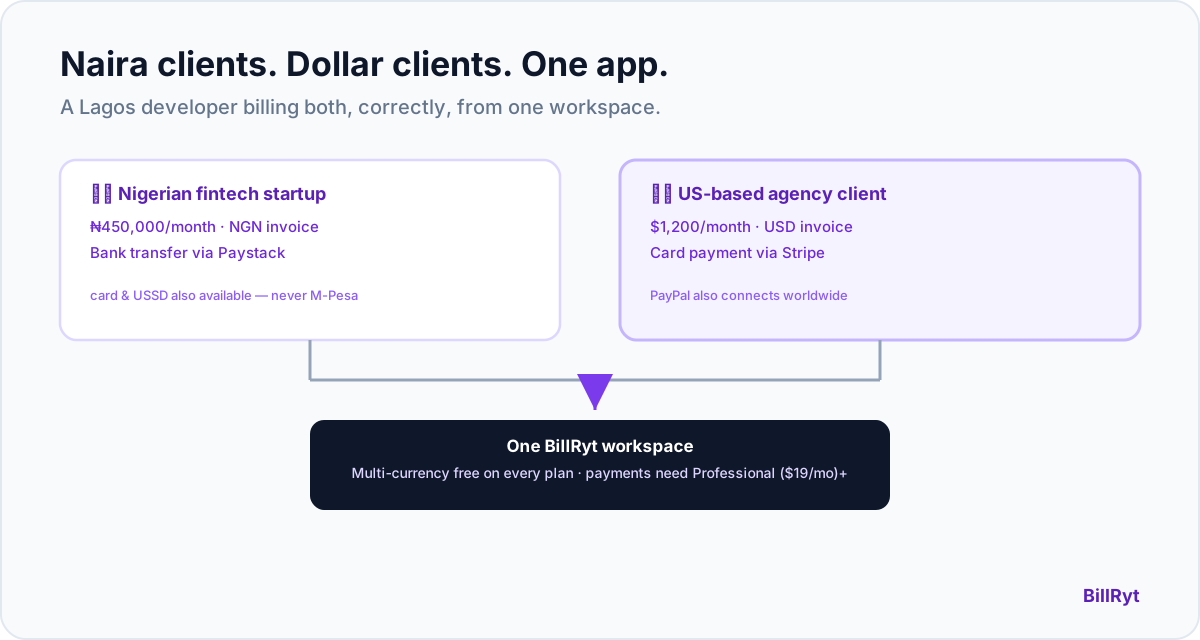
A Nigerian developer or designer freelancing rarely bills just one type of client. There's the local startup paying in naira by bank transfer, and there's the international client — a US agency, a European product team — paying in USD or GBP. Tools built around one currency and one payment rail treat the second kind of client as an afterthought. Here's an invoicing setup built for both from the start.
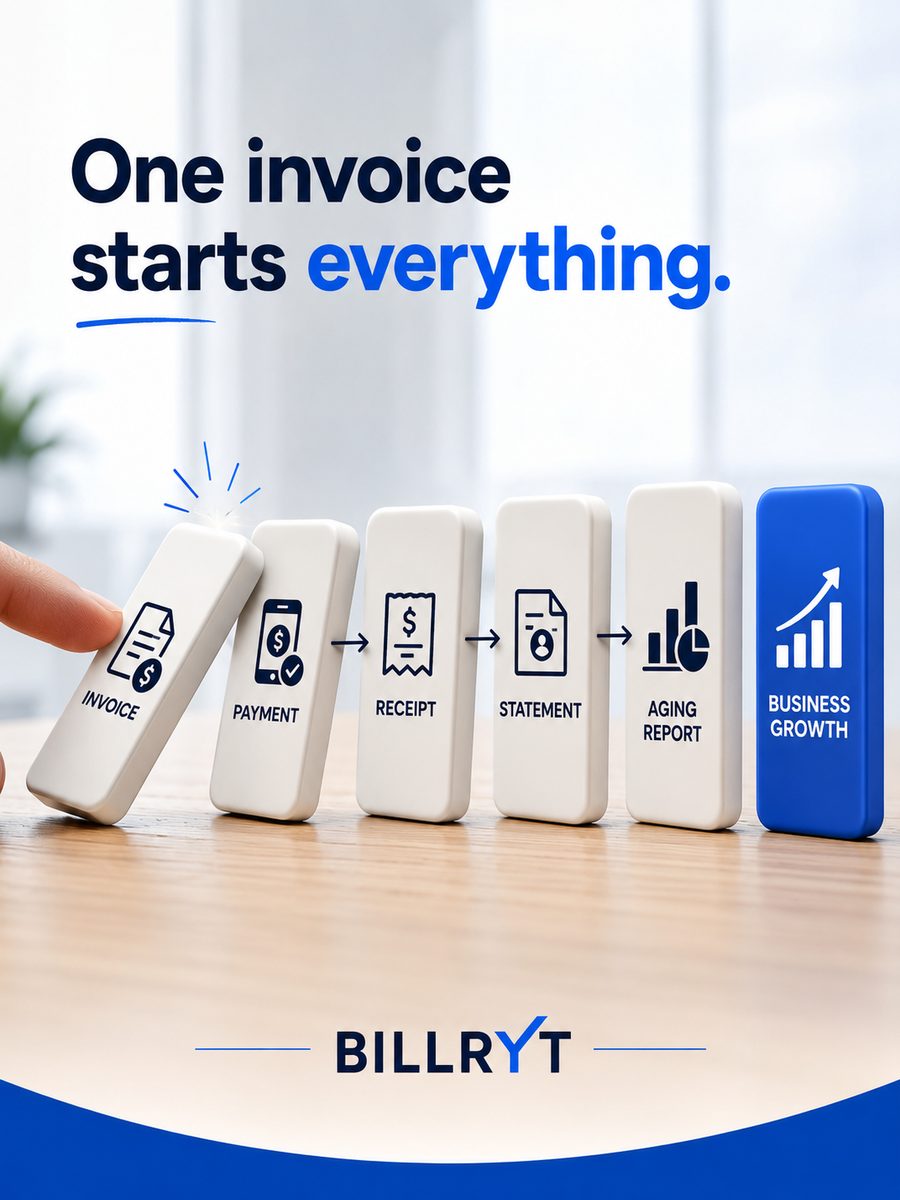
One invoice starts everything
The whole billing relationship — get paid, get a record of it, follow up if it's late, eventually show a client their full history — starts with one invoice sent correctly. BillRyt's pipeline covers that full arc: invoice, payment tracking, automatic receipt on payment, statement of account, aging report if something goes overdue, and the reporting that shows whether the work is actually paying enough to keep doing.
Local payments that actually fit Nigeria
For Nigerian clients, BillRyt connects Paystack — card, bank transfer, and USSD. That's the accurate set of rails for Nigeria; M-Pesa is a Kenyan (and Tanzanian/Mozambican) mobile-money system and was never a Nigerian payment method, so it doesn't appear as an option here. A local client paying a Lagos-based developer sees the payment methods that are actually normal for them, not a generic international checkout that assumes a card.
International clients paid the way they expect
For clients outside Africa, BillRyt connects Stripe and PayPal, covering card payments worldwide. A Nigerian freelancer billing a US or UK client can invoice in USD or GBP directly — multi-currency invoicing is available on every plan, including Free — and let the client pay through a gateway they already trust, without needing a foreign bank account or a third-party invoicing workaround just to receive international payment.
A worked example
A backend developer in Lagos has two active clients: a Nigerian fintech startup paying ₦450,000/month by bank transfer, and a US-based agency paying $1,200/month via Stripe. Both invoices come from the same BillRyt workspace, in their respective currencies, with the payment method that actually applies to each client attached automatically. When the naira invoice is overdue, an automatic email reminder goes out — no manual "just checking in" message required.
Getting online payments running
Sending invoices and tracking payments manually works on the Free plan (up to 12 documents/month, no client cap) — good for testing the workflow. Turning on online payment collection (Paystack, Stripe, or PayPal) requires Professional ($19/month), which also unlocks unlimited documents, proformas, credit notes, statements, aging reports, automated reminders, recurring billing, and the client portal — the full toolkit a freelancer juggling local and international clients actually needs, in one plan.
A portal for clients who check in occasionally
International clients who pay monthly don't want to create an account just to see their invoice history. BillRyt's client portal uses a passwordless magic-link login — the client enters their email, gets a secure 72-hour link, and sees their invoices and balance styled with your business branding. No password for them to forget between billing cycles, and no "can you resend the last three invoices?" message for you to answer.
Recurring contracts, not just one-off gigs
A lot of tech freelance work is ongoing — a monthly retainer maintaining a client's app, a recurring support contract, a subscription-style arrangement with an agency client. Re-invoicing the same client by hand every month is exactly the kind of manual task a developer would never accept in their own code. BillRyt's recurring billing generates and sends these invoices on schedule automatically, in whichever currency that client is billed in, so an ongoing ₦200,000/month maintenance contract and a one-off $800 project both run through the same workspace without extra manual work each cycle.
Trying it before paying for anything
The Free plan covers up to 12 documents a month with no cap on the number of clients — enough to send real invoices to real clients and see exactly how currency selection, templates, and the dashboard work before deciding whether Professional's automation and payment collection are worth $19/month.
Quoting a project before it starts
Tech freelance work — a new feature build, a website, an integration — usually starts with a scope and a price the client agrees to before any code gets written. BillRyt's quote builder handles that step directly: send a professional quote, the client approves it, and it converts in one click into a proforma invoice (useful for requesting a deposit before starting) and then the final invoice once the work is delivered. Nothing gets retyped between stages, and all 10 document templates are free on every plan, so the quote looks as professional as the finished invoice.
Knowing your actual position across both client types
Mixing local naira invoices and international dollar invoices makes "what did I actually earn this month" harder to answer by memory or a manually maintained spreadsheet — the numbers aren't in the same unit until someone converts them. BillRyt's dashboard shows revenue and outstanding balances broken down by currency and auto-converted into one overall total, so a developer with both kinds of clients has one real number for the month instead of two separate ones sitting side by side, unreconciled.
In short
A Nigerian tech freelancer's invoicing needs to treat local naira clients and international dollar clients as equally normal, not as a main case and an edge case bolted on. Real Paystack rails (card, bank transfer, USSD) for local clients, real Stripe/PayPal support for international ones, multi-currency by default, quotes and proformas for work that starts with a scoped proposal, and automated follow-up when a payment runs late — that combination is what an invoicing tool actually built for this specific reality looks like, rather than a generic template with a currency dropdown bolted on afterward.
Start free to send your first invoice, then move to Professional ($19/month) to turn on payments and automation.