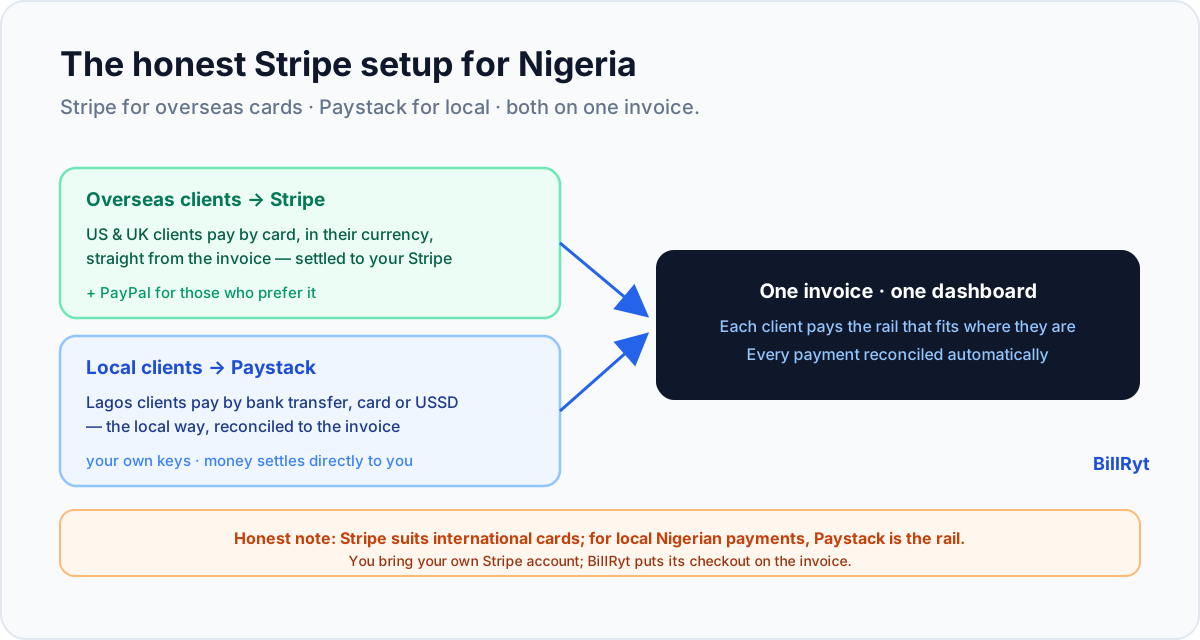
"How do I collect Stripe payments in Nigeria?" is one of the most common questions from Nigerian businesses selling to the world — and it deserves an honest answer rather than a sales pitch. Stripe is the smoothest way to take a card from a client in the US, UK or EU. The realistic setup for a Nigeria business is to use Stripe for exactly that — international card payments from your overseas clients — and Paystack for your local Nigerian clients, with both living on the same invoice. Here is how that works in practice.
The honest picture first
Stripe is built around card payments and is available to businesses in a specific set of countries. Your overseas clients — the ones in New York, London or Berlin — can pay you by card through Stripe with almost no friction, provided you have a Stripe account you can use. For payments from clients inside Nigeria, the natural rail is Paystack, which handles local cards, bank transfers and USSD the way Nigerian customers actually pay. So the practical answer to "collect Stripe payments in Nigeria" is not "replace everything with Stripe" — it is "use Stripe for the international card payments it is great at, and Paystack for local," on one invoice. BillRyt is built to do exactly that, with your own keys for each.
Use Stripe for your overseas clients
Connect your Stripe account in BillRyt and any invoice you send to an overseas client can be paid by card, in the client's own currency, straight from the document. The client opens a link — no account — sees a clean invoice in USD, GBP or EUR, taps Pay, and settles by card. The money goes to your Stripe balance and BillRyt marks the invoice paid automatically. There is no international bank transfer for the client to fill in, and no payment for you to match by hand afterwards — because it was initiated from the invoice, it reconciles to that invoice on its own.
Use Paystack for your local clients
For clients inside Nigeria, connect Paystack and they pay the same invoices by bank transfer, card or USSD — the local way — also reconciled automatically. So a single BillRyt account collects from a New York client by Stripe card and a Lagos client by bank transfer, each on their own invoice, each in the right currency, all in one dashboard. Add PayPal too for overseas clients who prefer it, and you have all three rails on one workflow.
A worked example
This month you invoice a US client 3,000 USD, a UK client 2,200 GBP, and a Lagos client 1,500,000 NGN. The US and UK clients open their invoices and pay by card through your Stripe; the Lagos client pays by bank transfer through your Paystack. All three mark themselves paid, and your dashboard shows USD, GBP and NGN distinctly. Your international card payments came in through Stripe exactly as you wanted, and your local client paid the local way — no single-rail compromise, no second tool.
Why "your own keys" matters here
Because you connect your own Stripe, Paystack and PayPal accounts, BillRyt never sits between you and your money. Each client pays through the rail that is cheapest and most natural for them, and the funds settle directly to your gateway balance at the gateway's standard rate — BillRyt earns from a flat subscription, not a slice of your payments. The economics of a Stripe card payment are between you and Stripe; the tool just puts the checkout on the invoice and reconciles it.
Where it fits in your plan
Online collection — connecting Stripe, Paystack and PayPal so clients pay on the invoice — starts on the Professional plan ($19/month). This post recommends Agency ($29/month) for a Nigeria business collecting across borders, because it adds up to 15 team seats and includes full accounting (BillRyt Books), so your international and local income feed one set of books. On the free plan you can still build and send the invoices (in any currency) and record payments manually while you set up your gateways.
The realistic bottom line
If you can use Stripe, it is the best way to take international card payments into your Nigeria business — and BillRyt puts that Stripe checkout right on your invoices. What it will not do is pretend Stripe is the local rail; for Nigerian clients, Paystack is, and BillRyt carries both so you never have to choose. That honesty is the point: you get the smooth international card experience where Stripe applies, the local experience where Paystack applies, and one dashboard and one set of books over both.
What your overseas client sees
The client experience is what turns a dollar invoice into a fast payment. Your client in New York or London opens a link — no account, no password — and sees an invoice in their own currency with a single Pay button. They tap it, pay by the card they use for everything else (or by PayPal), and they are done; the invoice shows Paid. What they never encounter is a Nigerian account number, a SWIFT form, or a request to work out an exchange rate — the exact frictions that make an overseas client set an invoice aside for "later." Removing them is the difference between being paid this week and chasing for a month. And on your side, because the payment was initiated from the invoice, it attaches to the right invoice automatically, so there is nothing to match against a bank statement afterward. The Stripe checkout does the collection; BillRyt does the reconciliation.
In short
Collecting "Stripe payments in Nigeria" really means using Stripe for card payments from your overseas clients and Paystack for your local ones — and BillRyt puts both on the same invoices, on your own keys, each reconciled automatically into one dashboard and, on Agency, one set of books. International clients pay by card in their own currency; Nigerian clients pay by bank transfer, card or USSD; nobody is forced onto a rail that does not fit where they are. Online collection starts on Professional ($19); Agency ($29) adds team and books. It is the honest, working setup for a Nigeria business that sells to the world.
You can start free to build invoices in any currency, then connect Stripe for overseas cards and Paystack for local clients.