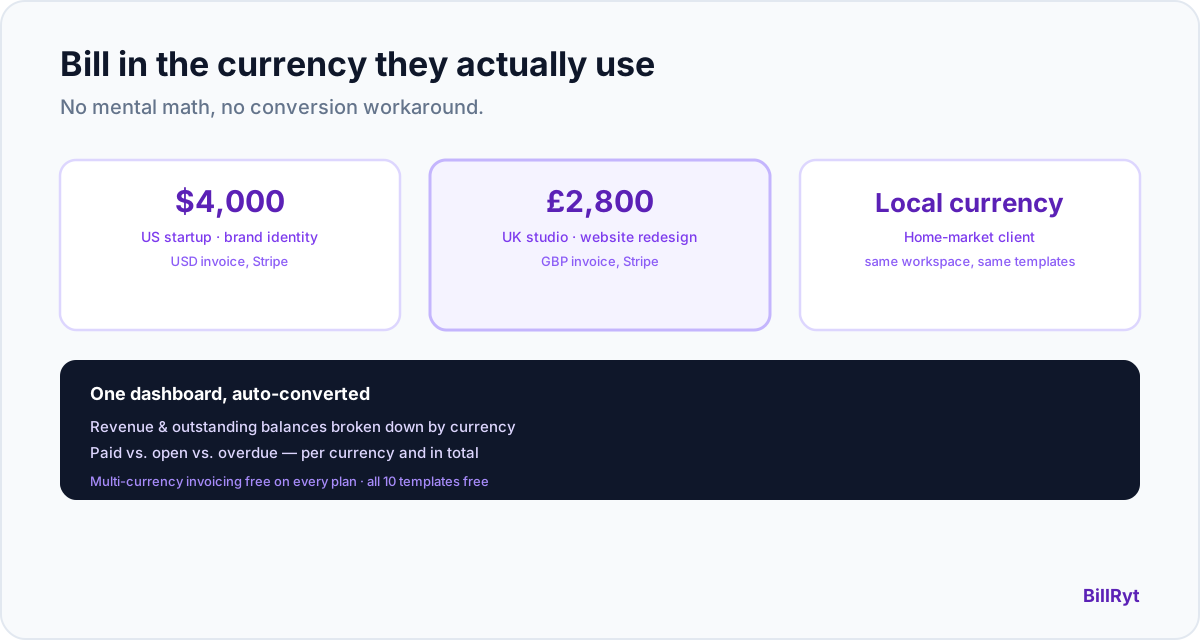
Design work travels. A freelance designer's clients are rarely all in one country, which means the invoices shouldn't all be in one currency either — a brand identity project for a US startup, a website for a UK agency, a local client paying in your home currency. Manually converting every invoice to your own currency, or worse, asking clients to figure out the conversion themselves, is friction that costs you nothing to remove.
Numbers your client actually recognizes
An invoice in a currency your client doesn't use day-to-day requires them to do mental math before they even know if the price feels right. Quoting and invoicing in the client's own currency — USD for a US client, GBP for a UK client, EUR for a European one — removes that step entirely. It reads as a number they immediately understand, not an amount they have to convert to know what they're actually paying.
Multi-currency, not gated behind a higher plan
BillRyt sets the currency per invoice, and multi-currency invoicing is available on every plan, including Free — it isn't held back as a premium feature the way it is on some tools. A designer with one Free-plan trial invoice to a US client and one to a local client can set each to the right currency without upgrading just to unlock the option.
Real-time revenue, actually broken down by currency
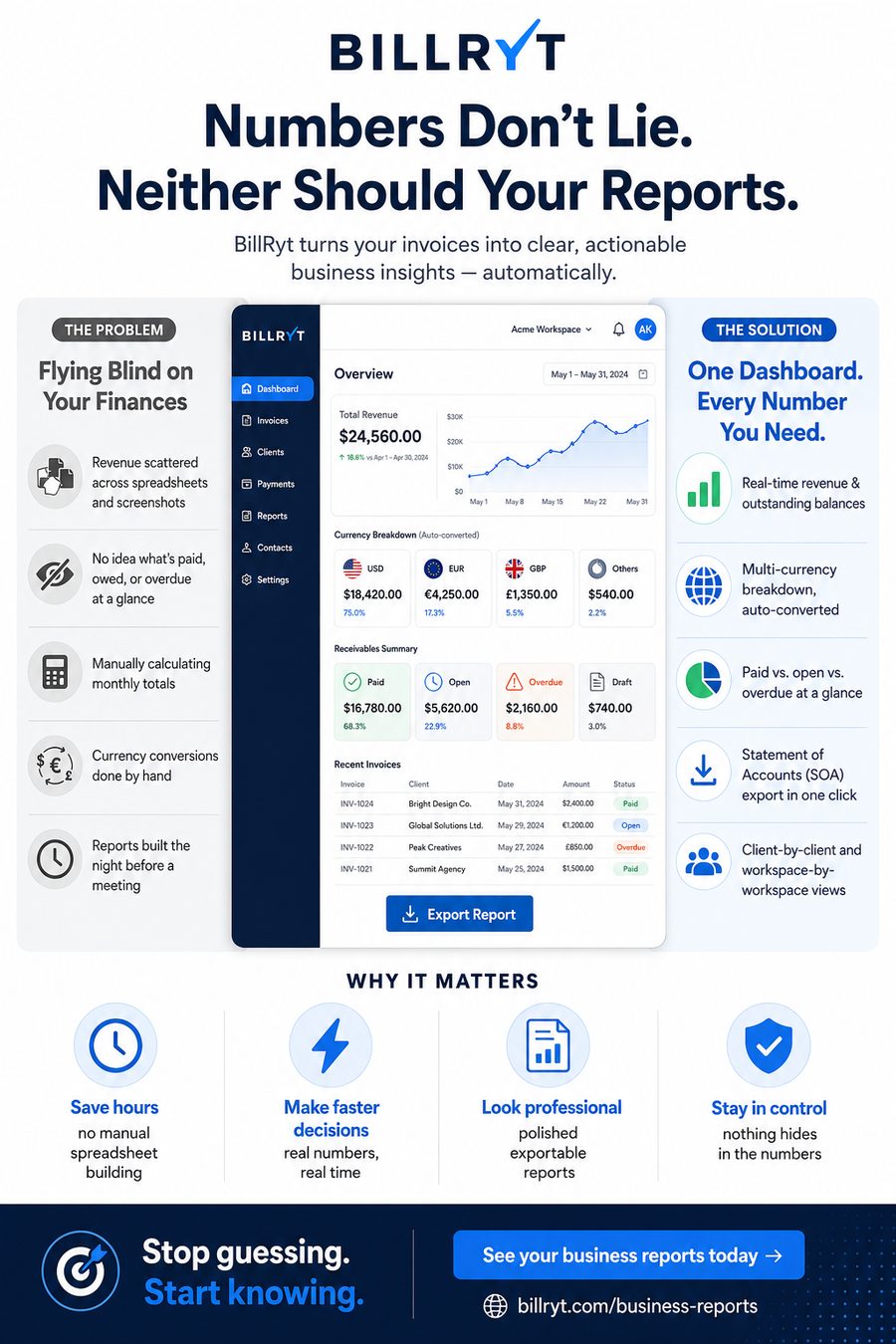
Beyond the invoice itself, BillRyt's dashboard shows revenue and outstanding balances broken down by currency, auto-converted so you have one real picture of your finances instead of adding up amounts in different currencies by hand and hoping the total means something. Paid versus open versus overdue is visible at a glance, per currency and in aggregate.
Getting paid, wherever the client is
Once the invoice is right, collection needs to match the client's location too. Stripe and PayPal connect for clients anywhere in the world — the natural fit for US, UK, and European clients paying by card. Paystack covers African clients specifically, including M-Pesa for Kenyan clients. Online payment collection through any of these requires the Professional plan ($19/month) — the Free plan covers document creation and multi-currency invoicing, but not payment collection.
A worked example
A freelance brand designer has three active projects: a $4,000 identity package for a US startup, a £2,800 website redesign for a UK studio, and a local project quoted in her home currency. Each client gets an invoice in their own currency, with Stripe handling both international payments. The dashboard shows all three converted into one total, so she knows her actual monthly revenue without doing the arithmetic herself.
Every template, every currency
Design-conscious freelancers care how their invoices look, and BillRyt doesn't gate the nicer templates behind a higher tier — all 10 document templates are free on every plan, and every one of them supports whatever currency you've set for that invoice. Your brand colour and logo carry through consistently regardless of which currency or template a given client's invoice uses.
Letting international clients check in without a password
A client on another continent who wants to confirm a payment landed or check what they still owe shouldn't need to email you and wait for a reply in your time zone. BillRyt's client portal gives them direct, self-service access — a passwordless magic-link login (a secure, 72-hour, single-use link sent to their email) that shows their invoices, balance, and full statement history, styled with your logo and brand colour rather than a generic template. For a client you deal with a few times a year across a time-zone gap, that removes an entire category of "just checking in" back-and-forth.
Retainer design work, invoiced automatically
Not all design work is project-based — ongoing brand or content retainers bill the same amount monthly, and re-creating that invoice by hand every cycle is time a designer would rather spend designing. BillRyt's recurring billing generates and sends these invoices on schedule automatically, in the client's currency, so a $1,500/month retainer with a US client runs itself once it's set up.
Quoting a project before the brief is final
Design engagements usually start with a quote — a proposed scope and price the client signs off on before work begins, often adjusted once as the brief firms up. BillRyt's quote builder handles that: send a quote in the client's currency, get it approved, and convert it in one click into a proforma (for a deposit) and then the final invoice, without rebuilding the line items each time the document changes stage. If scope shifts mid-project, a credit note adjusts the total cleanly rather than you manually editing an already-sent invoice.
When a project changes scope mid-stream
Design work shifts — a client adds a round of revisions beyond what was scoped, or trims a deliverable after the quote was approved. Rather than manually editing an already-sent invoice (and risking a client wondering why the numbers changed), a credit note applies the adjustment cleanly against the original document, in the same currency, with a clear record of what changed and why. That record matters more for international clients specifically, since a currency-and-scope discrepancy is much harder to sort out over email once time zones and a language gap are both in play.
In short
A freelance designer working internationally needs invoicing that treats every currency as the normal case, not a workaround for the "foreign" client. Per-invoice currency on every plan, a dashboard that actually converts and totals your real revenue, quotes that carry through cleanly to the final invoice, and payment gateways matched to where each client actually is — that's what removes the manual conversion step entirely, rather than just making the workaround look a little tidier.
Start free to send your first multi-currency invoice, then move to Professional ($19/month) to turn on payment collection.