An African startup is cross-border almost by definition. You might be built in Lagos, incorporated with a US entity, selling to customers in Nairobi and London, and paying contractors in Accra — all before you have a finance hire. The billing has to work across all of that from day one, and most tools force you to choose a home market and treat the rest as an afterthought. This is how to run cross-border billing for a startup that lives in several markets at once, without stitching tools together.
The specific pain of a startup that spans markets
The problem is not any single payment — it is the combination. Your customers pay in different currencies through different rails: a Kenyan customer wants M-Pesa, a Nigerian customer wants a bank transfer, a UK customer wants a card, a US investor's portfolio company wants to pay by PayPal. Your revenue arrives fragmented across a local processor here and an international one there, and your books never quite agree until someone reconciles them by hand. For a small team moving fast, that reconciliation tax is real drag — hours a month spent assembling a picture of your own cash that should be obvious.
A cross-border billing platform exists to collapse all of that into one workflow. That is what BillRyt is built for.
One platform, every rail, every currency
BillRyt puts all the payment rails on the same invoices, using your own keys for each:
- Stripe — card payments from customers anywhere in the world.
- PayPal — for customers and partners who prefer it.
- Paystack — for African customers paying by card, bank transfer, USSD, mobile money, or M-Pesa (in Kenya).
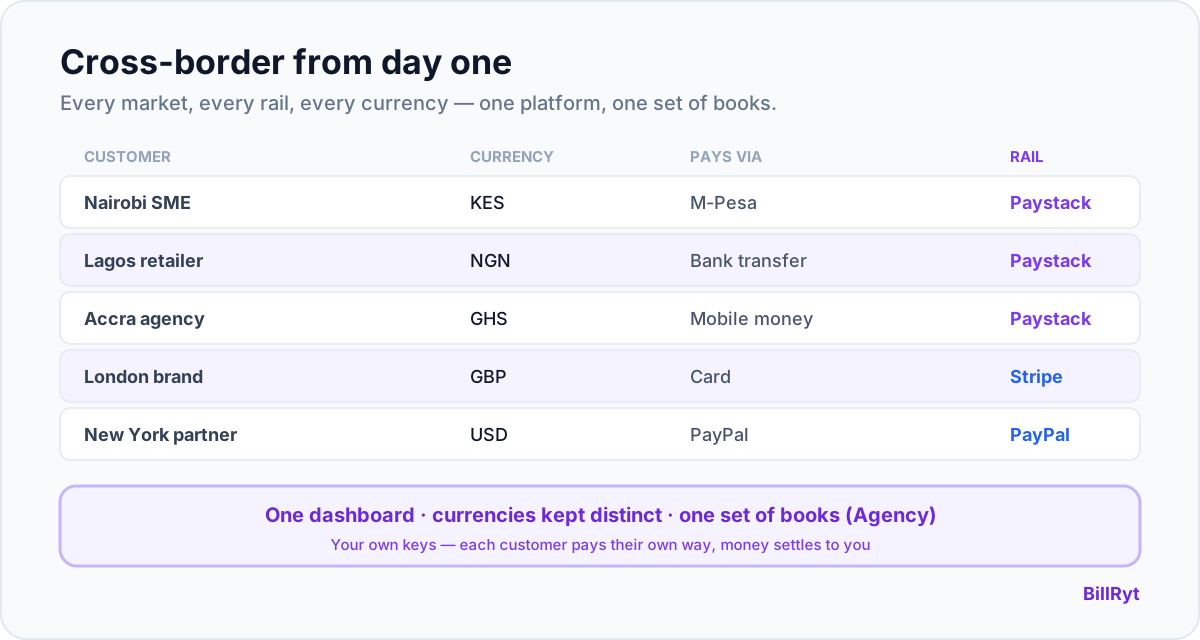
Every invoice can be denominated in the customer's own currency — USD, GBP, EUR, NGN, KES, GHS and more — totalled and taxed correctly. A Nairobi customer sees a KES invoice and pays by M-Pesa; a London customer sees a GBP invoice and pays by card; an Accra customer pays by mobile money; a US partner pays by PayPal. Same platform, same dashboard, one set of books — and your reporting keeps the currencies distinct rather than blending them into a meaningless total.
A worked example
Your startup closes five deals in a month:
| Customer | Currency | Pays via |
|---|---|---|
| Nairobi SME | KES | Paystack (M-Pesa) |
| Lagos retailer | NGN | Paystack (bank transfer) |
| Accra agency | GHS | Paystack (mobile money) |
| London brand | GBP | Stripe (card) |
| New York partner | USD | PayPal |
On a single-market tool, two or three of these would be a manual mess. On BillRyt they are five ordinary invoices; each customer pays the native way, every payment reconciles to its invoice, and your dashboard shows five currencies side by side. You served three African markets and two international ones from one screen — the exact shape of an international and African client base.
Books and a team, without a finance department
Startups need clean books earlier than they think — for investors, for tax, for knowing their runway. The Agency plan ($29/month) includes full accounting (BillRyt Books) and up to 15 team seats, so your cross-border revenue feeds proper double-entry books automatically and your founders and first ops hire work in one workspace. You get investor-ready records without hiring a bookkeeper to reconcile two payment systems by hand every month.
Start lean, scale the plan
You do not need to commit up front. Start on the free plan to build and send multi-currency invoices and record payments manually — enough to bill your first customers in any currency. When you are ready to collect online across rails, Professional ($19/month) switches on Stripe, PayPal and Paystack and removes the free document limit; Agency ($29) adds the team seats and books a growing startup wants. The platform scales with you rather than forcing a migration when you outgrow "local only."
Why "your own keys" protects a startup's margin
Because you connect your own Stripe, PayPal and Paystack accounts, each customer pays through the rail that is cheapest and most natural for them, and the money settles directly to you. BillRyt earns from a flat subscription, not a slice of your payments — so a local M-Pesa payment costs you the local rate, an overseas card costs you the card rate, and nothing extra is skimmed in the middle. For a startup counting every point of margin, letting each customer pay their own way is not just convenience; it is money kept.
What to check when choosing a platform
If you are a startup weighing billing tools, five questions separate a genuine cross-border platform from a single-market tool with a currency field. Can it collect on the rails your customers actually use in each market — M-Pesa in Kenya, mobile money in Ghana, bank transfer in Nigeria, cards and PayPal abroad? Does it denominate each invoice in the customer's own currency and keep currencies distinct in reporting, or does it quietly blend them? Does the money settle to your own gateway accounts, so you keep the local rate and no one skims the middle? Does it produce books you could hand an investor without a month of cleanup? And does it scale from a free tier to a team plan without a migration when you grow? A tool that answers yes to all five is a platform you can build a cross-border company on; one that does not will have you bolting on a second system the moment you win a customer in a new market. BillRyt is built to answer yes to every one.
In short
An African startup is cross-border from day one, and its billing has to be too. BillRyt is one platform with every rail — Stripe and PayPal for the world, Paystack for African customers including M-Pesa in Kenya and mobile money in Ghana — plus full multi-currency invoicing and, on Agency, included accounting and a team. Your KES, NGN, GHS, GBP, USD and EUR revenue all lands in one dashboard and one set of books, on your own keys, with no reconciliation tax. Start free, scale the plan, and never run two billing systems just because your customers live in more than one country.
You can start free to bill your first customers in any currency, then connect the rails as you grow.