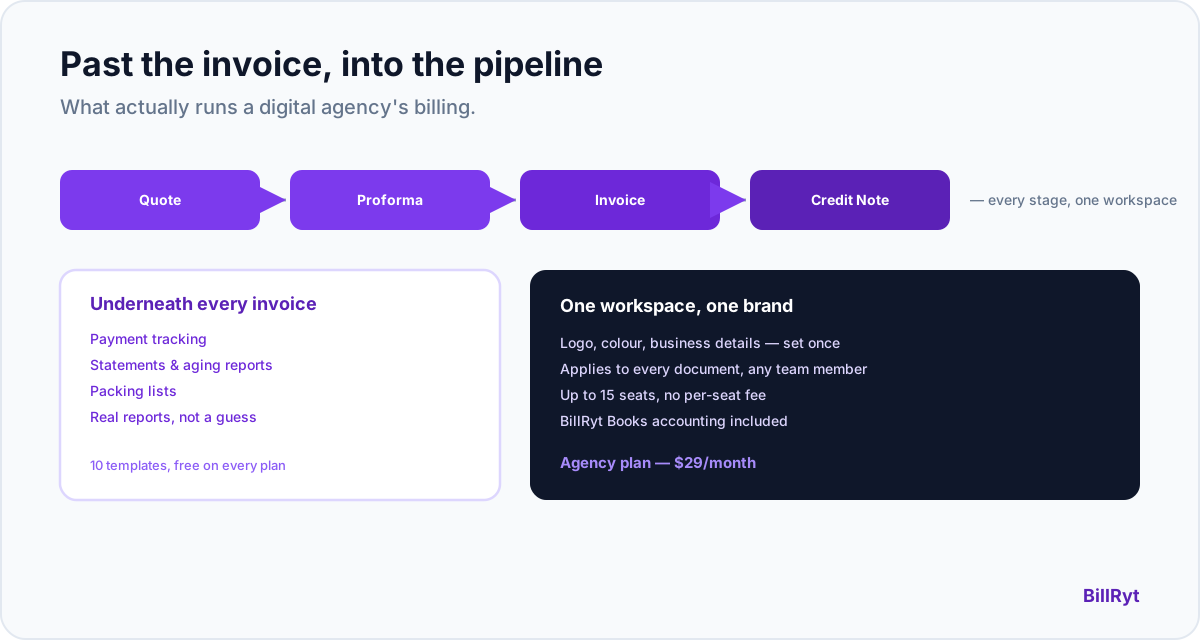
Most people evaluating a "billing app" only look at one thing: does it make a clean-looking invoice? That's the visible tip of what a digital agency actually needs. Underneath every invoice you send is a quote that got approved, a proforma the client signed off on, maybe a credit note when scope changed, and eventually a statement showing what's still outstanding across every client you bill. A tool that only does the invoice leaves everything else as spreadsheets and email threads. Here's what a billing app built for a digital agency's real workflow looks like.
The visible layer vs. what actually runs the business
Send Invoice is the part every client sees. Underneath it, an agency needs payment tracking (who's paid, who hasn't, and by how much), credit notes (for the inevitable scope adjustment or refund), statements (a client's full running balance, not just one invoice), aging reports (which overdue amounts need chasing first), packing lists (if you ship anything physical), and reports that tell you your actual revenue position, not a guess from memory. A billing app that only handles the first layer is doing a fraction of the job a digital agency needs done.

The full document pipeline, not just invoices
A digital agency's real workflow usually starts before an invoice exists at all: a quote goes out, the client approves it, it converts in one click to a proforma invoice for upfront deposits or client sign-off, and then converts again to the final invoice once work is delivered. If scope changes or a refund is needed, a credit note applies against the original invoice rather than you manually adjusting totals by hand. BillRyt runs this entire pipeline — quote → approval → proforma → invoice → credit note — inside one workspace, with every stage visible to your whole team, not buried in one person's inbox.
Branding that survives a growing team
As a digital agency adds people, the risk is that everyone's documents start looking slightly different — a different template, an inconsistent logo placement, a colour that's "close enough." BillRyt fixes this by putting branding on the workspace, not the individual sender: your logo, brand colour, and business details are set once and apply automatically to every quote, proforma, invoice, credit note, and portal view any team member creates. All 10 document templates are free on every plan — there's no premium template tier gatekeeping which one looks the most professional.
Knowing what's actually outstanding
An agency juggling a dozen active clients cannot track receivables from memory. BillRyt's aging report buckets outstanding balances into 0–30, 31–60, 61–90, and 90+ days overdue, so you know exactly which accounts need a nudge and which need an actual conversation. Pair that with automated email payment reminders (sent before and after the due date, without you having to remember to send them manually) and the awkward "did they ever pay that?" guesswork mostly disappears.
Where a team actually collaborates
On BillRyt's Agency plan ($29/month), up to 15 team members work from the same workspace with no per-seat fee — the price doesn't climb every time you hire. Every team member sees the same client records, the same document history, and the same aging report, so account handoffs between people don't mean re-explaining a client's whole billing history. Agency also includes BillRyt Books accounting, so your agency's revenue reconciles automatically instead of living in a separate spreadsheet someone updates once a month if you're lucky.
Giving clients self-service access, without extra work
Digital agency clients ask for the same things repeatedly: "what's my current balance," "can you resend that invoice," "do you have a statement for my records." BillRyt's client portal answers all three without a support request reaching your inbox — clients log in with a passwordless magic link (a secure, 72-hour, single-use link, not a password to manage), and see their invoices, balance, and full statement history styled with your agency's own branding. For an agency fielding these requests from a dozen active clients, that's a meaningful number of emails that simply stop arriving.
Recurring revenue, handled the same way
Not every agency engagement is a one-off project. Retainer clients — the ones paying monthly for ongoing work — need invoices generated on schedule without someone manually re-creating them every 30 days. BillRyt's recurring billing handles this automatically: set the amount, frequency, and client once, and the invoice generates and sends itself going forward, carrying the same workspace branding and payment options as every other document.
What an agency owner sees without asking around
Running a digital agency usually means not being in every client conversation personally, which makes the dashboard the actual source of truth rather than whatever the last status update from a project lead said. BillRyt's dashboard shows total revenue, outstanding balances, and an aging report broken into 0–30, 31–60, 61–90, and 90+ day buckets — updated the moment a payment lands, not the next time someone remembers to update a spreadsheet. For an owner managing several client relationships at once through a team, that's the difference between knowing the agency's real financial position and reconstructing it from memory before a partner meeting.
In short
A digital agency's billing needs go well past "generate a nice-looking invoice." The real requirements are a full document pipeline (quote through credit note), consistent team-wide branding, real visibility into what's outstanding, a client portal that answers routine questions without a support ticket, and a team plan that doesn't punish growth with per-seat pricing. That's the layer underneath the invoice that actually determines whether an agency's billing is genuinely under control, or just held together with memory, good intentions, and an ever-growing email search history.
Start free to try the document pipeline, then move to Agency ($29/month) when your team needs shared access.