Per-seat pricing is the quiet budget-killer of team software. A tool that looks affordable at one price per user becomes expensive fast the moment you add a fifth, tenth, or fifteenth team member — and the bill keeps climbing every time you hire. Billing software should not work this way, because the whole point of a team plan is to let your team grow into it. Here is how BillRyt prices team access instead: flat, with no per-seat charge, ever.
What "no per-seat fees" actually means
On BillRyt, team access is included in the plan price, not billed per person:
- Professional ($19/month) is single-user — no team seats, built for solo operators.
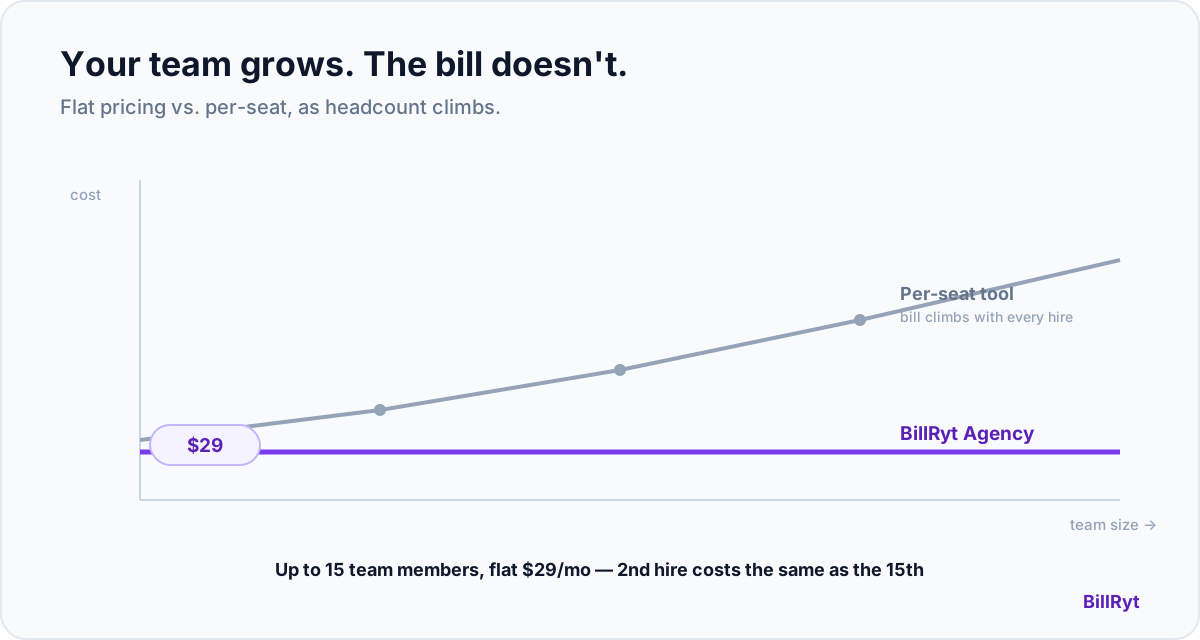
- Agency ($29/month) includes up to 15 team members, all for the same $29. Adding your 2nd teammate costs the same as adding your 15th: nothing extra.
- Merchant ($39/month) includes up to 20 team members, same principle.
There is no "$5 per additional user" line that creeps up as you hire. You pay the plan price once, and your team fits inside the included seat count for free.
Why this matters more than it sounds
Per-seat pricing punishes exactly the moment a business is succeeding: you are growing, you hire someone, and your software bill grows with you — often faster than your revenue does in the short term. It also creates a strange incentive to under-staff a tool, keeping people out of the system they should be using just to avoid another line on the invoice. Flat team pricing removes both problems. Adding your new account manager, or bringing on a part-time bookkeeper, is a decision about whether they need access — not a budget conversation.
A worked example
You run a 6-person agency on the Agency plan at $29/month. You hire two more people over the next year — a 9th and 10th team member would still cost you exactly $29/month, because you're within the included 15 seats. Compare that to a per-seat tool at $8/user/month: the same growth from 6 to 10 people would have taken your bill from $48 to $80 — a 67% increase driven entirely by headcount, with the tool doing nothing differently. Flat pricing means your software cost stays predictable while your team scales.
Where the ceiling actually is
Being precise matters here: "unlimited" describes your document volume, not literally infinite team seats. Agency's cap is 15 members, Merchant's is 20 — generous limits that comfortably cover the vast majority of small and mid-sized teams, but real numbers, not an unbounded promise. If you are a larger operation that will exceed 20 seats, that is an Enterprise conversation rather than something either plan covers today. For nearly every agency, consultancy, or growing merchant, though, 15–20 flat-priced seats is more room than you will use for years.
Unlimited documents, flat price, whole team
Pair the flat team pricing with BillRyt's other flat-rate promise — unlimited invoices, quotes, proformas and credit notes on every paid plan — and the picture is a business that can grow its headcount and its billing volume together without either one changing the subscription cost. Your 15-person team can each send as many documents as the work requires, for the same $29/month the account started at.
The math over a few years, not just a month
Per-seat pricing looks small in any single month, which is exactly why it is easy to sign up for without noticing the trajectory. Run the same 6-to-10-person growth from the earlier example out over three years at a typical agency's hiring pace, and a per-seat tool that started at $48/month can easily be past $150/month by the time the team doubles again — money that scaled with headcount rather than with anything the software actually did differently for you. A flat-priced plan stays exactly where it started for as long as you fit inside the seat cap, which for the large majority of agencies and merchants is a very long time. The saving is not really about any one invoice; it is about a cost line that does not creep upward every time HR sends a welcome email.
Who benefits most from this pricing shape
Flat team pricing rewards businesses that are growing their headcount faster than their software footprint — which describes most service businesses in their scaling years. A 5-person agency that plans to be a 12-person agency within two years benefits enormously from knowing the billing tool's cost is already fixed for that whole journey. A solo operator who never plans to hire gets no benefit from this specific pricing shape (Professional's $19/month single-user plan is the right fit instead) — which is exactly why BillRyt keeps the two priced separately rather than folding team access into every tier. You pay for team capacity only once you actually need it, and once you do, growing into it costs nothing extra.
What to check before you commit to any team tool
If you are comparing billing software for a team, ask the pricing page one direct question: what does adding the next person actually cost, today, not in a hypothetical future tier? A tool that answers with a per-seat number is telling you your software bill will track your headcount forever. A tool that answers with "nothing, up to your plan's included seats" is telling you the opposite — that hiring is a staffing decision the software will not tax. That one question, asked before you sign up rather than after your fifth hire, is the difference between a predictable line item and one that quietly grows every time your team does.
In short
BillRyt prices team access flat, not per seat: Agency includes up to 15 team members and Merchant up to 20, both for one plan price with no per-user charge stacking up as you hire. That means growing your team is a staffing decision, not a budget one — the tenth person costs the same as the second. Combined with unlimited documents on every paid plan, the whole promise is straightforward: one flat price, your whole team, no surprises as you scale.
You can see the full pricing breakdown and check how many seats your team actually needs. Whatever size your team grows to within the included cap, the number on your BillRyt bill stays exactly where it started — which is one less thing to model when you are planning next year's hires.