"Net 30" appears on more invoices than any other payment term, and it's also one of the most commonly miscounted — not because the concept is hard, but because it's easy to mentally round a date instead of actually counting it out. Here's the exact method, with the edge cases that trip people up.
What Net 30 actually means
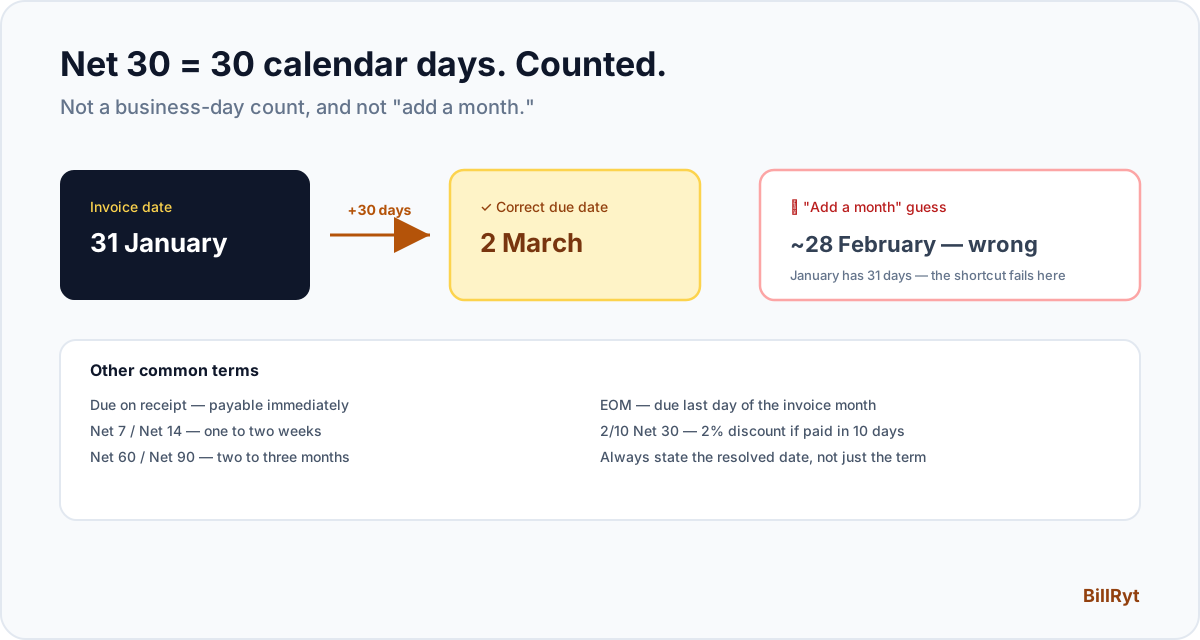
Net 30 means the full invoice amount is due 30 calendar days after the invoice date — not 30 business days, and not "around a month." Weekends and public holidays are included in the count; they don't push the due date later, though many businesses will informally treat a due date that lands on a weekend as due the next business day in practice.
The calculation, step by step
Take the invoice date and add exactly 30 days. That's the entire calculation — no rounding, no "add a month" shortcut (which fails as soon as you cross a 28-, 30-, or 31-day month boundary and gives you the wrong answer).
Worked examples
- Invoice dated 1 March → Due 31 March (30 days later).
- Invoice dated 15 January → Due 14 February.
- Invoice dated 31 January → Due 2 March (January has 31 days, so 30 days from the 31st lands on 2 March, not the 28th/29th of February — a genuinely common miscalculation).
- Invoice dated 1 December → Due 31 December.
The January 31st example is worth sitting with — "add a month" intuition says the due date should be near the end of February, but counting the actual 30 days lands you in March. When in doubt, count days, don't estimate months.
Why the exact date matters more than the term itself
Writing "Net 30" on an invoice without also stating the resolved due date leaves the client to do the calculation — and if they get it wrong (as the January 31st example shows is easy to do), you're the one who has to catch it and follow up. Stating both the term and the explicit calendar due date removes that ambiguity entirely, and gives you an unarguable date to measure "overdue" from.
Net 30 from the invoice date, or the delivery date?
A second common ambiguity: does the 30-day count start from when the invoice was issued, or when goods or services were actually delivered? Standard practice is to count from the invoice date, and most invoices are issued at or near the point of delivery specifically to avoid this gap — but if there's a real delay between delivery and invoicing (common with larger projects that get invoiced in a batch at month-end), state clearly which date the term is measured from, so there's no room for a client to argue the due date based on a different starting point than you intended.
Does Net 30 mean the same thing internationally?
The concept of "net" payment terms is understood globally, but the cultural default term length varies — Net 30 is standard in the US and UK, while some European and government contracts more commonly default to Net 60 or longer. When invoicing an international client for the first time, it's worth explicitly confirming their expected term rather than assuming your own market's default will be read the same way on the other end.
Other common payment terms, for comparison
- Due on receipt — payable immediately, 0-day term. Best for one-off jobs or new clients where you want fast turnaround.
- Net 7 / Net 14 — due in one or two weeks. Common for freelancers and small services needing quicker cash flow.
- Net 60 / Net 90 — due in two or three months. Common with larger corporate or government clients; weigh the cash-flow cost of waiting that long before agreeing to it.
- EOM (end of month) — due on the last calendar day of the month the invoice was issued, regardless of which day in that month it was sent.
- 2/10 Net 30 — the full amount is due in 30 days, but the client receives a 2% discount if they pay within the first 10 days — a common incentive for faster payment.
Net 30 on a quote, not just an invoice
Payment terms are also worth stating on a quote or estimate, before any work begins, not just at the invoicing stage — agreeing "Net 30 from invoice date" upfront means there's no renegotiation once the final invoice lands, and a client can plan their own cash flow around a term they agreed to in advance rather than one that arrives as a surprise alongside the bill.
Choosing the right term in the first place
Shorter terms protect your own cash flow; longer terms can help win or retain larger clients who have their own internal payment cycles. A reasonable default: Due on receipt or Net 7–14 for new or one-off clients, Net 30 for established relationships, and only Net 60–90 when a client's size and reliability genuinely justify the wait.
Try the free calculator
Counting 30, 60, or 90 days by hand across a month boundary is exactly where mistakes creep in. BillRyt's free payment terms calculator takes any issue date and any common term — Net 7, 14, 30, 45, 60, 90, or a custom number of days — and returns the exact due date instantly, along with whether it's already overdue.
In short
Net 30 is 30 calendar days from the invoice date, counted exactly — not a business-day count and not a rounded "about a month." State the resolved due date explicitly on every invoice rather than leaving the arithmetic to the client, and you remove one more place a payment can slip simply because of a miscounted date.