Shopify is a storefront. It is very good at what it does: a public online shop with a cart, a checkout and a catalogue for the world to browse. But a lot of businesses that end up on Shopify do not actually want a public shop — they want to invoice specific clients for specific goods and get paid, while keeping an eye on stock. If that is you — a wholesaler, a B2B supplier, a made-to-order maker, a service business that also ships product — you may be carrying the weight of a storefront you never needed. Here is a lighter, Paystack-integrated way to run that.
The mismatch: storefront tooling for a direct-billing job
Shopify's model assumes the buyer comes to your shop, adds to cart and checks out. That is perfect for retail. It is an awkward fit when your reality is: a client emails an order, you confirm a price, you send a bill, they pay, you ship and you deduct the stock. In that flow the storefront, the theme, the cart and the catalogue are overhead — you are paying a subscription plus app add-ons to run machinery aimed at a different job.
BillRyt is built for the direct-billing job specifically. On the Merchant plan ($39/month) you get:
- Proper documents — quote → invoice → credit note, not a cart. Send a client a quote, turn it into an invoice, issue a credit note if something is returned.
- Paystack on the invoice itself — the client opens the invoice and pays by card, bank transfer, USSD or M-Pesa (in Kenya) through your own Paystack account, and BillRyt marks it paid.
- Inventory without a store — items deduct stock automatically as you invoice them, with packing slips and low-stock alerts — no storefront required to track what you have.
- Books included — full accounting (BillRyt Books) comes with the plan, so your sales, payments and stock feed your accounts.
About Paystack specifically
Shopify does support Paystack as a payment gateway for storefront checkout in the countries where that is available — so this is not "Shopify can't do Paystack." The difference is where the payment happens. On Shopify, Paystack sits at the end of a storefront checkout. On BillRyt, Paystack sits on a direct invoice you send to a named client. If your sales are invoice-shaped rather than shop-shaped, collecting via Paystack on the invoice is simply the more natural fit — and you keep your own Paystack keys, so settlement goes straight to your account with no middle layer.
Where BillRyt fits — and where it does not
Being honest about this saves everyone time. BillRyt is not a storefront. If you need a public shop that strangers browse and buy from — with a catalogue, themes, discount codes and a cart — Shopify is the right tool and BillRyt is not trying to replace it. Choose BillRyt when your selling is direct and invoice-based:
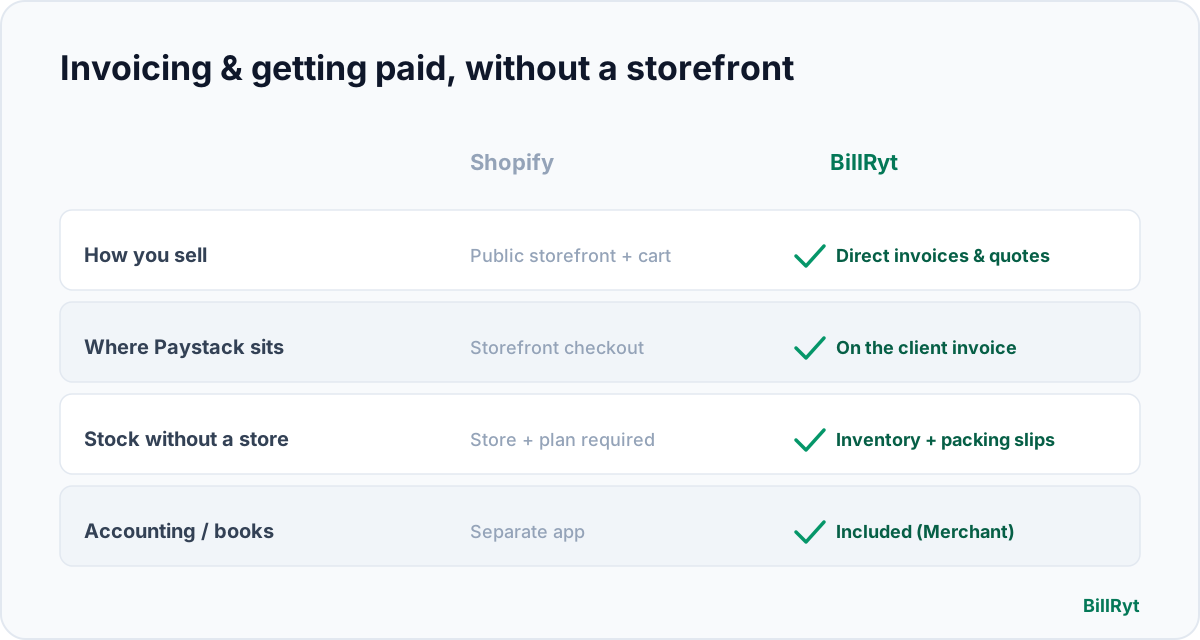
| For invoicing & getting paid, without a storefront | Shopify | BillRyt Merchant |
|---|---|---|
| How you sell | Public storefront + cart | Direct invoices & quotes |
| Where Paystack sits | Storefront checkout | On the client invoice |
| Track stock without running a store | Store + plan required | Inventory + packing slips |
| Accounting / books | Separate app | Included |
| Monthly shape | Subscription + app add-ons | Flat $39, all-in |
The table is scoped on purpose — "for invoicing and getting paid, without a storefront." Inside that scope, a lighter, all-in tool wins on simplicity and cost. Outside it — if you genuinely want a shopfront — it does not, and you should stay with Shopify.
A worked example
You supply a dozen retailers with a product you make in batches. Each week they message their order; you confirm quantities and price, bill them, they pay, you ship. On a storefront platform you are maintaining a public shop, wiring apps for invoicing and stock, and paying a subscription plus per-app fees for the privilege — most of it aimed at walk-up buyers you do not have. On BillRyt Merchant you send each retailer a quote, convert accepted ones to invoices, collect via Paystack on the invoice, and watch stock deduct as you go — while the whole thing posts to your books automatically. Same outcome — goods billed, paid and shipped — with none of the storefront overhead, at a flat $39/month.
What you keep, what you drop
Moving a direct-billing business off a storefront tool, you keep everything that mattered — recording orders, collecting via Paystack, tracking stock, keeping books — and you drop the parts that were only there to run a shop you did not want. For a business whose customers order by message and pay by invoice, that trade is almost always worth it.
Moving a product list over
Switching a direct-billing business to BillRyt does not mean rebuilding a catalogue. You add the products you actually invoice as reusable saved items, each with a price and a stock count, and from then on they deduct as you bill them. There is no theme to design, no storefront to launch, no domain to point — because there is no shop. Most sellers are billing their first client within an hour of starting, because the setup is a client and a handful of items rather than an online store. And because the free plan lets you build invoices and try the item workflow before paying, you can confirm the fit on your own catalogue before moving your product business onto the Merchant plan.
In short
Shopify is a storefront; if your selling is really direct invoicing with stock behind it, a storefront is overhead. BillRyt Merchant gives you the invoice-shaped version of the same business: quotes and invoices instead of a cart, Paystack on the document instead of a storefront checkout, inventory and packing slips without running a shop, and full books included — flat at $39/month with your own Paystack keys. It will not build you a public shop, and it does not pretend to. But if you have been paying for a storefront to do a billing job, this is the lighter, Paystack-integrated alternative that fits the job you actually have.
You can start free to try the invoicing and stock workflow, then move to Merchant when you are ready to run your product business on it.