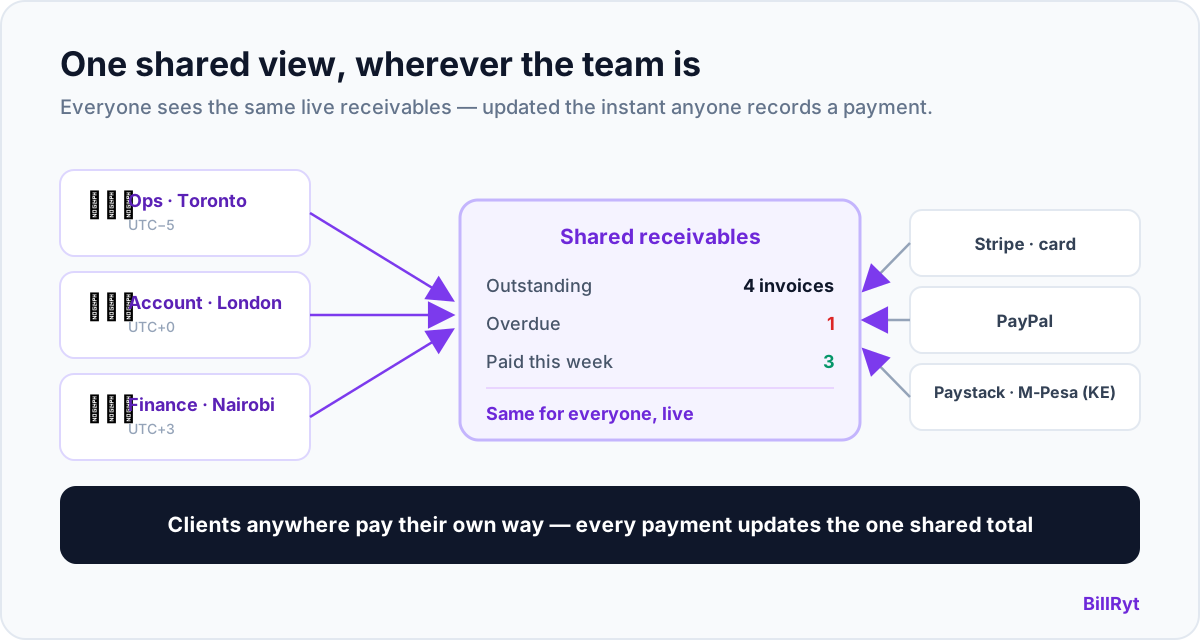
A remote team is a business without a shared desk. Your operations lead might be in Toronto, your account manager in London, your finance person in Nairobi, and your clients scattered across three continents. That geography is a strength — but it turns one deceptively simple question into a daily source of confusion: who has actually paid us, and who still owes? When the answer lives in one person's inbox or a spreadsheet only they update, a distributed team is always slightly out of sync about its own money. Payment-tracking tools exist to fix exactly that, and this is how to think about them for a team that does not share a room.
The real problem: one source of truth, many locations
The failure mode for remote teams is not laziness — it is fragmentation. Payments land in different places, someone marks an invoice paid in a personal file, a colleague chases a client who already paid last week, and a founder asks for "the outstanding number" that nobody can produce on the spot. None of this happens because the team is careless; it happens because there is no single, shared, always-current view of receivables that everyone can see from wherever they are.
BillRyt is built around one shared source of truth. Every invoice, every payment, every outstanding balance lives in one workspace that your whole team opens from anywhere in the world. Mark an invoice paid in Nairobi and the founder in Toronto sees it update. There is no "latest version" of a spreadsheet to hunt for, because the tool is the version.
What a remote team actually needs from payment tracking
Not every feature labelled "payment tracking" helps a distributed team. The ones that matter:
- A shared, live receivables view. One screen showing what is outstanding, what is overdue and what is paid — the same for everyone, updated the instant anyone records a payment.
- Team seats with a shared workspace. Your colleagues work in the same account, not in copies that drift. On the Agency plan ($29/month) that is up to 15 seats; Merchant ($39) raises it to 20.
- Automatic status, not manual bookkeeping. Invoices move to Paid or Overdue on their own — from the due date and the recorded payment — so no single teammate is the bottleneck for "is this current?"
- Automatic reminders. Overdue clients are chased on a schedule, so following up is not a task that falls to whoever remembers, in whatever time zone.
- Collection from clients anywhere. Because your clients are global, the tool has to collect globally — which is where the payment rails come in.
Getting paid across time zones and currencies
A remote team almost always has remote clients, and remote clients pay in different currencies through different methods. BillRyt handles that natively: invoice each client in their own currency — USD, GBP, EUR, KES, NGN and more — and let them pay online through the rail that suits them. Connect your own Stripe for card payments worldwide, PayPal for clients who prefer it, and Paystack for African clients paying by bank transfer, USSD or M-Pesa (in Kenya). Every payment, whichever rail it came through, lands against its invoice and updates the same shared receivables view your whole team is watching. The team does not care which continent a payment came from; they just see the balance fall.
A worked example
Your five-person team closes three invoices this week: a US client pays 6,000 USD by card, a UK client pays 3,200 GBP by PayPal, and a Kenyan client pays 180,000 KES by M-Pesa. On a fragmented setup, three different people would learn about three different payments at three different times, and the "what are we owed?" number would be wrong until someone reconciled it by hand. In BillRyt, all three invoices flip to Paid automatically as the payments arrive, the shared outstanding figure drops in real time, and every teammate — in every time zone — sees the same current picture without a single status message being sent. Nobody double-chases; nobody guesses.
Why "shared" beats "powerful" for a distributed team
A remote team does not need the most feature-dense finance tool; it needs the one where everybody sees the same truth without effort. The value is in the absence of reconciliation meetings and "did the client pay?" pings across time zones. When the receivables view is shared and live, and the reminders run themselves, the team spends its energy on the work — not on assembling a picture of its own cash that should have been obvious all along. That is the same reason a growing team benefits from a lightweight client billing system rather than a heavy one: shared clarity, not configuration.
Where accounting fits
For a remote team that also wants real books, the Agency and Merchant plans include full accounting (BillRyt Books), so the payments your team tracks become proper financial records without exporting to another tool. Your distributed finance person works in the same workspace as everyone else, and the books are built from the invoices the team already manages.
What to look for in a remote-team billing tool
If you are comparing options for a distributed team, judge them on shared clarity rather than feature count. Five questions cut through it: Does every teammate see the same receivables view, updated live, from wherever they are? Do people work in one shared workspace on real team seats, or in copies that drift out of sync? Does invoice status update on its own from the due date and recorded payments, so no single person is the bottleneck? Can clients anywhere pay their own way — card worldwide, PayPal, or African rails — with each payment landing against its invoice automatically? And do overdue invoices chase themselves, so following up does not fall to whoever happens to be awake in that time zone? A tool that answers yes to all five keeps a distributed team honest about its own cash; one that does not will have your people reconciling by hand across continents. BillRyt is built to answer yes to every one.
In short
Remote teams do not struggle to send invoices — they struggle to agree, across locations and time zones, on who has paid. The fix is a single shared, live view of receivables that updates the moment anyone records a payment, team seats so everyone works in one workspace, automatic status and reminders so no one person is the bottleneck, and global payment rails — Stripe and PayPal worldwide, Paystack for Africa — so clients anywhere can pay their own way. BillRyt puts all of that in one place on the Agency plan, with included accounting on top. Your team can be spread across the world and still share one honest answer to "what are we owed?"
You can start free to see the shared receivables view, then move to Agency for team seats and books.