"I add a 50% margin to my costs" is one of the most common pricing sentences said by freelancers and small business owners — and it's almost always describing a markup, not a margin. The two are related but genuinely different numbers, and mixing them up is a quiet, easy way to underprice your own work without realising it.
The core difference
Markup is profit expressed as a percentage of your cost. Margin is profit expressed as a percentage of your selling price. Same profit, same cost, same revenue — but two different percentages, because they're measured against two different bases.
The formulas, side by side
- Markup % = (Revenue − Cost) ÷ Cost × 100
- Margin % = (Revenue − Cost) ÷ Revenue × 100
Notice the numerator is identical — gross profit — only the denominator changes: cost for markup, revenue for margin.
A worked example that shows the gap
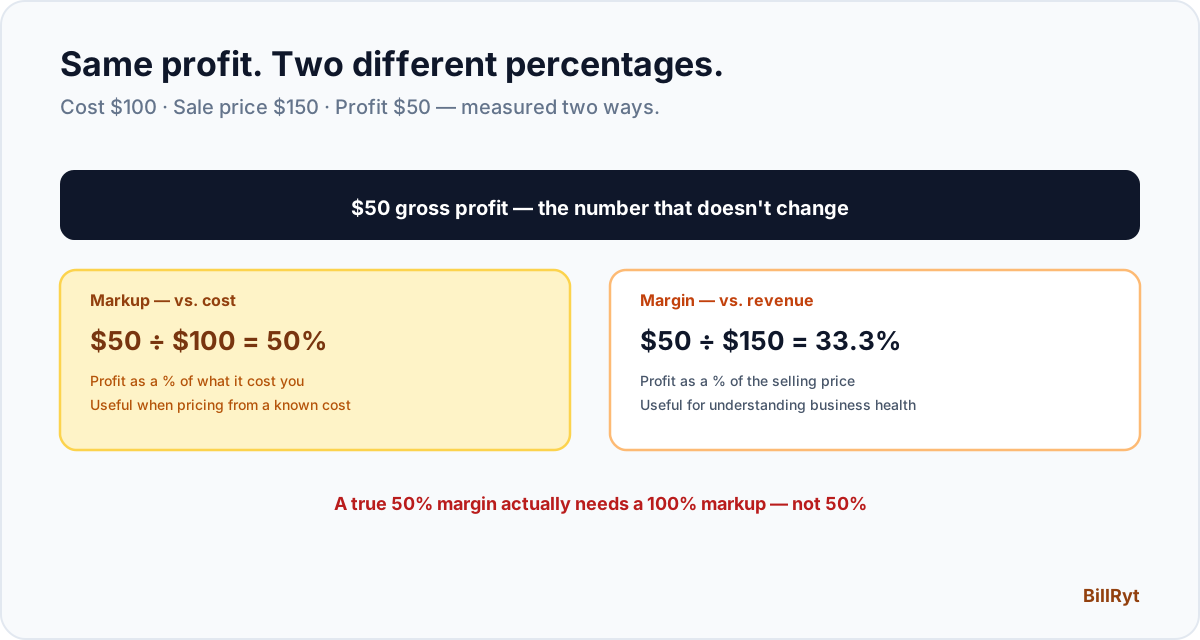
Say your cost is $100 and you sell for $150. Gross profit is $50.
- Markup: $50 ÷ $100 = 50%.
- Margin: $50 ÷ $150 = 33.3%.
Same transaction, same $50 profit — but "50%" and "33%" are both correct answers, depending on which one you were actually asked for. This is exactly where the confusion causes real financial damage: if you intend to run a 50% margin but calculate it as a 50% markup instead, you're actually running a 33% margin without realising it — a meaningfully thinner buffer than you planned for.
Why this mix-up leads to underpricing
If your target is a 50% margin and you mistakenly apply a 50% markup formula, you sell at $150 when a true 50% margin actually requires selling at $200 ($100 cost ÷ (1 − 0.50) = $200 revenue, giving $100 profit ÷ $200 = 50% margin). That's a $50 shortfall on every single sale — invisible on any individual invoice, but very visible once you look at a full year of underpriced work.
Converting between the two
If you know markup and want margin: Margin = Markup ÷ (1 + Markup). A 50% markup (as a decimal, 0.5) converts to 0.5 ÷ 1.5 = 33.3% margin.
If you know margin and want markup: Markup = Margin ÷ (1 − Margin). A 50% margin (0.5) converts to 0.5 ÷ 0.5 = 100% markup.
That last one is worth sitting with: a true 50% margin requires a 100% markup — doubling your cost, not adding half of it. This is the single most common place the confusion causes real underpricing.
Which one should you actually use?
Margin is generally the more useful number for understanding your business's health, because it's expressed against revenue — the number that determines your actual cash position and what fraction of every dollar coming in is profit versus cost. Markup is more useful at the point of pricing an individual item, because you're usually starting from a known cost and deciding how much to add. Neither is "wrong" — the mistake is only ever using one when you meant the other.
How the confusion plays out in a real business
A freelance designer decides she wants to run a 40% margin on project work. Without thinking closely about the difference, she applies a 40% markup to her costs instead — $1,000 of cost becomes a $1,400 quote. Her actual margin on that quote is $400 ÷ $1,400 = 28.6%, not the 40% she intended. Over a year of similarly under-quoted projects, the gap between the 40% she thought she was running and the 28.6% she actually achieved adds up to a meaningfully smaller profit than her business plan assumed — without a single quote looking obviously wrong on its own.
Margin and break-even
Margin also feeds directly into a break-even calculation: Break-even revenue = Fixed costs ÷ Gross margin (as a decimal). If your fixed costs are $3,000 a month and your gross margin is 40%, you need $3,000 ÷ 0.40 = $7,500 in revenue just to cover fixed costs before any profit begins. Because break-even is calculated from margin, not markup, confusing the two here doesn't just misstate your profit — it misstates the revenue target you actually need to hit to avoid a loss.
A quick reference table
| Markup | Margin |
|---|---|
| 25% | 20% |
| 50% | 33% |
| 100% | 50% |
| 200% | 67% |
| 300% | 75% |
Notice markup always reads higher than the equivalent margin — which is exactly why a business that "marks up 100%" sounds more aggressive than one that "runs a 50% margin," even though they're the identical price.
Try the free calculator
Working this out by hand under pricing pressure is exactly when the two get confused. BillRyt's free profit margin calculator computes both markup and margin from the same inputs simultaneously — enter your revenue and cost once, and see both percentages side by side, so you always know which one you're actually looking at.
Gross margin vs net margin — one more distinction
Margin itself splits into two useful figures: gross margin measures revenue against direct costs alone (materials, contractor fees, the direct cost of delivering the work), while net margin subtracts overheads too (rent, software subscriptions, admin) to show what's actually left as profit. A healthy gross margin with a thin net margin usually means overheads, not pricing, are the problem worth addressing — a distinction that's only visible once markup and margin themselves are being calculated correctly in the first place.
In short
Markup and margin measure the same profit against two different bases — cost for markup, revenue for margin — and the gap between the two percentages grows the higher they get. Know which one your pricing target actually refers to, because using the wrong formula at the wrong moment is one of the most common, entirely invisible ways a freelancer or small business quietly underprices its own work.