Plenty of freelancers price everything in hours and never quote a day rate — right up until a client, often an agency or a corporate procurement team, asks for one directly and expects an answer on the spot. A day rate isn't a different pricing philosophy, it's just your hourly rate expressed differently, and it's worth having ready before you're asked for it mid-negotiation.
The basic formula
Day rate = Hourly rate × hours in a working day
Most freelancers use 8 hours as the standard working day, though some client-facing or on-site engagements run 7.5 or 6 billable hours once breaks and admin are accounted for. Pick the number that matches how you actually work, and be consistent about it across quotes.
A worked example
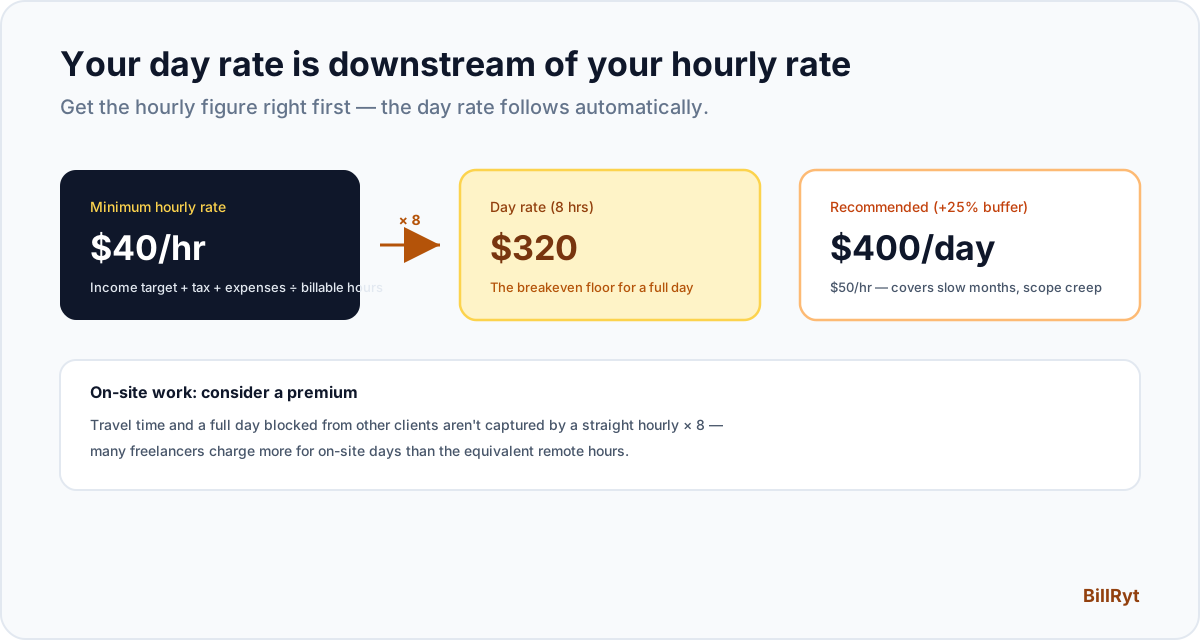
Say your calculated minimum hourly rate — after covering your income target, expenses, tax, and non-billable time — comes out to $40/hour. At an 8-hour day, that's a $320 day rate. If your recommended rate (minimum plus a buffer for scope creep and slow months) is $50/hour, your day rate becomes $400.
Notice the day rate isn't a separate calculation from your hourly rate — it's downstream of it. Get your hourly rate right first, using your real income target, expenses, and realistic billable hours (not your total working hours), and the day rate falls out automatically.
Why day rate isn't just "hourly × 8" in every case
Some freelancers apply a small day-rate discount relative to straight hourly multiplication, on the logic that a full day booked in advance removes the uncertainty of intermittent hourly bookings and is worth rewarding slightly. Others charge exactly hourly × 8, or even a premium for on-site work that adds travel time and reduces flexibility for other clients that day. None of these is universally correct — it depends on how you value certainty versus flexibility in your own schedule.
When a client asks for a day rate specifically
Agencies staffing a project alongside their own team, corporate clients with day-rate-based contractor budgets, and government or public-sector procurement processes very commonly default to day-rate contracts rather than hourly ones — it's simply how their internal approval and budgeting systems are built. Having a day rate ready, calculated properly rather than guessed on the spot, avoids either underquoting under pressure or losing the engagement to a slower, more prepared competitor.
On-site work: adjust for what a day actually costs you
A day rate for on-site work should account for anything a remote hourly engagement doesn't cost you: travel time, reduced ability to fit in other clients that day, and sometimes a full day blocked even if the actual working time is shorter. It's reasonable — common, even — to charge a premium for on-site days versus the equivalent number of remote hours, for exactly this reason.
From day rate to weekly or monthly retainers
The same multiplication logic extends further: a weekly rate is commonly the day rate × 5 (sometimes with a small volume discount for the guaranteed commitment), and a monthly retainer is often priced as a negotiated discount off the equivalent number of day-rate days in a month, reflecting the value of predictable, recurring income to you as the freelancer. As with the hourly-to-day step, get the base day rate right first — every longer-term rate is built on top of it, and an error at the day-rate stage compounds at every larger unit above it.
A day-rate negotiation, worked through
A corporate client offers a 10-day engagement and asks for "your best day rate." If your calculated day rate is $400 and you've priced in a small volume consideration for a guaranteed 10-day block, quoting $380/day ($3,800 total) rather than a much larger, improvised discount keeps the engagement profitable while still rewarding the client for committing to volume upfront — a controlled, calculated concession rather than a guess made under negotiating pressure.
The mistake that undercuts your own day rate
Quoting a day rate by mentally halving your weekly rate, or working backwards from what "sounds reasonable" rather than from your actual hourly-rate calculation, tends to land noticeably below what your real minimum hourly rate would produce at 8 hours. If you haven't calculated your hourly rate properly first — accounting for tax, expenses, and genuinely billable (not total) hours — any day rate built on top of it inherits the same underpricing.
Quoting a day rate to an international client
If a client is in a different currency, quote the day rate in a currency you're comfortable being paid in, or state clearly which exchange rate and date will apply if you're quoting in theirs — a day rate that looked correct when quoted can quietly shrink in real terms if currency movement between quoting and payment isn't accounted for, particularly for engagements booked weeks or months in advance.
Try the free calculator
BillRyt's free freelance rate calculator works backwards from your income target, expenses, tax rate, and realistic billable hours to your minimum and recommended hourly rate — and shows the equivalent day rate for an 8-hour project alongside it, so you have both numbers ready before a client asks for either.
In short
A day rate is simply your properly calculated hourly rate multiplied by your working day length — it's not a separate guess. Work out your hourly rate honestly first, using your real expenses, tax, and billable hours rather than your total hours, and you'll always have a day rate ready that you can actually live on, not one improvised under negotiation pressure.