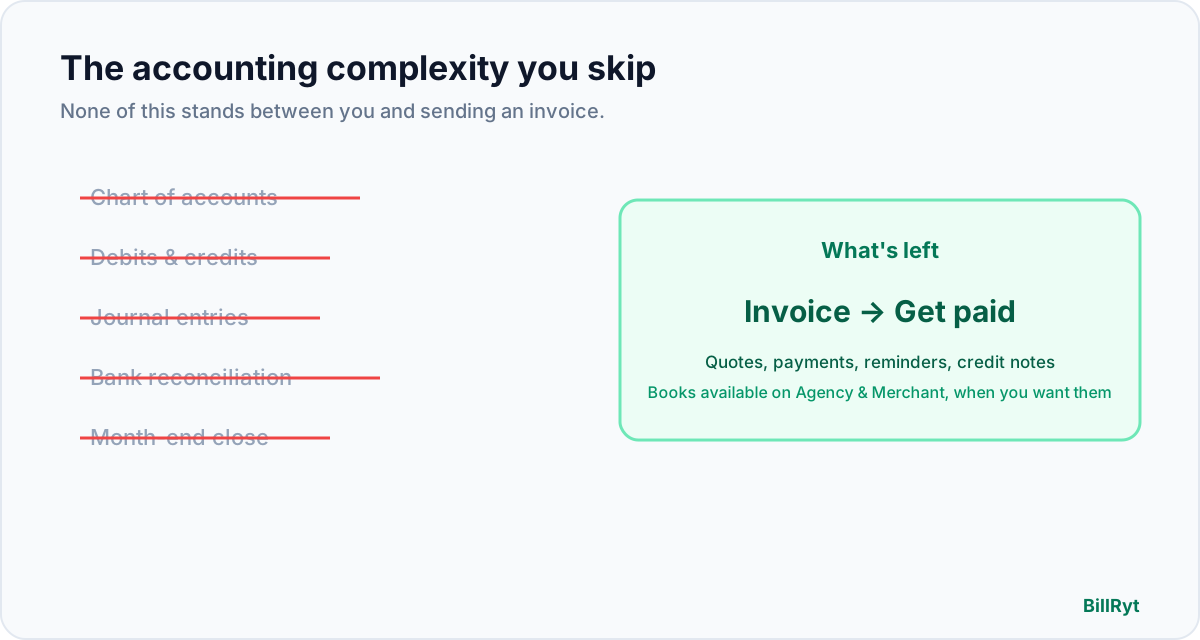
Most people who say "I don't want accounting complexity" are not being lazy. They have opened an accounting suite, been asked to pick a chart of accounts before doing anything useful, and closed the tab. This post is concrete: here are the specific pieces of accounting complexity BillRyt spares you, and what you get in their place.
The complexity you don't have to deal with
A chart of accounts. Traditional accounting starts by making you set up (or accept) dozens of ledger accounts — assets, liabilities, income, expenses, each with a code. In BillRyt there is nothing to set up. You add a client and send an invoice.
Debits and credits. Double-entry bookkeeping records every transaction twice, in opposing columns. It is powerful and it is also the single most common reason non-accountants bounce off "invoicing" tools. BillRyt's daily surface has none of it — an invoice is an invoice, a payment is a payment.
Journal entries. No manually posting a journal to move money between accounts. Sending an invoice and recording a payment is the whole action.
Bank reconciliation. No importing a bank feed and matching lines every month to make two systems agree. BillRyt records the payment against the invoice when it is paid, so your outstanding and paid figures are simply correct.
Month-end close and trial balances. The rituals that make accounting feel like a second job are absent from the billing workflow entirely.
What you get instead
Take the complexity away and what is left is the part that actually pays you:
- Quotes and invoices in your currency, with the right tax, sent in minutes.
- Online payment — connect Stripe and Paystack so clients pay by card, bank transfer, USSD or M-Pesa (Kenya) from a link.
- Get-paid-faster tooling — a client portal, automatic reminders, and one screen showing outstanding, overdue and paid.
- The full document chain — quote → proforma → invoice → credit note — without a single journal entry.
That is the whole job for most small businesses, done without the vocabulary.
"But don't I need real books eventually?"
Sometimes, yes — for a loan, an investor, or the tax authority. The difference is when and whether it is forced on you. BillRyt keeps real accounting opt-in: BillRyt Books is included on the Agency and Merchant plans and, when you switch it on, it builds proper double-entry books from the invoices and payments you have already recorded. You get the profit and loss and balance sheet your accountant wants — without ever having hand-posted a journal, and without migrating to a different tool.
So the choice is not "simple now, painful migration later." It is "simple now, and the books are one upgrade away when you actually need them."
Why so many "invoicing" tools bury you anyway
It usually comes down to how the product was built. Many tools that market themselves as invoicing are really accounting engines with an invoice form on top — so the moment you do anything beyond the simplest invoice, the ledger underneath surfaces: an account to choose, a tax mapping to confirm, a reconciliation to clear. BillRyt is built the other way round. The billing workflow is the product; the double-entry engine only exists once you deliberately turn on Books, and even then it runs underneath rather than in your face. That ordering is the whole reason the daily experience stays simple.
A worked example
You send a client a 900 invoice, they pay by card, and you issue a small 100 credit note the next month for a returned item. In a general-ledger tool, each of those is a posting you might be asked to classify. In BillRyt, you send the invoice, the payment records itself when it lands, and the credit note is a two-field action that adjusts what the client owes. Three real business events, zero journal entries — and if you ever switch on Books, all three are already represented correctly in the ledger it builds for you.
What you are really choosing
Choosing "invoice software without the accounting complexity" is not choosing to be disorganised. It is choosing to spend your time on the part that pays you and to let the formal books be generated from that work, on your schedule, when a bank or the tax authority actually needs them. You get clean records now and proper double-entry books the day you want them — without ever learning the vocabulary in between.
Where to start
The Professional plan ($19/month) is invoicing with zero accounting surface: all document types, all reports, recurring billing, the client portal and online payments. If and when you want the books, Agency ($29) adds them in place.
What your accountant actually needs from you
Here is the quiet reassurance behind all of this. When your accountant asks for "the books," what they need is a clean, complete record of your income and the payments against it — which is exactly what BillRyt captures every time you send an invoice and record a payment, with no bookkeeping vocabulary required from you. If they need the formal double-entry view — a profit and loss, a balance sheet — switching on Books produces it from that same record, and they can export it. You did the simple thing all year; the complex thing is generated on demand at the end. That is the opposite of most accounting software, which asks you to do the complex thing all year so the reports are ready at the end. Same destination, far less friction along the way — and you never touch a chart of accounts to send an invoice.
In short
You can run a clean, professional billing operation — quotes, invoices, payments, credit notes — without ever meeting a chart of accounts, a debit, a journal or a reconciliation screen. BillRyt keeps that machinery switched off until you deliberately turn on Books, and even then it generates the formal accounts from work you have already done. Simple by default, thorough on demand — and never complex just to send an invoice.