A remote agency's billing problem is rarely "we don't know how to invoice." It's that the team is in three time zones, the clients are in five countries, and every one of those clients has a different idea of what currency, payment method, and document format looks normal to them. Stitching that together with a tool built for one person invoicing one local client in one currency breaks down fast. Here's what an invoicing system built for a distributed team actually needs to do.
The problem is coordination, not documents
Any tool can make an invoice look presentable. The harder problem for a remote agency is coordination: does everyone on the team use the same branding, the same templates, the same client records — or does each person keep their own spreadsheet and hope nothing drifts? BillRyt's answer is that billing lives on the workspace, not the individual. Your logo, brand colour, and business details are set once and apply to every document any team member sends, from any location, on any device. A client who's worked with three different people at your agency sees one consistent identity, not three interpretations of your brand.
Currency has to be a non-issue, not a workaround
Global clients pay in their own currency, and a remote agency needs to quote and invoice in it without a manual conversion step. Multi-currency invoicing is available on every BillRyt plan, including Free — it isn't gated behind a higher tier the way it is on some tools. You set the invoice currency per document, and BillRyt handles the display and totals in that currency. This matters more for a distributed agency than almost anyone else: your US client expects USD, your UK client expects GBP, your Kenyan client may expect KES — and none of them should ever see a document that looks like it was awkwardly translated from your home currency.
Getting paid across borders, without a patchwork of tools
Once documents are right, the harder part is collection. BillRyt connects Stripe and PayPal for clients anywhere in the world, and Paystack for African clients (card, bank transfer, USSD, and M-Pesa in Kenya specifically). A remote agency with clients on three continents doesn't need three separate invoicing tools — one workspace, one set of templates, and the payment method that fits each client's location shows up automatically on their invoice. Online payment collection through any of these gateways is a Professional-plan feature and above ($19/month); it isn't available on the Free tier.
A worked example
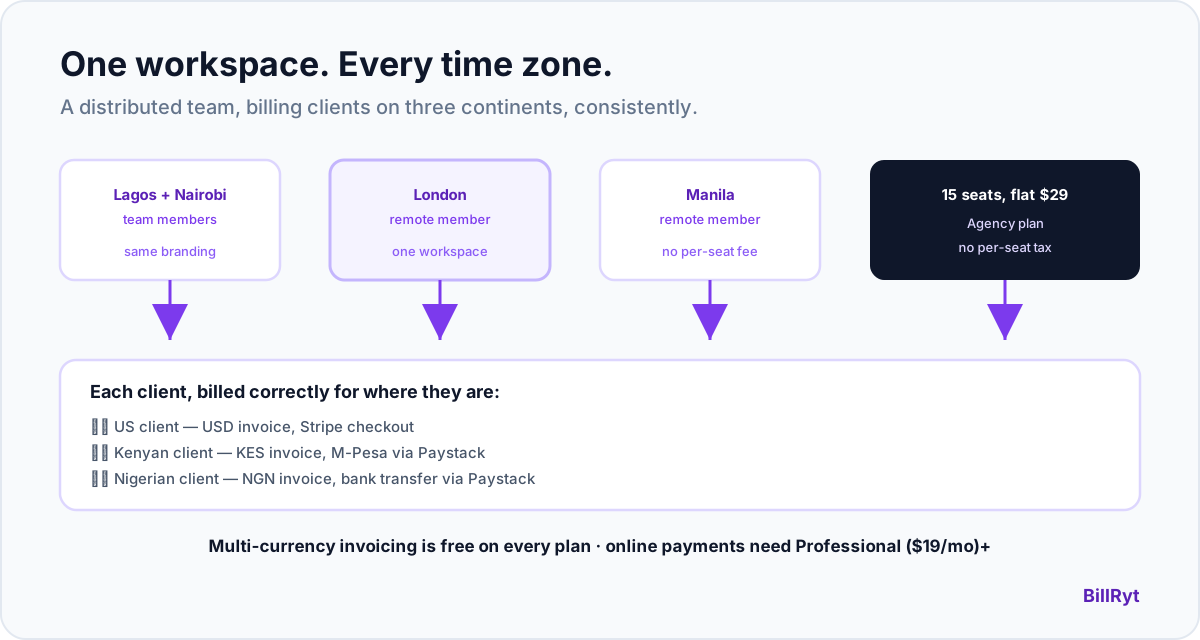
Picture a five-person design agency: two people in Lagos, one in Nairobi, one remote in the UK, one in the Philippines. A US client gets invoiced in USD with a Stripe payment link. A Kenyan client gets a KES invoice with M-Pesa as a payment option via Paystack. A Nigerian client pays by bank transfer through Paystack. Every invoice — regardless of who on the team created it or what currency it's in — carries the same agency logo, the same brand colour, and comes from the same client-facing portal. No one is reconciling three tools at month-end; it's one dashboard showing what's paid, what's outstanding, and by whom.

Team access without a per-seat tax
Distributed agencies grow by adding people, and a billing tool that charges per seat punishes exactly that. BillRyt's Agency plan ($29/month) includes up to 15 team members with no per-seat fees — your second hire costs the same as your fifteenth. Each team member can create and send invoices, quotes, and proformas, all carrying the shared workspace branding, and all visible in one place rather than scattered across individual accounts.
What a client actually experiences
A client anywhere in the world who receives a BillRyt invoice gets a document in their own currency, a payment method that actually works where they are, and — if you've turned it on — access to a self-service portal where they can check their balance and pay without emailing you to ask "can you resend that?" The portal uses a passwordless magic-link login (a 72-hour, single-use secure link, not a password to manage), which matters more for occasional international clients who will not remember a password they use twice a year.
Where this fits your plan
Multi-currency invoicing works on every plan, including Free (12 documents/month, no client cap). Turning on online payment collection — Stripe, PayPal, or Paystack — requires Professional ($19/month) or above. For a distributed team specifically, Agency ($29/month) is where this becomes genuinely built for you: up to 15 seats at no per-seat cost, plus BillRyt Books accounting included, so your global revenue reconciles in one place instead of a shared spreadsheet everyone's afraid to touch.
What to check before quoting a new international client
A few things are worth confirming before a distributed agency sends its first invoice to a new client in an unfamiliar market: which currency they actually expect to see (not necessarily your own or a "safe default" like USD), whether Stripe/PayPal or Paystack is the right gateway for their location, and whether your quote or proforma needs to go through a client-side approval step before converting to a final invoice. Getting this right on invoice one avoids the awkward follow-up email asking a client to resend payment in a currency you can actually reconcile.
Reporting that works across a distributed team
For an agency owner who isn't in every client conversation, the dashboard is often the only real-time view into how the business is doing. BillRyt's reporting shows revenue and outstanding balances broken down by currency and auto-converted into one total, paid-versus-overdue at a glance, and an aging report bucketed by how long each balance has been outstanding. For a remote agency, that visibility matters more than it does for a single-location business — it's often the only way an owner sees the full picture without sitting in every client call across every time zone.
In short
A remote agency doesn't need a fancier invoice template — it needs one system that keeps branding consistent across a distributed team, quotes and bills in whatever currency each client expects, and connects the right payment rail for wherever that client actually is. That's the specific problem BillRyt is built to solve, not a generic "make a PDF" tool retrofitted for a use case it wasn't designed for.
Start free to see how documents look across currencies, then move to Agency when your team needs shared access.