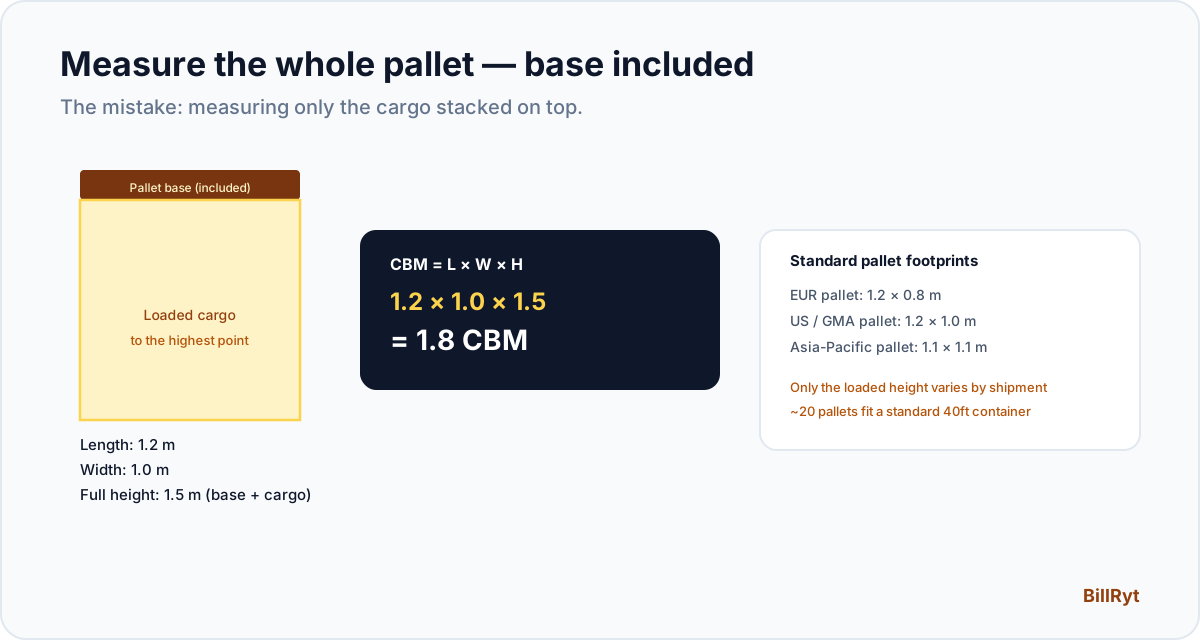
CBM for a single carton is straightforward — length × width × height, done. Pallet CBM trips up more people, for one specific reason: it's easy to measure the cargo stacked on top and forget the pallet base itself is part of the shipped footprint that a freight forwarder is actually charging for.
The formula — same as any carton, applied correctly
CBM = Length × Width × Height (all in metres)
The part that matters for a pallet specifically: measure the full loaded height, from the floor to the top of the highest item, including the pallet base itself — not just the height of the goods stacked on it.
Standard pallet sizes, for reference
- EUR pallet (Europe): 1.2m × 0.8m footprint.
- US / GMA pallet: 1.2m × 1.016m footprint (commonly rounded to 1.2m × 1.0m).
- Asia-Pacific pallet: 1.1m × 1.1m footprint.
The footprint is fixed by the pallet type; only the loaded height varies shipment to shipment, based on how high the cargo is stacked.
A worked example
Take a standard 1.2m × 1.0m pallet, loaded 1.5m high including the pallet base. CBM = 1.2 × 1.0 × 1.5 = 1.8 CBM. Shipping 10 identical pallets brings the total to 18 CBM — the figure a sea freight forwarder would use to quote an LCL (less-than-container-load) rate.
The common mistake: measuring only the cargo
If you measure only the boxes stacked on the pallet — say, 1.2 × 1.0 × 1.35m, excluding the roughly 15cm pallet base itself — you'll understate the true CBM, because the pallet takes up real space in the container or truck regardless of whether it's "cargo" in the strict sense. Freight is priced and space is allocated on the full loaded footprint, base included.
Irregular stacking: round up, don't average
If a pallet isn't loaded to a perfectly even height — boxes of different sizes stacked unevenly — measure to the highest point, not an average. Space is allocated for the tallest point of the load, so that's the number that determines how much room the pallet actually occupies.
Stacking multiple pallets and mixed loads
When several pallets ship together, total CBM is simply each pallet's individual CBM added together — but only if they're loaded to the same height. Mixed loads (some pallets loaded higher than others) need each pallet's CBM calculated separately, then summed, rather than averaging a single height across all of them. Averaging understates the taller pallets' true space requirement and will under-quote the shipment when a forwarder is pricing by total CBM.
Double-stacking pallets
Some cargo can be double-stacked — one loaded pallet placed on top of another — provided the lower pallet's contents can bear the weight and the combined height still fits the container or truck. Double-stacking doesn't change the CBM calculation itself (it's still length × width × combined height), but it does change how many pallet positions you need on the floor of the container, which is a separate planning question from the volume calculation.
From pallet CBM to an actual freight quote
Once you have total CBM across all pallets, an LCL forwarder typically quotes a rate per CBM (or per revenue ton, whichever is greater between weight and volume). Eighteen CBM at a quoted rate of $85 per CBM comes to roughly $1,530 in sea freight — a number you can only get to once the pallet CBM itself has been calculated correctly, which is exactly why an understated pallet height (the common mistake above) doesn't just misstate a technical figure, it misquotes the actual cost you'll be charged.
Why this feeds directly into your shipping cost
Once you have total CBM across all your pallets, that figure is what a sea freight forwarder quotes LCL rates against, and it's also what determines how many pallets fit a given container — a standard 40ft container holds around 20 pallets on average, though this varies with pallet height and container type. Get the pallet CBM wrong and every downstream cost estimate — freight quote, per-unit landed cost, container plan — inherits the same error.
Overhanging cargo
Occasionally cargo is stacked wider than the pallet's own footprint — overhanging the edges slightly. When this happens, measure the actual footprint of the loaded cargo, not the pallet's nominal size, since it's the cargo's real outer dimensions that determine the space it occupies in a container, regardless of what the pallet underneath measures. Overhanging loads are also worth flagging to your forwarder directly, since they can affect how tightly adjacent pallets can be packed next to it.
Try the free calculator
BillRyt's free CBM calculator handles pallet dimensions exactly the same way as cartons — enter the full loaded length, width, and height in cm, inches, or metres, and the number of pallets, and it returns CBM per pallet, total shipment CBM, and the equivalent air volumetric weight, all at once.
Does shrink-wrap or strapping add to the height?
Shrink-wrap, stretch film, and strapping add a negligible amount to a pallet's true dimensions and are generally ignored in a CBM calculation — measure to the top of the actual cargo, not an estimate inflated for packaging film. The exception is a genuine protective cap, corner board, or top frame that measurably adds height; if it's rigid and adds real centimetres, include it, since it does occupy real space in the container.
In short
Pallet CBM uses the identical formula as any other package — length × width × height in metres — the only real risk is measuring the wrong height. Always measure the full loaded pallet, base included, to the tallest point of the stack, and the number you get is the one your freight forwarder will actually quote against.