"How many cartons fit in a 40ft container?" doesn't have one universal answer, and any source that gives you a single fixed number without asking your carton size is guessing. What does have a fixed answer is the method — and once you have your carton's dimensions, the actual number takes seconds to work out.
Container internal volumes — the fixed part
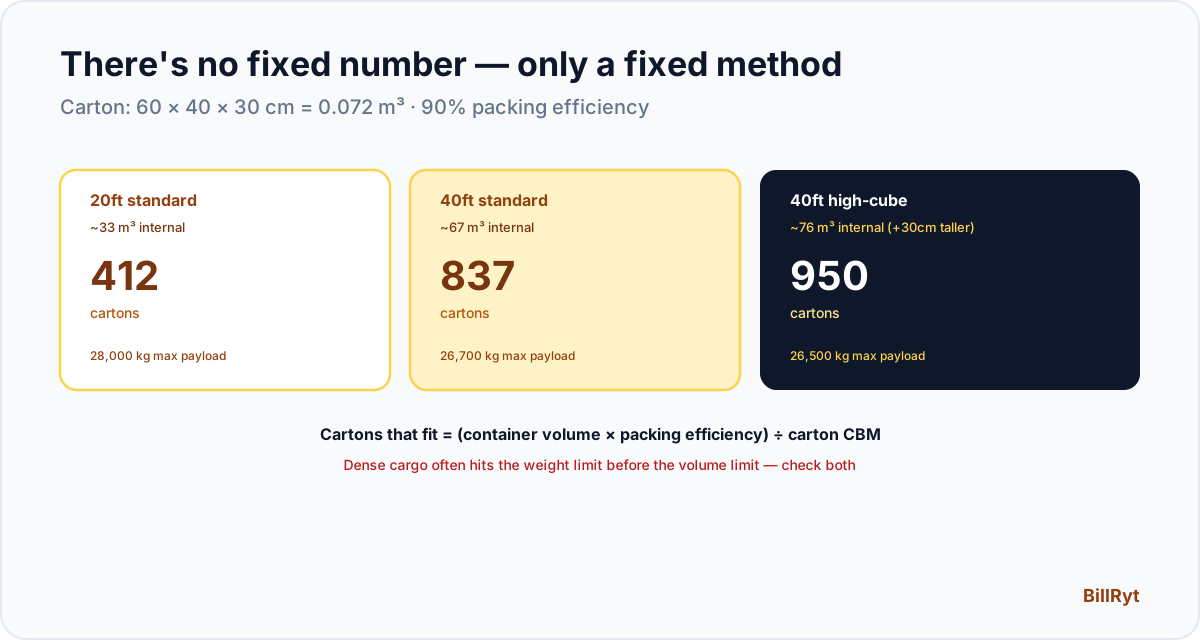
- 20ft standard: ~33 m³ internal volume, ~28,000 kg max payload.
- 40ft standard: ~67 m³ internal volume, ~26,700 kg max payload.
- 40ft high-cube: ~76 m³ internal volume, ~26,500 kg max payload — same footprint as a 40ft standard, but about 30cm taller, adding roughly 9 m³ of usable space.
These figures are fixed by the container type. Everything else — how many of your cartons fit — depends on your carton's own CBM.
The actual calculation
Cartons that fit = (container internal volume × packing efficiency) ÷ CBM per carton
Packing efficiency accounts for the reality that rectangular cartons never tessellate perfectly inside a container — there's always some unusable gap, and you need room to load and brace the cargo. 85–90% is a realistic planning assumption for most cargo; drop it lower for irregular or fragile items that can't be packed tightly.
Worked example
A carton measuring 60 × 40 × 30cm has a CBM of 0.6 × 0.4 × 0.3 = 0.072 m³. At 90% packing efficiency:
- 20ft: (33 × 0.90) ÷ 0.072 ≈ 412 cartons
- 40ft: (67 × 0.90) ÷ 0.072 ≈ 837 cartons
- 40ft high-cube: (76 × 0.90) ÷ 0.072 ≈ 950 cartons
Change the carton size and every one of these numbers changes with it — which is exactly why "how many cartons fit in a 40ft container" only has a real answer once you know what you're actually shipping. For reference, industry figures commonly cited elsewhere put a 40ft container's realistic range anywhere from roughly 700 to over 5,000 cartons depending on carton size — a wide enough range that it confirms there's no meaningful single number to memorise.
Don't forget the weight limit
Volume is only one of two constraints — weight is the other, and dense cargo often hits the weight limit long before the container is visually full. If our 60 × 40 × 30cm carton weighs 18kg, the 40ft container's ~26,700kg payload limit allows 26,700 ÷ 18 ≈ 1,483 cartons by weight alone — comfortably above the 837 the volume calculation allows, so this particular shipment is volume-limited, not weight-limited. Denser cargo (metal parts, liquids, dense packaging) frequently flips this: the container "weighs out" long before it "cubes out," leaving paid-for space unused.
Standard vs high-cube: is the extra height worth it?
A 40ft high-cube adds roughly 9 m³ over a standard 40ft for the same footprint and a similar payload allowance — a real gain for light, bulky cargo that's volume-constrained rather than weight-constrained. For dense, heavy cargo that already hits its weight limit in a standard 40ft, the extra height of a high-cube adds cost without adding usable capacity, since weight — not volume — was the actual constraint all along.
When does it make sense to ship LCL instead of a full container?
If your carton count doesn't come close to filling even a 20ft container, paying for an entire container is usually more expensive than booking LCL (less-than-container-load) space and paying only for the CBM you actually use. As a rough guide, once your shipment's volume approaches somewhere around half of a 20ft container's usable space, it's worth getting quotes for both — the crossover point where a full container becomes cheaper than the equivalent LCL rate varies by route and season, so this is a "get both quotes" decision, not a fixed threshold.
Mixed cargo: multiple carton sizes in one container
Real shipments rarely involve just one carton size. When mixing sizes, calculate each size's total CBM separately, sum them, and compare the combined total against the container's loadable volume — don't try to average carton sizes together first, since irregular mixed loads typically pack less efficiently than uniform cartons of one size, meaning a slightly lower packing efficiency percentage (closer to 80–85% than 90%) is the more realistic planning assumption for a genuinely mixed load.
Palletised loads: a different starting point
If your cargo ships on pallets rather than loose cartons, the calculation starts from pallet CBM instead of carton CBM — see our pallet CBM guide for the correct method there, since a loaded pallet's footprint and height need to be measured slightly differently from a bare carton.
Leave room for a realistic buffer, not the theoretical maximum
Even after applying a packing efficiency percentage, treat the resulting carton count as a planning ceiling, not a number to order right up to. Real-world loading rarely hits even an 85–90% assumption exactly — a slightly conservative order quantity is cheaper to correct with a small top-up order than discovering at loading time that your full order doesn't actually fit the container you booked.
Try the free calculator
Doing this arithmetic by hand for every possible container type, and separately checking whether weight or volume binds first, is exactly the kind of repetitive calculation worth automating. BillRyt's free container load calculator takes your carton's dimensions and optional weight, and instantly shows how many cartons and units fit a 20ft, 40ft, and 40ft high-cube — flagging which constraint, volume or weight, limits your specific shipment.
In short
There's no fixed number of cartons that fit a container — only a fixed method: container volume × realistic packing efficiency ÷ your carton's CBM, checked against the weight limit as a second constraint. Once you have your own carton's dimensions, the real answer for your shipment takes seconds, not a guess based on someone else's cargo.