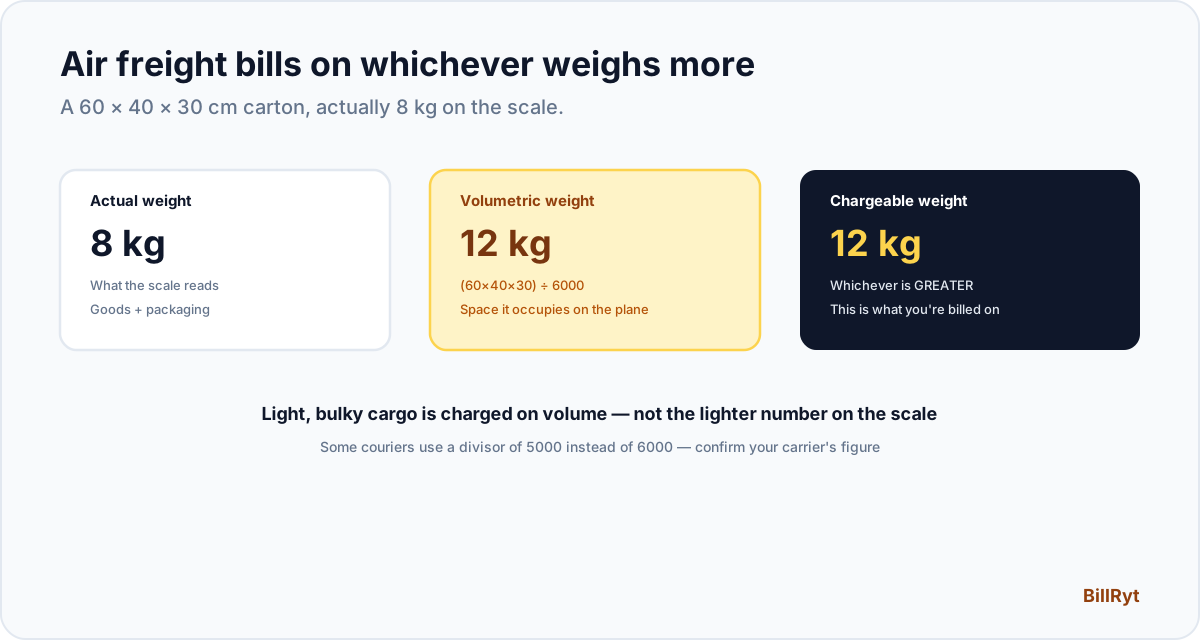
A shipment that "only weighs 8kg" can still be charged as though it weighs far more — and it's not an error on the airline's invoice. Air freight is priced on chargeable weight, which is deliberately not the same thing as the number your bathroom scale would show.
Actual weight vs volumetric weight
Actual weight (sometimes called gross weight) is the real physical weight of the shipment on a scale — the goods, inner packaging, and outer carton, all included.
Volumetric weight (also called dimensional weight) is a calculated stand-in weight based on how much space the shipment occupies, regardless of what it actually weighs. Aircraft have limited cargo volume as well as limited weight capacity, so a large, light shipment can take up space that a much heavier, denser shipment could have occupied instead — and airlines price for that trade-off.
Chargeable weight: whichever is greater
Chargeable weight = the greater of actual weight and volumetric weight
This is the number that actually appears on your air freight invoice — not necessarily either individual figure, but whichever of the two is larger for your specific shipment.
The volumetric weight formula
Volumetric weight (kg) = (Length × Width × Height, in cm) ÷ 6000
Some couriers use a different divisor — 5000 is also common — so it's worth confirming your specific carrier's figure before assuming 6000 applies universally.
A worked example
A carton measuring 60 × 40 × 30cm and weighing 8kg. Volumetric weight = (60 × 40 × 30) ÷ 6000 = 12kg. Since 12kg (volumetric) is greater than 8kg (actual), the airline charges on 12kg, not the 8kg the scale actually shows — a 50% higher chargeable weight purely because of the shipment's size relative to its weight.
Why this catches people off guard
It's intuitive to assume a shipping quote will be based on what you'd read off a scale, and for dense, compact cargo it usually is — actual weight wins when the item is genuinely heavy for its size. But for anything light and bulky (clothing, foam packaging, low-density plastics, oversized-but-light components), volumetric weight frequently wins instead, and the quote comes back higher than a scale reading alone would predict.
How to reduce your chargeable weight
If volumetric weight is the binding constraint, the only real lever is reducing the shipment's dimensions — tighter, more efficient packaging, removing excess void space in a carton, or consolidating multiple small items into fewer, more densely packed cartons. Reducing actual weight doesn't help at all once volumetric weight is already the larger of the two figures.
Express couriers vs freight forwarders
Express couriers (DHL, FedEx, UPS and similar) and traditional air freight forwarders both use the actual-vs-volumetric chargeable weight principle, but the specifics can differ — couriers commonly use a divisor of 5000 rather than 6000, and often round each package's chargeable weight up to the next whole or half kilogram before totalling a multi-package shipment. If you're quoting between a courier and a forwarder for the same shipment, recalculate volumetric weight with each provider's own divisor rather than assuming one figure applies to both — the difference between a 5000 and 6000 divisor is a genuine 20% swing in the volumetric weight figure.
Why this matters for your per-unit landed cost
If you're importing product to resell, chargeable weight — not actual weight — is what determines your true freight cost per unit, and freight is a real component of landed cost alongside the product price, duty, and any handling fees. A shipment that looks cheap based on its actual weight can turn out significantly more expensive once volumetric weight is applied, which is exactly the kind of gap that erodes a margin calculated without checking which weight figure actually applied.
Sea freight uses a related but different logic
For LCL (less-than-container-load) sea freight, the equivalent concept is the revenue ton — the greater of the shipment's weight in tonnes or its volume in CBM — priced per revenue ton rather than per kg. The underlying idea is the same (carriers charge on whichever dimension, weight or space, actually constrains them) but the units and formula differ from air freight's chargeable weight.
A second worked example, at a larger scale
Ten cartons, each 50 × 50 × 40cm and weighing 15kg (150kg total actual weight). Volumetric weight per carton = (50 × 50 × 40) ÷ 6000 ≈ 16.7kg, or 167kg total across ten cartons. Since 167kg (volumetric) exceeds 150kg (actual), the shipment is charged on 167kg — a smaller gap than the single-carton example earlier, but still a real one, and still resolved by the same rule: chargeable weight is whichever total is greater.
Don't confuse chargeable weight with insured value
Chargeable weight determines freight cost; it has nothing to do with the declared value you insure the shipment for. A light, bulky, low-value shipment can have a high chargeable weight (driving up freight cost) while carrying a low insured value (keeping insurance cost low) — the two figures are calculated independently and shouldn't be conflated when budgeting total shipping cost.
Try the free calculator
Working out whether your own shipment is weight-bound or volume-bound, for either air or sea freight, is exactly the calculation BillRyt's free freight cost calculator automates — enter your carton dimensions and weight, and it computes both LCL sea freight (on the revenue ton) and air freight (on chargeable weight), showing you which constraint actually applies before you get quoted.
In short
Air freight is priced on chargeable weight — the greater of actual and volumetric weight — not scale weight alone. Light, bulky shipments are the ones most likely to be surprised by this, since their volumetric weight frequently exceeds their actual weight. Knowing which constraint applies to your shipment before you request a quote means the number you get back won't be a surprise.