In Kenya, "how do I pay?" has one obvious answer for most clients: M-Pesa. It is how rent, suppliers, and half the economy move money. So the real test of an invoicing tool in Nairobi or Mombasa is simple — can your client settle the invoice with M-Pesa in a few taps? With Wave, the answer is no. Here is the honest picture and the alternative.
Where Wave is strong
Wave's invoicing and accounting are free and genuinely well made. For a US or Canadian business, that is hard to beat. If you never need to collect a local Kenyan payment, Wave is fine.
Where Wave leaves a Kenyan business stuck
- No M-Pesa, no local collection. Wave's built-in payments are limited to the US and Canada. A Kenyan business can send a Wave invoice, but the client cannot pay it with M-Pesa, a local card, or bank transfer from inside the invoice. You end up sharing a Paybill or till number separately and reconciling by hand — exactly the work invoicing software is supposed to remove.
- The shilling is an afterthought. Multi-currency exists, but the experience assumes USD/CAD. KES and Kenyan VAT are not the default the way you actually operate.
- Support leans North-American. Building your receivables on a tool that treats your market as an edge case is a risk you feel later, not on day one.
None of this is a knock on Wave — it is built for a different market.
What BillRyt does instead
BillRyt is invoicing and accounting designed for how Kenyan businesses actually get paid.
- Collect M-Pesa on the invoice. Connect Paystack and your BillRyt invoices accept M-Pesa, card, bank transfer and USSD — settled to your account, with the payment recorded against the invoice automatically. No more matching a stray Paybill message to a client by hand.
- The shilling is first-class. Bill in KES with the right VAT; invoice overseas clients in USD or GBP and connect Stripe for their card — on the same invoice.
- Books included. BillRyt Books gives you double-entry accounting — profit and loss, balance sheet, ledgers — on the Agency and Merchant plans, so your invoicing and accounts stay in one place.
- The full flow. Quote → proforma → invoice → credit note, a client portal, and automatic reminders.
A quick side-by-side
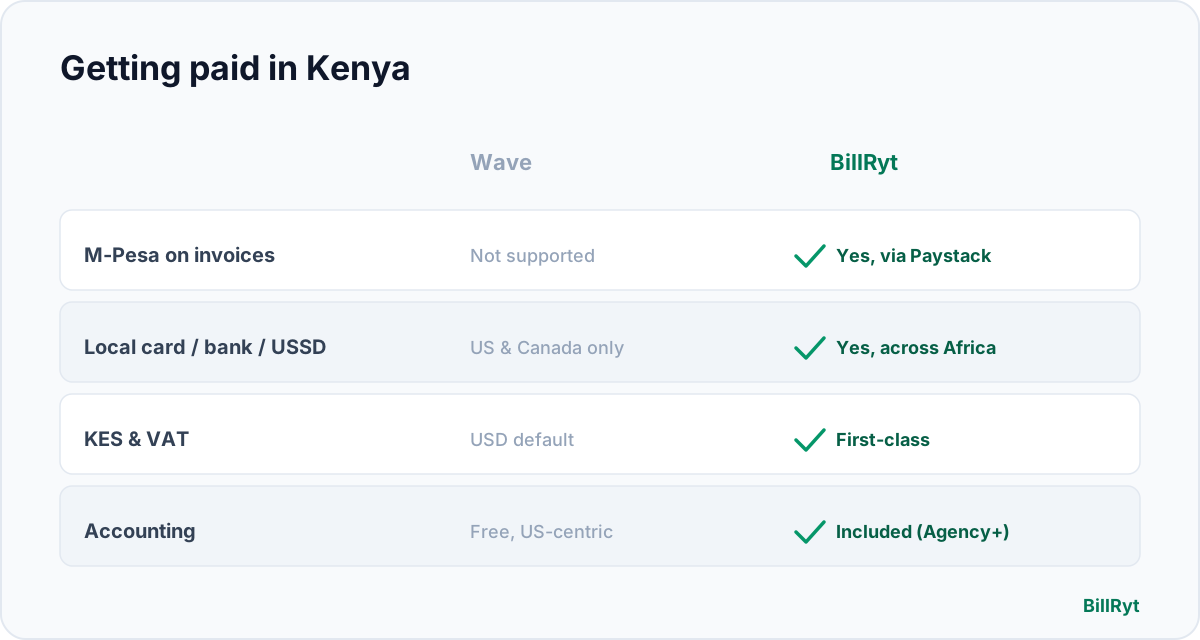
| Wave | BillRyt | |
|---|---|---|
| M-Pesa on invoices | Not supported | Yes, via Paystack |
| Local card / bank / USSD | US & Canada only | Yes, across Africa |
| KES & VAT | USD/CAD default | First-class |
| Accounting | Free, US-centric | Included on Agency & Merchant |
| International cards | US/Canada payments | Stripe, 40+ countries |
Switching is a small first step
Connect Paystack, send your next invoice through BillRyt, and the next M-Pesa payment lands against that invoice automatically. Add clients as you bill them, and let your books build from real transactions. Within a couple of weeks the receivables you actually chase are in one place — and your clients are paying the way they always wanted to.
A worked example
You are a consultant in Nairobi invoicing a local company 45,000 KES and a diaspora client in London 400 GBP the same week. With Wave, the Nairobi client has no in-invoice way to pay, so you send an M-Pesa number separately and later try to match a payment message to the right invoice by memory. With BillRyt, the Nairobi client opens the invoice and pays by M-Pesa (via Paystack) in a few taps; the London client pays by card via Stripe on their own invoice in GBP. Both payments record themselves against the correct invoice, in the correct currency — nothing to reconcile, nothing to chase down in your messages.
Why "recorded automatically" matters in Kenya
The hidden cost of collecting M-Pesa outside your invoicing tool is not the payment — it is the reconciliation. When money arrives as a standalone M-Pesa message with a reference the client may or may not have entered correctly, matching it back to an invoice is manual, error-prone work at month-end. Because BillRyt collects M-Pesa through the invoice itself, the match is made for you: the invoice flips to paid, drops off your aging report, and flows into your books. That is time you get back every single week.
What you keep, and what you gain
You keep clean invoices and, if you want it, a real double-entry ledger — the things Wave did well. What you gain is the part Wave leaves out for Kenya: M-Pesa and local collection on the invoice, first-class KES and VAT, Stripe for your overseas clients, and books in the same place. It is the same category of tool, rebuilt around how Kenyans actually pay.
Getting set up
Setup is quick and forward-looking. Create your workspace, add the clients you are actively billing, and recreate your common services as reusable line items. Connect Paystack so Kenyan clients can pay by M-Pesa, card, bank transfer or USSD straight from the invoice, and add Stripe if you also bill diaspora or overseas clients by card. Then send one real invoice — the next one you were going to send anyway. When your client pays it with M-Pesa and BillRyt marks it paid automatically, you will feel the difference immediately: no separate Paybill message to chase, no manual matching at month-end. From there you just keep invoicing, and your client list and books fill in from real transactions. There is no import weekend and no need to move historical data before you start getting paid the way Kenya actually pays.
In short
In Kenya, getting paid means M-Pesa. Wave cannot collect it; BillRyt can, through Paystack, right on the invoice — with the payment recorded and reconciled for you. Add first-class KES, Stripe for your overseas clients, and included double-entry books, and you have Wave's simplicity with the one thing it is missing for a Kenyan business.
If Wave has meant "a free invoice my Kenyan client still can't pay with M-Pesa," that is the exact gap BillRyt closes.