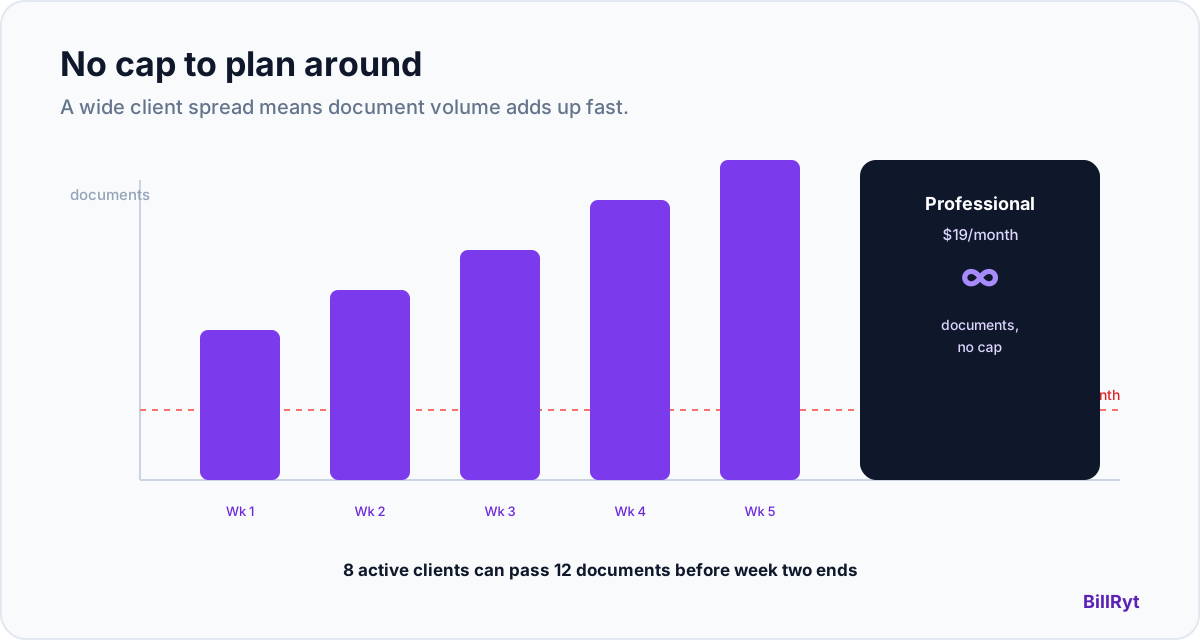
A boutique agency's client roster often looks different from a handful of large accounts — it's a wider spread of smaller, high-touch relationships, each generating its own steady stream of quotes, proformas, invoices, and the occasional credit note. That volume adds up fast, and a billing tool with a monthly document cap turns into a planning problem: do you batch invoices to stay under the limit, or upgrade reactively the month you blow through it?
What a boutique model actually looks like in documents
Picture a five-person studio with twelve active clients at any given time — some in early-stage proposal conversations, some mid-project, a couple on light monthly retainers. Each relationship might only generate two or three documents in a slow month, but multiplied across twelve clients simultaneously, that's already well past a dozen documents before the studio's biggest, most demanding client has sent anything at all.
What a document cap actually costs you
BillRyt's Free plan covers up to 12 documents a month — genuinely useful for testing the product or running a single-client side project, but a boutique agency issuing quotes, proformas, invoices, and credit notes across even five or six active clients can hit that ceiling inside the first two weeks of a month. Once that happens on a capped plan, the choice is: stop invoicing until next month, or scramble to upgrade mid-cycle while a client is waiting on a document.
Unlimited documents, from Professional up
Every plan from Professional ($19/month) up removes the document cap entirely. There's no second tier of "more documents" to plan around — Professional already includes unlimited invoices, quotes, proformas, and credit notes, alongside the client portal, automated reminders, and multi-currency invoicing. A boutique agency doesn't need to forecast document volume against a pricing tier; the number of documents you send stops being a variable to manage.
Why this matters more for a boutique model specifically
A larger agency with fewer, bigger clients might genuinely stay under a document cap without noticing it exists. A boutique agency's model is often the opposite — more relationships, each smaller, each still needing its own quote, deposit request, and invoice. The volume comes from breadth, not from any single client being demanding. That's exactly the shape a per-document ceiling penalizes hardest, and exactly the shape unlimited documents removes as a constraint entirely.
A worked example
A boutique branding studio runs eight active client relationships in a typical month — some in active project work (quote, proforma deposit, final invoice), some on a light monthly retainer (one recurring invoice each), one mid-revision needing a credit note against an earlier invoice. That's easily 20+ documents in a normal month, more than double the Free plan's cap, and every one of them is routine business, not an edge case. On Professional, none of it requires tracking against a limit.
What else comes with removing the cap
Unlimited documents on Professional isn't an isolated upgrade — it arrives alongside the rest of the toolkit a growing boutique agency actually needs: proformas and credit notes for the full quote-to-invoice pipeline, a client portal so clients can check their balance without emailing to ask, automated email payment reminders, and statements of account per client. All 10 document templates are free on every plan, including Free, so a boutique agency's document volume was never capped by which template looked the most polished — only by the monthly count, and that's the specific thing Professional removes.
Growing into a team without a per-seat tax
Boutique agencies that grow often add a second or third person before they add a large team. BillRyt's Agency plan ($29/month) keeps unlimited documents and adds up to 15 team members with no per-seat fee, plus BillRyt Books accounting — so the studio can bring someone on without the billing tool's cost climbing per hire, and every document they send carries the same consistent branding automatically.
Credit notes and adjustments aren't capped separately either
A boutique agency with a wide client spread also tends to issue more small adjustments — a scope change here, a goodwill discount there, a correction on an earlier invoice. Every one of those is a credit note, and it counts against the same removed cap as everything else on Professional: there's no separate, smaller allowance for adjustments that fills up faster than your main invoice volume. The whole document type — quotes, proformas, invoices, credit notes — shares one unlimited pool.
The aging report scales with your document volume, not against it
More documents naturally means more to track, which is exactly where a tool without real reporting starts to strain. BillRyt's aging report buckets every outstanding balance into 0–30, 31–60, 61–90, and 90+ days overdue regardless of how many clients or documents feed into it, so a boutique agency with twenty small accounts sees the same clear picture a larger agency with five big ones would — nothing gets harder to track just because there's more of it.
Reminders and portal access aren't rationed either
Unlimited documents matters less if the features that make those documents useful are still artificially limited. On Professional, automated email payment reminders run on every invoice you send, for every client, and the client portal is open to every client relationship, not just a handful — a boutique agency with twenty small clients gets the same reminder coverage and portal access as one with two large ones, at the same flat price.
In short
A document cap is the kind of limit that's invisible until it isn't — fine for testing a tool, genuinely disruptive for a boutique agency whose whole model runs on a wide spread of smaller, document-heavy client relationships. Professional removes that ceiling entirely, with the rest of the AR toolkit — reminders, the client portal, statements, aging — included alongside it at the same flat price regardless of how many small clients that volume comes from, so document count stops being something to plan a billing strategy around.
Start free to try the document pipeline, then move to Professional ($19/month) when your volume outgrows the cap.