Plenty of people end up on QuickBooks because someone — an accountant, a forum, a search result — told them that is what businesses use. QuickBooks is genuinely powerful full accounting software. But if what you actually do is send invoices and collect payments, it is a lot of tool for a small job, and you feel it in both the learning curve and the bill. Here is a simpler alternative, with a clear path to real books if you ever need them.
QuickBooks is accounting software first
QuickBooks is built around the general ledger: chart of accounts, bank feeds, reconciliation, journals, often payroll and inventory, and a full set of financial statements. For a business that needs all of that — or whose accountant works in it daily — it is a strong choice.
The mismatch happens when your real need is "invoice my clients and get paid on time." Then most of QuickBooks is surface area you navigate around, and you are paying accounting-suite prices for what is, for you, an invoicing app.
What "simple invoicing only" should feel like
BillRyt is built for exactly that job:
- Add a client, send an invoice — or a quote first, then convert it in one click.
- Get paid — connect Stripe and Paystack so clients pay by card, bank transfer, USSD or M-Pesa (Kenya) from a link.
- Stay on top of it — one screen of outstanding/overdue/paid, automatic reminders, and a client portal.
No chart of accounts. No reconciliation. No general ledger to learn. The Professional plan is $19/month (20% off annually), with unlimited clients and documents and every report a small business needs — and a free tier to start.
The part that makes this safe
The usual worry about "just an invoicing tool" is: what happens when I do need real books? With BillRyt you are not painting yourself into a corner. BillRyt Books — full double-entry accounting, profit and loss, balance sheet, ledgers — is included on the Agency and Merchant plans and builds itself from the invoices and payments you already recorded. So you start simple now and, if the day comes that you need QuickBooks-style books, they are one upgrade away inside the same tool, not a migration.
A quick side-by-side
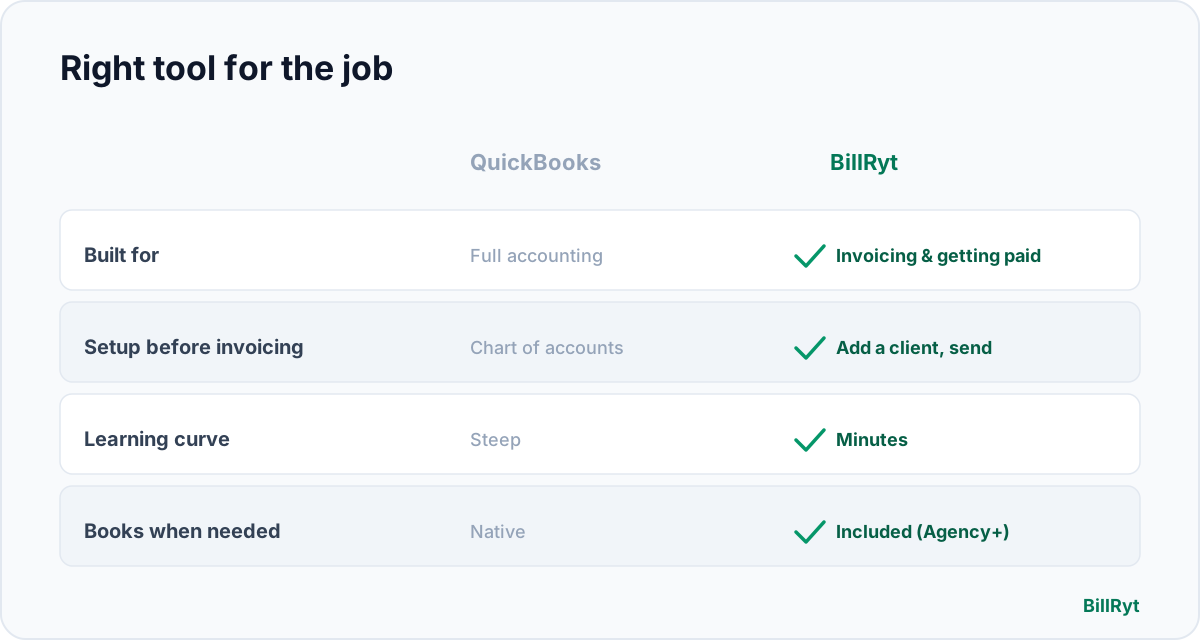
| QuickBooks | BillRyt | |
|---|---|---|
| Built for | Full accounting / bookkeeping | Invoicing and getting paid |
| Setup before you invoice | Chart of accounts, etc. | Add a client, send |
| Learning curve | Steep for non-accountants | Minutes |
| Online payments | Via add-ons | Stripe + Paystack (incl. M-Pesa in Kenya) |
| Books when you need them | Native | Included on Agency & Merchant |
When QuickBooks genuinely is the right call
To be fair to a great product: if you run payroll, track inventory across locations, need detailed cash-flow forecasting, or your accountant already works in QuickBooks daily and wants you there too, QuickBooks is built for exactly that and BillRyt is not trying to replace it. The mismatch is only when a full accounting platform gets sold as the answer to "I just need to invoice." Matching the tool to the actual job is the whole point.
A worked example
You send a client a 1,500 invoice, they pay by bank transfer, and you later credit 200 for a change in scope. In QuickBooks, those events sit inside a general ledger you are expected to understand and maintain. In BillRyt, you send the invoice, the payment records itself when it lands, and the credit note is a quick adjustment to what the client owes — three business events, no ledger to navigate. And if your accountant later needs the formal view, switching on Books turns those same events into a profit and loss and balance sheet without you re-entering a thing.
The migration worry, answered
The reason people tolerate an oversized tool is fear of the switch later. BillRyt removes that fear by keeping billing and books in one product: you are not choosing "simple tool now, painful migration to real accounting later." You are choosing "simple now, and the books turn on in place when you need them." That is the safety net that makes starting simple the sensible choice rather than a risk.
The 30-second test
Not sure whether you need QuickBooks or something simpler? Run this quick test. Do you need to run payroll, manage inventory, forecast cash flow, or hand your bookkeeper a live general ledger? If yes to several, QuickBooks is doing a job BillRyt does not aim to do — stay. But if your honest answer is "I mostly send invoices, take payments, and want to know who owes me," then the accounting suite is weight you are carrying for no benefit. The tell-tale sign is how you use the tool today: if you log in, go straight to invoices, and navigate around everything else, you are paying for — and learning — features you never touch. A tool that opens on the thing you actually do, and keeps the ledger out of sight until you ask for it, will save you both money and the low-grade friction of working around software that is bigger than your job.
Where to start
If you want invoicing without the accounting suite, Professional ($19) is the fit — simple, flat, unlimited. If you later want the books, Agency ($29) adds them in place. Either way, you are sending your first invoice in minutes, not learning a ledger.
In short
QuickBooks is full accounting software; if you need payroll, inventory or a live general ledger, keep it. But if your real job is invoicing and getting paid, it is more tool than the work requires. BillRyt does that job simply at a flat $19 — and if you ever need QuickBooks-style books, switching on Agency generates them from the invoices you already sent, with no migration. Match the tool to the job, and you save both the money and the friction of working around software bigger than your business.