FreshBooks is a genuinely good product. For a freelancer or small service business in the United States or Canada, its invoicing, time tracking and light accounting are polished and easy to live in. This is not a takedown — it is an honest look at where FreshBooks stops working once your business operates in Africa, and what to use instead.
Where FreshBooks is a great fit
If most of your clients pay by card in USD or CAD, and you file taxes in North America, FreshBooks does the job well. Clean invoices, expense tracking, time logging, and a friendly interface. If that describes you, you probably do not need to switch.
Where it leaves an African business stuck
Three gaps show up quickly once you are billing from — or into — Africa:
- You can't collect the way your clients pay. FreshBooks' built-in payments run through card processors available in a limited set of countries. There is no Paystack, no bank transfer, no USSD, and no M-Pesa (Kenya). So a Nigerian or Kenyan business can send a beautiful FreshBooks invoice, but the client cannot tap a button and pay it locally — you fall back to pasting bank details and reconciling by hand.
- It thinks in USD. Multi-currency exists, but the whole experience assumes a North-American default. Naira, cedis and shillings are second-class, and the tax handling is not shaped around how you file VAT.
- You pay in dollars, tier by tier. Pricing is in USD and rises as you add clients, which stings when your revenue is in a softer local currency.
None of this is a flaw in FreshBooks' engineering — it is simply built for a different market than yours.
What BillRyt does instead
BillRyt is invoicing and accounting designed for businesses that get paid across Africa and abroad, so collection and localisation are not afterthoughts.
- Get paid locally. Connect Paystack and your invoices accept card, bank transfer and USSD across Africa — plus M-Pesa for Kenyan clients. Add Stripe for card payments from overseas clients, on the same invoice.
- Your currency is first-class. Bill in NGN, KES, GHS, USD or GBP; the amount, tax and payment page all speak that currency, and mixed-currency totals are handled correctly rather than blindly summed.
- Accounting is included. BillRyt Books gives you proper double-entry accounting on the Agency and Merchant plans — profit and loss, balance sheet, ledgers — so invoicing and books live in one system.
- The full document flow. Quote → proforma → invoice → credit note, with a client portal and automatic reminders.
A quick side-by-side
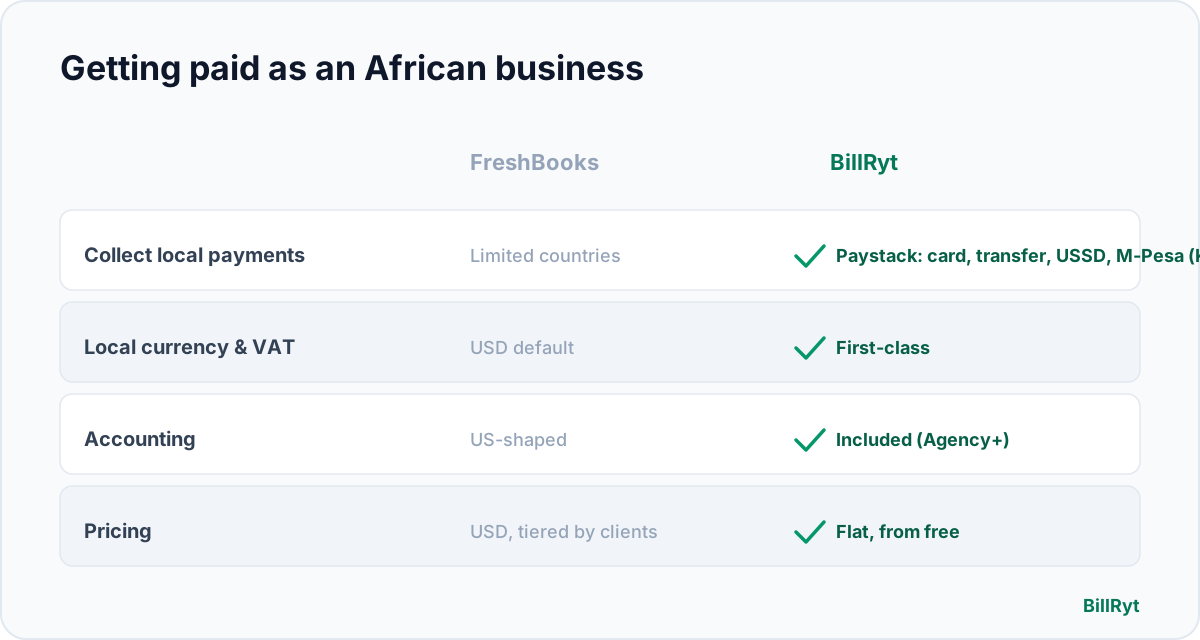
| FreshBooks | BillRyt | |
|---|---|---|
| Collect African payments | Not supported | Paystack: card, transfer, USSD, M-Pesa (KE) |
| Local currency & VAT | USD/CAD default | First-class multi-currency + tax |
| Accounting | Included, US-shaped | Included on Agency & Merchant |
| International cards | Limited-country payments | Stripe, 40+ countries |
| Pricing | USD, tiered by clients | Flat plans — free, then $19 / $29 / $39 |
What switching actually looks like
You do not migrate years of history on day one. Connect Paystack, send your next invoice through BillRyt, and the very next payment lands automatically in your local account. Add clients as you bill them, connect Stripe if you also invoice abroad, and let your books build from real transactions going forward. Within a couple of weeks the receivables you actually chase are in one place — and getting paid through the rails your clients already use.
A worked example
Say you run a small studio in Lagos and invoice two clients the same week. Client one is a brand in London who pays by card; client two is a shop down the road in Lagos who pays by bank transfer. In FreshBooks, the London card might go through, but the Lagos client has no in-invoice way to pay — you send account details in a separate message and hope the transfer reference matches when it lands. In BillRyt, the same invoice offers the London client a Stripe card checkout and the Lagos client a Paystack bank transfer or USSD option; both settle, and both are recorded against the right invoice automatically. Same week, two clients, zero manual reconciliation.
What you keep, and what changes
You keep the things you liked about FreshBooks: clean, professional invoices, quotes, expense-style line items, and a tidy record of who has paid. What changes is the two places FreshBooks quietly costs an African business — collection and currency. Your clients get a native way to pay, your prices read in the money your clients think in, and your books live in the same tool instead of a separate export. The tool stops being a beautiful document your client cannot act on and becomes the thing that actually gets you paid.
Who should not switch
To be fair: if you are a US or Canadian freelancer whose clients all pay by card in dollars, and you have no need to collect locally in Africa, FreshBooks is a fine place to stay. BillRyt earns its place the moment "my client received the invoice but still cannot pay it here" becomes a recurring problem — which, for a business operating across Africa, it usually does.
Getting started in an afternoon
You do not need a project plan to try it. Create a workspace, add the two or three clients you are actively billing, and recreate your common services as reusable line items so future invoices take seconds. Connect Paystack so African clients can pay locally, and add Stripe if you also bill overseas. Send one real invoice — the one you were going to send through FreshBooks anyway — and watch the payment land against it automatically. That single loop tells you everything: the invoice looks professional, the client pays the way they actually pay, and the money is recorded without a spreadsheet. From there you simply keep invoicing, and your client list and books fill in as you go. No migration weekend, no data-import marathon — just your next invoice, getting paid properly.
If FreshBooks has felt like "a lovely invoice my client still can't pay," that is exactly the gap BillRyt was built to close for African businesses.